

The Arabian Oryx: The UAE's National Animal and What Makes It Remarkable
The Arabian oryx is one of the UAE's most meaningful desert animals. Children may first notice its bright white coat and long straight horns, but the real story is about survival and protection: how an animal that vanished from the wild was brought back to the desert it came from.
|
Key takeaways • The Arabian oryx (Al Maha) is the UAE's national animal and appears on the old 50-dirham note. • It was extinct in the wild by 1972 and survived only in zoos and private collections. • In 2011 it became the first species ever moved off the Extinct in the Wild list on the IUCN Red List. • The UAE today has the largest Arabian oryx population in the world, much of it descended from breeding programmes started by Sheikh Zayed. • Its story is a clear, local way to talk to children about conservation and national identity. |
What is the Arabian oryx?
The Arabian oryx is a medium-sized white antelope native to the deserts of the Arabian Peninsula. It's the smallest member of the oryx genus, with a distinct shoulder bump and a tufted tail. Both males and females carry long, straight, ringed horns, usually 50 to 75 centimetres long. That's unusual among antelope, where horns are often a male-only feature, and it's part of why the animal looks so striking against the sand.
The white coat does a job. It reflects heat, and the oryx is built to handle a desert that pushes past 50 degrees in summer. It can go for weeks without drinking, pulling moisture from the plants it grazes, and it can pick up the scent of rainfall and fresh growth far across the desert, then walk toward it. A newborn calf stands and walks within an hour of being born, and arrives light brown rather than white, darkening as it grows.
In Arabic the animal is called Al Maha. You'll hear the name across the country, in places, hotels, and brands, long before most children ever see the animal itself.
Why is the Arabian oryx the UAE's national animal?
The Arabian oryx is the national animal because it stands for endurance and for the UAE's record of bringing its own wildlife back from the edge. Ask most people who live here and they'll guess the camel. The camel runs deep in Emirati heritage, but the official national animal is the oryx.
You can see that choice on the old 50-dirham note, where the oryx appeared as one of the UAE's familiar national symbols.
I'll admit I assumed it was the camel for years, like most people. What changed it for me was working on our UAE Map puzzle and having to decide which animals earned a place on it.
How did the Arabian oryx come back from extinction?
By the early 1970s, hunting had stripped the Arabian oryx from almost its entire range. The last confirmed wild animal is believed to have been shot in 1972. After that, the species existed only in zoos and a handful of private collections. In the open desert, there were none left.
The recovery was slow and deliberate. In 1968, the late Sheikh Zayed bin Sultan Al Nahyan set up the first captive breeding programme for the oryx in Al Ain. Ten years later, in 1978, four animals were moved from Al Ain to Sir Bani Yas Island off the Abu Dhabi coast to start a herd there. Those small founding groups, with others around the region, became the breeding stock that rebuilt the species.
Today the UAE is home to several thousand Arabian oryx, the largest population anywhere in the world, with most of them living in and around Abu Dhabi.
What makes the oryx a global conservation milestone?
The oryx holds a place in conservation history that no other animal can claim. In 2011 the International Union for Conservation of Nature (IUCN) moved it off its Extinct in the Wild list, the first species ever to make that journey back. (Extinct in the Wild means an animal that no longer lives freely in nature, surviving only in zoos and reserves.)
That does not mean the work is finished. The oryx is still listed as a species that needs protection, and poaching has flared up again at points along the way, which is why the breeding and release programmes continue. The full conservation record is held by the IUCN Red List.
Where can you see the Arabian oryx in the UAE?
You don't have to settle for photographs. The oryx lives here, and families can go and watch it.
Sir Bani Yas Island, off the Abu Dhabi coast, holds one of the largest free-roaming herds in the world. Sheikh Zayed first set the island aside as a reserve in 1971, and the conservation team there still works with the Environment Agency Abu Dhabi to breed oryx and release them. You can also find oryx at the Dubai Desert Conservation Reserve, the Al Marmoom Desert Conservation Reserve, the Arabian Oryx Protected Area in Abu Dhabi, and the Qasr Al Sarab area in the Liwa desert, several of them reachable on guided wildlife drives.
My own first memory of the oryx is from Sir Bani Yas. I woke early one morning and found one standing at the edge of the plunge pool, drinking, completely calm, close enough that I held my breath. It is the kind of thing that stays with you, and it is why I think seeing the animal in the open does so much more than a picture ever could.
Why does the oryx matter for children growing up here?
The oryx turns up everywhere in Emirati life: on the old banknote, in place names, in school projects around National Day. Part of the reason is that it gives children two things at once. It's a science story about an animal engineered for the desert, and it's a national story about something their own country chose to save.
This is what we mean by culturally relevant learning. A child remembers an animal they can find on a map, in a puzzle, and on a drive out of the city far more easily than one they only meet in an imported picture book.

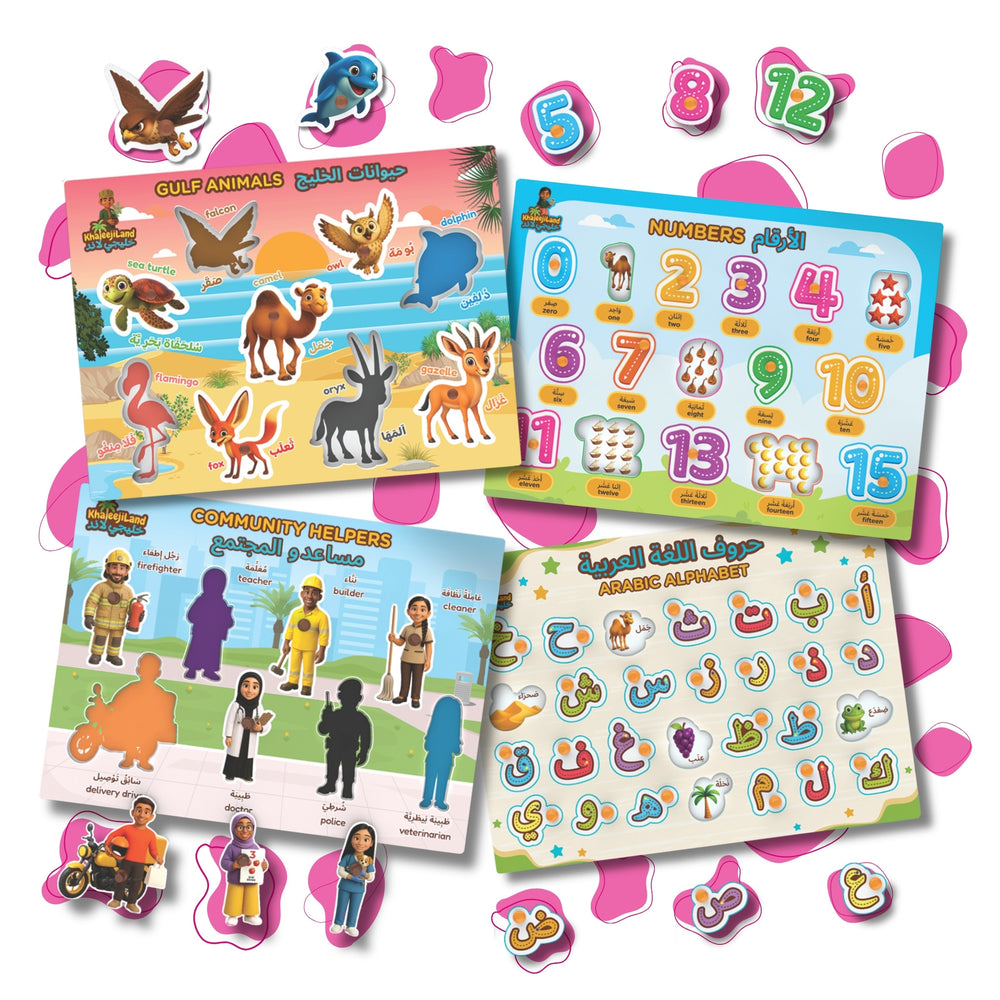
Our Gulf Animals Wooden Peg Puzzle puts the oryx in the same set as the falcon, the camel, and the flamingo. For a lot of children, fitting the piece into the board and being told its name is the first time the oryx becomes a real animal to them rather than a shape.
How to talk about the oryx with young children
You don't need to be an expert to turn a picture, a puzzle piece, or a reserve visit into a conversation. A few open questions go a long way:
• What do you notice about its colour?
• Why do you think its hooves help it walk in the sand?
• Where would an animal like this find food and water in the desert?
• How can people help animals stay safe?
• Can you spot the oryx on a map, a puzzle, a picture, or an old banknote?
There are no wrong answers. The point is to get children looking closely and connecting the animal to the world around them.
|
KEEP THE LEARNING GOING Our Activity Library has a free printable Gulf animals sheet that gets children matching local wildlife to land, sea, and air, the oryx included. No sign-up required, just download and print. |
Frequently asked questions
Is the UAE's national animal the camel or the oryx?
It's the Arabian oryx, not the camel. The camel is closely tied to Emirati heritage and is often assumed to be the national animal, but the official national animal is the oryx, a white desert antelope that appears on the old 50-dirham note.
Is the Arabian oryx still endangered?
Not as it once was. It was extinct in the wild in 1972, then in 2011 the IUCN recognised its recovery after years of breeding and reintroduction. It still needs protection, but it's no longer on the edge of disappearing.
What does Al Maha mean?
Al Maha is an Arabic name for the Arabian oryx, and it's also a girl's name meaning “beautiful eyes.” Classical Arabic poetry often compared a beautiful person's eyes to the large, dark eyes of the oryx. Locally the animal is also known as wudhaihi.
Where can children see an Arabian oryx in the UAE?
Sir Bani Yas Island off Abu Dhabi has one of the largest free-roaming herds in the world, and oryx also live in desert reserves including the Dubai Desert Conservation Reserve and the Al Marmoom Desert Conservation Reserve. Several can be visited on guided wildlife experiences suitable for families.
|
Madhav is the co-founder of KhaleejiLand. He grew up at the intersection of Emirati and expat life, and would not have it any other way. That experience is why KhaleejiLand exists: so children grow up genuinely connected to the place they call home. |


