

Growing Up in the Gulf: A Guide to UAE Culture and Identity for Children, Parents, and Educators
Helping a child connect with Gulf culture means giving them everyday experiences of the country's language, landscapes, animals, symbols, and people, rather than one formal lesson. For children growing up in the UAE, identity is built through familiar stories, places they can name, and traditions they take part in, so the country they live in genuinely feels like home.
|
Key takeaways • Cultural identity in young children is built gradually through everyday exposure, not formal teaching. • Children engage and learn more deeply when the toys, books, and images around them reflect their own world. Educators call this culturally responsive teaching. • Gulf culture is best understood as heritage, present, and future at once: deeply rooted, and confidently open to the world. • Start with what is concrete and visible: animals, the seven Emirates, national symbols, and community helpers. • Whether your family is Emirati or expat, connection to place supports rather than competes with a child's wider sense of identity. |
Why does cultural identity matter for young children?
A child's sense of who they are starts forming earlier than many parents expect. By the preschool years, children already notice where they belong, what is familiar, and what makes their world theirs. For a child here, that world includes the call to prayer, the desert at the edge of the city, the mix of languages spoken around them, and the people who keep their community running.
When children feel connected to the place they live, they tend to be more secure, more curious, and more open to learning. A child who can name the seven Emirates, recognise a falcon, or understand why Ramadan is a special time of year is doing more than memorising facts. They are building a sense of place that helps them feel rooted.
Nearly every family raising a child here feels some version of this, even if it takes a different shape from one home to the next. For Emirati and Gulf families, the worry is often about holding on: how do you keep a child closely connected to their heritage, and confident in Arabic, in an environment that is heavily English-speaking, globalised, and full of screens. For many expatriate families, it runs the other way: how do you help a child feel genuinely connected to a country your own family is still getting to know. Either way, the goal is the same: a child who feels they belong here.
My family moved to Abu Dhabi in 1999, in the middle of my Grade 3 year, just before the summer. I had never read or heard a word of Arabic before that. I picked up the alphabet, learned to read, and passed the exams, but I never came out of it able to hold a real conversation. For a long time Arabic was a subject I worked through rather than a language I lived in. I started KhaleejiLand in large part because I did not want the next generation of children here to grow up with that same gap, spending years in a place without ever feeling fully connected to its language.
Culture here is easy to picture as something old and fixed, which misses most of it. The culture of the Gulf has deep roots, a living present, and a future still being written. In Arabic, the Gulf is Al Khaleej, and something from the Gulf is Khaleeji. The region has also long been open to the world: a trading crossroads for centuries, where welcoming people from elsewhere is one of its oldest traditions. That same openness is part of why heritage here is nurtured so deliberately. A culture this welcoming can fade if each generation is not given a real connection to it, which is part of why national identity is taken so seriously here. A child growing up here can hold both at once: a secure heritage, and a confident, outward-looking culture.
What is culturally responsive learning, and why does it matter?
Culturally responsive teaching is the well-established educational principle that children learn more effectively when the resources, images, and stories around them reflect their own lives and surroundings. It is not a niche idea. It sits at the heart of how good early years educators think about engagement.
The principle is well established, and it goes beyond culture. A child who uses a wheelchair engages more with a story when a character in it uses one too. A child working through maths word problems concentrates better when the names in the questions are familiar ones, rather than the unfamiliar names a foreign curriculum happened to use. Familiarity lowers the barrier to learning, because the content already means something to the child. Gulf culture is no different: when the pictures, names, and objects in a toy come from a child's own world, they connect with it faster.
This is something I ran into routinely while we were developing our products. Sara, my co-founder, who taught in Abu Dhabi classrooms for nearly a decade, pointed out that many of the imported toys she had used, even the bilingual ones or those translated into Arabic, were effectively unusable because they had not been made for this region. Play money showed the wrong currency. Dolls did not reflect how children here look or dress. Arabic toys used a dialect and pronunciation that were not Khaleeji. The mismatches were everywhere, and teachers and parents often ended up altering products or making their own. Perfectly fine in the country they were made for. But choices like that quietly tell a child that the learning world and their real world are two different places. That conversation shaped a lot of what we went on to build.
For parents, the takeaway is simple: the toys, books, and learning resources you choose send a message about whose world counts. Resources grounded in Gulf culture tell a child that their surroundings are worth knowing about. That is a meaningful pedagogical tool, not just a nice touch.
How do you start teaching UAE culture to a young child?
Start with what is concrete, visible, and easy for a child to connect to directly. Abstract ideas about heritage and identity come later. For a three to six year old, culture is best introduced through things they can see, name, touch, and recognise around them. Four starting points work especially well.
Local animals
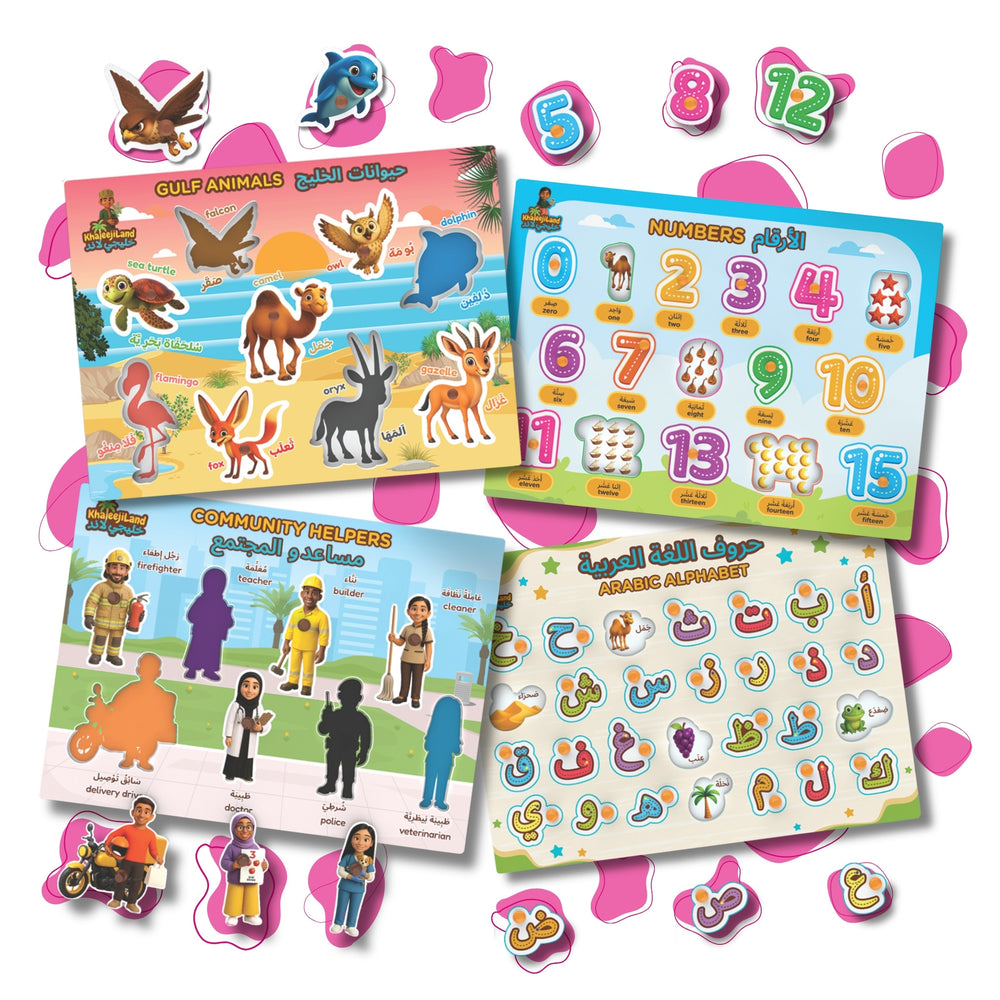
Gulf wildlife is one of the most natural ways into UAE culture, because young children are drawn to animals already. The Arabian Oryx, the country's national animal, is a genuinely remarkable story: once extinct in the wild, it was brought back through careful conservation (IUCN Red List). The falcon carries deep cultural meaning and is closely tied to Emirati heritage and identity. Camels, flamingos, and sea turtles connect children to the landscapes around them, from the desert to the coast.
Learning local wildlife does more than build vocabulary; it connects a child to the natural world they live in. For a closer look at the species worth knowing, see Gulf animals children should know, and for the oryx in particular, the story of the Arabian Oryx.
The seven Emirates
Geography gives children a clear, structured way to understand the country they live in. The UAE is made up of seven Emirates: Abu Dhabi, Dubai, Sharjah, Ajman, Umm Al Quwain, Ras Al Khaimah, and Fujairah. For a young child, learning to name them, place them on a map, and recognise a landmark or two in each builds a sense of the whole country rather than just the street or city they know.
This is also where many expatriate families find an easy point of connection, because place is something the whole family can explore together on weekends and trips. For more on introducing geography at this age, see the seven Emirates explained for young children.
FROM THE KHALEEJILAND SHOPUAE Map Wooden Peg Puzzle: a hands-on way for children to place the seven Emirates and connect familiar landmarks, animals, and symbols to real parts of the country. View the puzzle. |

National symbols and identity
The UAE flag, national landmarks, and dates such as National Day on 2 December give children visible anchors for national identity. These symbols carry meaning, and children enjoy recognising them. National Day in particular is something most children here already experience at school, which makes it a natural opening for a conversation about what the symbols mean and why they matter.
This is not only a home or National Day topic. National identity is a formal priority across the UAE: in Abu Dhabi, ADEK rates private schools on how well they nurture it through its National Identity Mark, which looks at culture, Arabic language, history, and heritage. Because it covers schools serving children of every nationality, this is something most children here will meet in their formal education, whatever their background. For how it looks in the classroom across the year, see what UAE national identity looks like in education.
Community helpers
Children are naturally curious about the people who keep their world working: doctors, teachers, police officers, firefighters, and the many others they meet. “People who help us” is also a staple theme in nurseries and early years classrooms, so this is something children meet in their formal learning as well as at home. Talking about it connects children to their immediate social world, and to the idea that a community is made of people who look after one another. For more, see community helpers in the UAE.
How does language fit into cultural identity?
Language and culture are closely connected, and in the UAE it sits at the centre of family life for many households. Arabic is the national language and a compulsory subject in UAE schools, including for children who are not native speakers, who take it as Arabic as a second language (the UAE Government portal). For parents who do not speak Arabic themselves, this raises real, practical questions about how to help.
You do not need to be fluent in Arabic to help a child build a connection to the language. At this age, small and consistent exposure matters more than formal instruction. Learning the Arabic words for numbers, colours, and everyday objects gives a child an early, positive relationship with the language, the kind of foundation that makes school Arabic feel less foreign later on.
This is a large topic, so we cover it properly elsewhere. If language is your main concern, our guide to raising bilingual children is the best place to start, and for parents who do not speak Arabic, supporting your child's Arabic learning when you don't speak it yourself is written specifically for you.
How can families build cultural connection into everyday life?
The most effective cultural learning rarely looks like a lesson. It is woven into the ordinary rhythm of family life, which is good news for busy parents: it needs no special time set aside.
Talk about what you see. On a drive, name the Emirate you are in or point out a landmark. At the supermarket, talk about the local foods, where they come from and how they are made. During Ramadan or around National Day, explain simply what is happening and why. None of this is formal teaching, and that is exactly why it works: children absorb an enormous amount through everyday conversation with the adults they trust.
Some of my clearest early memories of feeling connected to this place are not from a classroom. They are small, ordinary things: neighbours sending over sweet sevvaiya during Eid, heritage-village pop-ups with their halwa and traditional dancing, boxes of dates arriving from a friend's family farm, and long evenings of street football with the neighbourhood kids, which was where so many of us from different countries actually got to know one another. That is what I want for children growing up here now: a sense that this place is genuinely theirs, built from a hundred small moments rather than taught in a single lesson.
For families who want to go further, visits make culture tangible. Heritage sites, the desert, wildlife reserves, and cultural festivals give children direct experience no toy or book can fully replace, and pairing those visits with play and conversation at home is where the learning embeds.
Does cultural connection work for expat families too?
Yes. For many families in the UAE, cultural identity is not a single story. A large majority of people living in the UAE are expatriates, and most children growing up here have roots elsewhere. A fair worry for many expat parents is whether encouraging a connection to Gulf culture competes with their own family's heritage.
It does not. Helping a child feel at home where they live and honouring their family's origins are not in competition. Children hold more than one cultural connection comfortably, usually more easily than adults expect. A child can love the country their family comes from and also feel genuinely at home in the UAE. Building a connection to the Gulf simply means the place your child is growing up in becomes part of who they are, rather than a backdrop they happen to live against.
For expat families especially, this is often what turns “the country we are posted to” into “the place I grew up.” That is a meaningful thing to give a child, whatever their passport says.
The bigger picture
Helping a child connect with UAE culture is less about raising someone who can recite facts about the Emirates, and more about giving them a felt sense of belonging to the place they live: its people, its customs, its landscapes. Part of that is feeling at home in a culture that is proud of where it comes from and excited about where it is going. Done well, it is not extra work added on top of family life but part of the ordinary moments that fill it: a conversation in the car, a puzzle on the floor, a landmark you drive past every day.
The tools you choose matter, because they signal to a child whether their world is worth knowing about. But the tools are only ever a starting point. The real work, and the real pleasure, is in the everyday business of growing up somewhere and slowly coming to feel that it is home.
Frequently asked questions
At what age should I start teaching my child about UAE culture?
You can start from toddlerhood through everyday conversation, naming animals, places, and symbols as they come up. Formal awareness of identity develops in the preschool years (around three to five), but the foundation is built earlier through familiar, repeated exposure rather than structured lessons.
We are an expat family. Will teaching Gulf culture confuse my child or dilute our own heritage?
No. Children comfortably hold more than one cultural connection at the same time, and the two reinforce rather than compete. Helping your child connect to the UAE simply means the country they are growing up in becomes part of their identity, alongside, not instead of, where your family comes from.
Do I need to speak Arabic to teach my child about Emirati culture?
No. While Arabic is closely tied to Gulf culture, you can introduce a great deal, local animals, geography, national symbols, traditions, and community life, in English or bilingually. Small amounts of Arabic vocabulary, such as animal names, add value, and you can learn alongside your child.
What are the best ways to make UAE culture engaging for a young child?
Start with concrete, visible things children already enjoy: animals, maps, and the people in their community. Pair hands-on play and everyday conversation with real experiences such as visits to heritage sites, the desert, and wildlife reserves. Culturally relevant toys and books help by reflecting a child's own world back to them.
|
Madhav is the co-founder of KhaleejiLand. He grew up at the intersection of Emirati and expat life, and would not have it any other way. That experience is why KhaleejiLand exists: so children grow up genuinely connected to the place they call home. |


