

Community Helpers in the UAE: Who They Are and Why Children Should Know Them
Community helpers are the people who keep daily life running and safe: doctors, nurses, teachers, firefighters, police officers, postal and delivery workers, shopkeepers, and more. Children should know them because recognising these roles builds early social understanding, vocabulary in both Arabic and English, and a sense of belonging to the place they live. In the UAE, that means meeting helpers children see around them every day.
|
Key takeaways • Community helpers are everyday workers whose jobs keep a community safe, healthy, and running. • Learning about them builds social awareness, bilingual vocabulary, and a child's sense of place. • It connects to the UAE's Moral Education curriculum, where “the Individual and the Community” is one of four pillars. • Children connect fastest with helpers they meet in person, so start with the people in your own neighbourhood. • Talk, pretend play, and real outings teach this better than worksheets on their own. |
What is a community helper?
A community helper is anyone whose work supports the people around them. The category is deliberately broad. It covers emergency and safety roles like police officers, firefighters, and paramedics. It covers care roles like doctors, nurses, and dentists. It covers education roles like teachers and nursery staff. And it covers the everyday service roles a child sees constantly: shopkeepers, bus drivers, cleaners, and the delivery riders who are a familiar sight on every UAE street.
For young children, the goal isn't to memorise a list. It's to help a child grasp that a community is made of people who each do something useful, and that those people can be relied on. From there, a child starts to build empathy, gratitude, and eventually a sense of what they themselves might do one day.
Why should children learn about community helpers?
Three reasons stand out, and they support one another.
The first is social understanding. When a child can name what a doctor or a firefighter does, the wider world feels less abstract and less frightening. With adult guidance, children can begin to understand which trusted helpers support safety in the community, such as police officers, firefighters, nurses, and security staff.
The second is language. Professions are concrete, picturable nouns, which makes them ideal vocabulary for early bilingual learning. A child can attach the Arabic and English words for “doctor” or “teacher” to a clear image and a clear job, and the pairing tends to stick. For a UAE family raising a bilingual child, helpers are one of the easiest places to build everyday bilingual vocabulary in a natural, low-pressure way.
The third is belonging. Community helpers are how a young child first reads the society they're growing up in. In the Emirates, that society includes Emirati and expatriate workers side by side in almost every role, which is an honest and useful picture of the country for a child to absorb early.
One thing matters more than naming the jobs. The aim is not just to label roles, but to teach children to notice people respectfully, greet them politely, and understand that every role has dignity.
How does this connect to learning in the UAE?
This topic connects naturally to the UAE's Moral Education curriculum, where “the Individual and the Community” is one of the four pillars. The UAE Government's official portal describes the related Moral, Social and Cultural Studies subject as covering personal and community development, culture and heritage, and civic education, among other elements. In Abu Dhabi, ADEK's National Identity Mark also shows how schools are being encouraged to build belonging, values, and citizenship into school life.
For families whose children attend an international school, the same idea appears in the EYFS framework most of these schools follow. Its “Understanding the World” area names meeting important members of society such as police officers, nurses, and firefighters as a core way children make sense of their community. In other words, this isn't a niche topic. It's something your child's nursery or school is very likely already building towards, and it's easy to support at home.
I see this with my niece and nephew. She is eight, he is five, and because they live in Abu Dhabi while I am in Sharjah, our time together is usually built around outings and weekend plans rather than the everyday routine.
On one trip, my nephew became completely focused on a traffic patrol officer near a busy junction. He wanted to know what the officer was doing, why he was standing there, and how he was helping. My niece, older and much more matter-of-fact, started explaining it to him before any adult needed to step in.
That small moment stayed with me. It showed how children begin to understand community helpers: not as a list of jobs to memorise, but as real people doing real work in the places children already go.
Which community helpers should a UAE child know first?
Start with the helpers your child meets in person, because recognition is what makes the learning real. A sensible first group for most families in the Emirates:
• Doctors, nurses, and dentists, met at clinics and check-ups.
• Teachers and nursery staff, the helpers a child sees daily once they start school.
• Police officers, recognisable and central to a child's sense of safety.
• Firefighters, endlessly interesting to young children and easy to connect to safety.
• Shopkeepers and supermarket staff, behind transactions a child witnesses constantly.
• Delivery riders and postal workers, among the most visible workers in UAE daily life.
• Bus and taxi drivers, who connect to how the child moves around their own city.
Once the familiar roles are secure, you can widen the circle to helpers a child sees less often but will still recognise: paramedics, pilots and cabin crew, vets, and the municipal workers who keep parks and streets clean.
How can parents teach this at home?
The most effective approach is also the simplest one: talk about helpers as you meet them, and let pretend play do the rest.
Name roles in the moment. At the clinic, “this is the nurse, she's helping you stay healthy.” At the till, “the shopkeeper is helping us buy our food.” This running commentary, in whichever language you're building, does more than any flashcard, because it ties the word to a real person doing a real thing.
Pretend play lets children try the roles on. A child playing at being a doctor, a shopkeeper, or a bus driver is rehearsing both the vocabulary and the social meaning of the job. Open-ended questions stretch it further: What does a firefighter do? Who helps us when we're sick? Why is that job important? What would you like to be when you grow up?

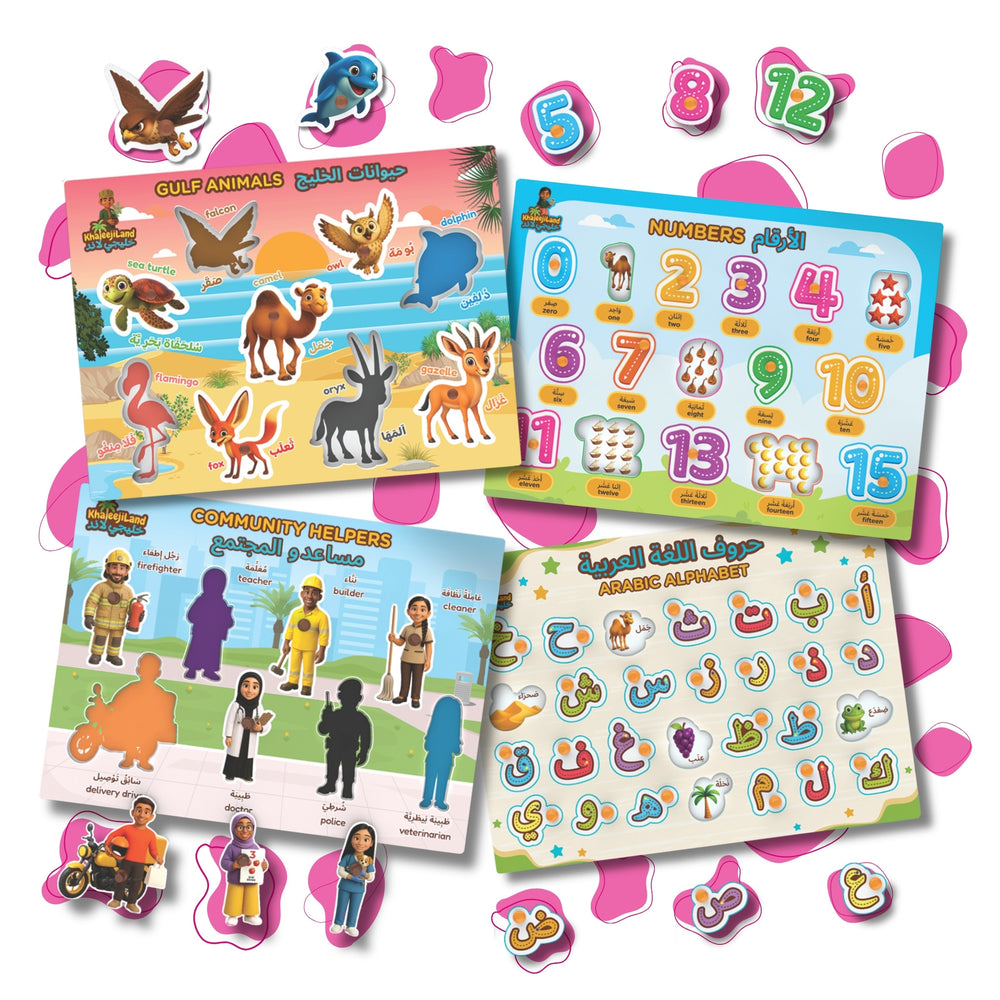
Hands-on toys help anchor the idea, especially for children who learn by doing. A bilingual Community Helpers Wooden Peg Puzzle gives a child the professions to name and match in Arabic and English, which pairs naturally with the real-world conversations above.
Try this with young children
A few simple activities, drawn from how early years teachers approach this, work just as well at the kitchen table:
• Sort helpers by where they work: clinic, school, shop, road, building.
• Match helpers to their tools: stethoscope, helmet, bus, trolley, parcel.
• Ask questions like “Who helps us when we're sick?” or “Who helps keep our building safe?”
• Let children act out a clinic, a shop, a classroom, or a bus ride.
• After an outing, ask “Who helped us today?” and see how many your child remembers.
|
FREE ACTIVITIES TO EXTEND THE LEARNING Looking for more? Our Activity Library has free printable activities you can use to keep the conversation going, including matching and sorting sheets that turn community helpers into a game. |
Frequently asked questions
At what age should children learn about community helpers?
Many children can begin learning about familiar helpers from preschool age, especially when the roles are connected to real people they see often. Start with the helpers they meet most, such as doctors and teachers, and add more roles as their interest and vocabulary grow.
What are examples of community helpers for kids?
Common examples include doctors, nurses, dentists, teachers, police officers, firefighters, shopkeepers, delivery and postal workers, bus and taxi drivers, and vets. In the UAE, children will also recognise familiar roles like building security staff and municipal cleaning workers.
How do I teach community helpers in both Arabic and English?
Attach the word to a real person in the moment, naming the role in one language and then the other, for example as you meet the nurse at a clinic. Picture-based toys and puzzles that label professions in both Arabic and English reinforce the pairing, and pretend play lets children use the new words actively.
Why are community helpers important for young children to learn about?
Knowing community helpers builds social understanding, gives children a sense of safety and which trusted adults support them, and develops empathy for the people whose work supports the community. It also strengthens a child's sense of belonging to the place they're growing up in.
|
Madhav is the co-founder of KhaleejiLand. He grew up at the intersection of Emirati and expat life, and would not have it any other way. That experience is why KhaleejiLand exists: so children grow up genuinely connected to the place they call home. |


