

How to Tell if your Child is Actually Learning from a Toy, or Just Being Entertained
You can usually tell a toy is helping your child learn when your child is doing the work: thinking, choosing, talking, trying again, or improving over time. If the toy does most of the performing and your child mostly watches, it is probably entertainment. That is not always bad, but it is different from learning.
|
Key takeaways • Entertainment keeps a child occupied; learning gives the child something meaningful to do. • Watch for four signals: effort, choices, talk, and improvement over time. • A quiet toy that makes your child think can be more useful than a loud toy that does most of the work for them. • One of the biggest factors is not the toy at all: it is whether someone plays alongside the child. • A toy your child returns to and uses in new ways is usually doing more than one that is forgotten in a week. |
Walk through any toy shop in the UAE, or scroll Noon or Amazon for ten minutes, and almost everything claims to be educational. The box says STEM. The label says develops 14 skills. There is a little brain icon in the corner. As a parent, you are left with a fair question: is my child learning anything from this, or is it just keeping them busy while I make dinner?
Before you buy another educational toy, the useful question is not “does the box say learning?” It is “what will my child actually do with this toy?”
I spent the better part of two years sourcing and testing children's toys before we launched KhaleejiLand, and I will be honest: I bought a few “educational” toys for my niece and nephew that turned out to be mostly lights and noise. One toy played a song every time a button was pressed. They loved it for a few days and pressed the button endlessly. But after the novelty wore off, I realised they had not really had to think, choose, solve, or talk much. That toy probably taught me more than it taught them.
There is no brain icon that proves anything. So here is the practical version: what I look for when I am deciding whether a toy is doing useful work. You do not need an education degree for this. You just need to watch what your child is actually doing.
Before you buy: a quick check
If you want something to glance at in the shop or before you tap “add to cart,” this is it. None of these are absolute rules, but together they are a reliable guide.
|
Before you buy, ask |
Good sign |
Warning sign |
|
Who does the work? |
Child thinks, builds, sorts, solves |
Toy performs while child watches |
|
Is there choice? |
More than one way to play |
Same button or action repeated |
|
Does it create talk? |
Adult and child interact |
Toy talks over the play |
|
Does skill improve? |
Child gets better over time |
Same reaction every time |
The rest of this guide explains what sits behind each of those four questions, and how to use them on a real toy.
What is the difference between learning and entertainment?
The difference is simple: entertainment keeps a child occupied, while learning asks a child to do something. A screen, a song, or a flashing light can hold attention beautifully without asking anything of the child's mind. Learning happens when the child has to think, choose, try, or solve, even in a small way.
This matters because attention and learning are not the same thing. A toy can be magnetic and still teach almost nothing. The more a toy does on its own, the less is usually left for the child to do. In a study comparing traditional and electronic versions of a shape-sorter-style toy, the electronic enhancements changed the quality of parent-child interaction: the version with lights, sounds, and a recorded voice produced less of the back-and-forth talk that drives early learning.
That's the key thing to remember. Useful learning toys leave room for the child. The weaker ones leave very little for the child to figure out.
Four signs a toy is actually teaching your child
You do not need to assess a toy on paper. You can read it off your child's face and hands while they play. Here are the four signals I look for.
1. Effort: is your child doing the work?
Watch who is putting in the effort. With a learning toy, the child is trying: turning a piece to make it fit, working out where something goes, concentrating. With an entertainment toy, the toy performs and the child watches. A useful test is to ask yourself, if I removed the lights and sounds, would there still be anything to do? With a puzzle, a building set, or play money, the answer is yes. With many electronic toys, the answer is no.
2. Choices: is there more than one way to play?
Toys that teach tend to be open: there is more than one right way to use them, and the child makes decisions. Toys that mostly entertain are usually closed: press the button, get the reward, repeat. Closed toys can have a place, but a child who is making choices, sorting, arranging, deciding what comes next, is doing cognitive work. A child pressing the same button for the fiftieth time is not.
3. Talk: does the toy create conversation?
This is the signal most parents overlook, and it may be the most important. Listen to whether the toy generates talk between you and your child, or shuts it down. In one study with infants, electronic toys were linked with less parent-child language than books or traditional toys. That does not mean every electronic toy is bad, but it does mean parents should watch whether the toy reduces the conversation around play. When a toy talks, parents tend to go quiet and let it. When a toy stays quiet, you become the narrator, and that conversation is where a huge amount of early language and thinking is built.
For UAE families, the best toys often create natural Arabic-English conversation: naming animals, counting pieces, playing shop, or talking about familiar places and objects.
4. Improvement: does your child get better over time?
Real learning shows up across days and weeks, not in a single session. A toy that teaches something will show visible progress: the puzzle that took ten minutes on Monday takes three by Friday; the child who needed help naming the animals starts naming them unprompted. If a toy produces the same behaviour every single time with no sign of growing skill, it is being used as entertainment, however much fun it is.
|
A QUICK AT-HOME TEST Sit with the toy for five minutes and ask three questions: Who is doing the work, my child or the toy? Is there more than one way to play with this? Are we talking to each other while we play? If the answers are “my child,” “yes,” and “yes,” you are almost certainly looking at a learning toy. |
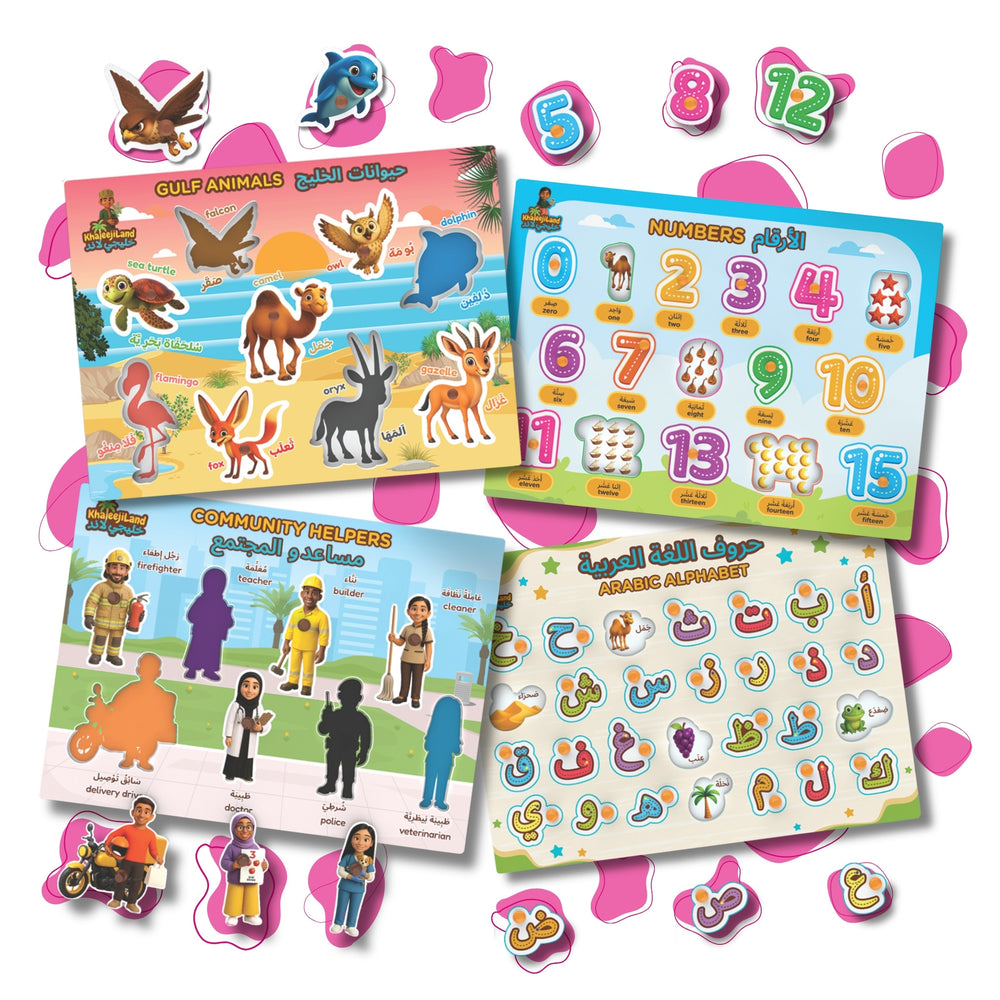
Example from our range: the Gulf Animals Wooden Peg Puzzle is a quiet example of this. The child does the matching, the adult can name the animals in Arabic and English, and the play can extend into questions like “which one flies?” or “which one lives in the sea?” Because nothing on the board talks, the conversation is yours. You can see the Gulf Animals Wooden Peg Puzzle here.
Does this mean all electronic and “noisy” toys are bad?
No, and it would be dishonest to say so. The research is about balance, not bans. The point is not that a toy with a battery cannot teach; it is that a toy should not do all the work for the child. An electronic toy that responds to what a child does, that asks a question and waits, or that introduces sounds a child then has to repeat and use, can support learning. The problem is the large category of toys that perform on a loop while the child watches. The problem isn't the sound, it's the passivity.
I think about this carefully because we make a talking product ourselves. With our bilingual flashcards, the question was never “how do we make this as noisy as possible?” It was “does the child still have something to do?” A useful talking toy should invite a response: listen, repeat, find, name, compare, or use the word in play. That is very different from a toy that just plays a jingle and asks nothing back.
So when you pick up an electronic toy, run the same test. Does it invite a response, or just deliver a performance? Does your child do anything other than trigger it? A toy that earns a place in the home is one that puts the child to work, with or without a battery.
When is an educational toy worth the money?
A toy is worth paying for when it gets repeated use, asks the child to participate, suits their age and stage, and creates interaction with an adult or sibling. A toy is poor value when the child only watches it, even if it looks impressive.
This is good news, because it takes the pressure off the price tag. An inexpensive set of blocks in the hands of an engaged parent will out-teach the most expensive gadget left with a child alone.
The most important factor is not the toy
Here is the part the packaging never mentions. One of the biggest factors is not the toy at all. It is whether someone plays alongside the child. The American Academy of Pediatrics, reviewing decades of evidence, describes playful, back-and-forth interaction with a caregiver as one of the most powerful drivers of early development. No toy, however cleverly designed, replaces that.
What turns a good toy into a learning toy is the conversation around it: the questions you ask, the way you wait for an answer, the moment you resist jumping in to fix it and let your child work it out.
That last point deserves its own emphasis. When a child is stuck, the instinct is to take the piece and place it for them. Try not to. A little struggle is part of the learning, as long as it stays manageable. Show them how to turn a piece, then hand it back. The skill that builds in those few seconds of effort is worth more than a finished puzzle.
Example from our range: the KhaleejiCash UAE Learning Money Set works the same way. The notes and coins are just props; the learning happens in the back-and-forth. It works best when an adult joins in: setting up a pretend shop, counting together, asking for change, or letting the child be the cashier. Along the way, children start to recognise UAE currency and put numbers to real use. You can see the KhaleejiCash UAE Learning Money Set here.
What types of toys usually pass the learning test?
Open-ended, hands-on toys are often a strong starting point. They give children something active to do and make it easier for an adult to join the play:
• puzzles
• blocks and building toys
• pretend-play sets
• play money
• books
• sorting and matching toys
• art and mark-making materials
• bilingual flashcards, when used interactively rather than just played at the child
None of these are expensive or complicated. What they share is that they put the child to work and leave space for conversation.
Red flags on an educational toy listing
When you are reading a product page, a few things are worth treating with caution:
• It claims vague or implausible skills (“boosts IQ,” “develops 14 skills”) without explaining how.
• It does most of the talking, singing, or lighting up for the child.
• The child mainly presses and watches.
• There is no age guidance.
• There is no clear material or safety information.
• The photos show a happy child, but not what the child actually does with the toy.
None of these are automatic dealbreakers, but two or three together are a fair sign you are looking at entertainment dressed up as learning.
|
EXTEND THE FUN Want a simple way to turn any toy into a learning moment? Our free Activity Library has printable play prompts and activities you can use alongside the toys you already own, with no sign-up needed. They are built to get children thinking and talking, which is what turns play into learning. |
Frequently asked questions
Are educational toys worth the money?
A toy is worth it when it makes your child think, choose, or try, and when you play alongside them; that is what turns play into learning. An expensive toy that the child only watches is poor value, while simple, open-ended toys used with an engaged adult deliver far more. Price is a weak signal of educational value; how the toy is used matters more.
Are screens and electronic toys bad for toddlers?
Electronic toys are not automatically bad, but they need balance. Research with infants has found that electronic toys can reduce parent-child conversation compared with books and traditional toys, which matters because back-and-forth interaction supports language development. A battery-powered toy is more useful when it invites the child to respond, repeat, choose, or solve, rather than simply watch.
How can I tell if my child is learning or just being entertained?
Watch four things: whether your child is doing the work, whether there is more than one way to play, whether the toy sparks conversation, and whether your child improves over repeated play. If the toy lights up and your child only watches or presses without thinking, choosing, talking, or trying again, it is mostly entertainment. If your child is thinking, talking, and getting better, it is teaching.
What are the best types of toys for early learning?
Open-ended, hands-on toys are often a strong starting point: blocks, puzzles, pretend-play sets, books, sorting toys, play money, and art materials. They give children something active to do and make it easier for adults to join the play. The specific toy matters less than whether it engages the child actively and whether an adult is involved in the play.
|
Madhav is the co-founder of KhaleejiLand. He grew up at the intersection of Emirati and expat life, and would not have it any other way. That experience is why KhaleejiLand exists: so children grow up genuinely connected to the place they call home. |


