

How to Choose Educational Toys That Actually Teach Something: A Practical Guide for UAE Parents
A genuinely educational toy targets one to three specific skills, matches your child's developmental stage, and holds up to real safety certification. Before buying, check three things: the age grading and whether it fits your child now (not a year later), what specific skill it builds, and whether it carries G-Mark or EN71 certification. If a toy claims to teach everything, it usually teaches nothing well.
|
Key takeaways • Match the toy to your child's current stage, not their age on the box. Age grades are safety floors, not learning targets. • A good educational toy does one to three things well. Be sceptical of toys that promise to cover the whole curriculum. • In the UAE, look for G-Mark and EN71 certification. These are legal requirements for toys sold here, not marketing extras. • Open-ended toys that a child plays with for months beat single-use novelty toys that entertain once and get abandoned. • Cultural and linguistic relevance matters. Children play more with toys they recognise, and a toy that gets played with is the one that teaches. |
What makes a toy genuinely educational?
A genuinely educational toy is designed around a specific learning outcome, not decorated with one. The difference is whether the learning is built into how the child plays, or simply printed on the packaging. A wooden puzzle where a child has to match a shape to its slot builds spatial reasoning every single time it is used. A plastic toy with a “learning” sticker that lights up when pressed builds very little, because the child is reacting, not thinking.
The clearest test I use is this: take away the lights, sounds, and screen, and ask what is left. If there is still a problem to solve, a skill to practise, or a concept to grasp, the toy is doing real work. If nothing is left, you were buying entertainment with an educational label on it. Both have their place, but you should know which one you're paying for.
The best educational toys also tend to stay in one lane. They do one or two things really well rather than trying to teach a child everything at once. Take a simple alphabet puzzle: its job is to teach letters and their sounds, and the act of placing the pieces builds fine motor control along the way, because that's just the nature of puzzles. But if the maker also tried to cram in counting, addition, and spelling, three things would happen. It would be very hard to do any of them well, it would confuse and overstimulate the child, and it would pull attention away from the phonics that were the whole point. With young children, simple usually wins. More features are not better unless they truly belong together.
Beyond that, a good educational toy is well made from good materials, and it's designed with children in mind, with the science of how they learn built into it rather than bolted on. And it reflects the world the child actually lives in, because children learn best from toys that represent the people, places, and things around them. A toy that grows with the child, played with simply at a younger age and in more sophisticated ways later, is usually the sign of one designed by people who understand how children develop, not one designed to sell on a shelf.
One of the perks of building a toy company is that I've played with an (almost) embarrassing number of toys, in the name of research, of course. After enough of them, the patterns become hard to miss. The cheapest ones almost always had the most features printed on the box and the least to actually do in the hand. The ones worth pursuing were the focused ones: well-cut pieces, a clear task, one job done properly. It taught me to distrust the feature list and watch how a child actually plays.
How do I match a toy to my child's age and stage?
Match the toy to what your child can do now, not to the number printed on the box. There is one firm rule here that comes first: always respect the minimum age on the packaging, even if your child seems advanced. That number is a safety boundary, telling you the toy is unlikely to be a choking hazard for that age group. A clever two-year-old is still a two-year-old when it comes to putting small parts in their mouth, so a 3+ toy stays off-limits regardless of how ready they seem in other ways.
Within the safe range, though, the age grade is not a promise that the toy is the right learning challenge for your specific child. The principle that matters is keeping the challenge just ahead of the child's current ability. A toy that is too hard gets abandoned out of frustration. A toy that looks too easy is more complicated: if your child finishes our UAE Map puzzle in seconds, it's tempting to conclude they have outgrown it, but the learning is often still there. This is where you come in. An adult can keep a “too easy” toy challenging by asking which emirate is which, covering a piece and asking what's missing, or turning it into a timed game. The sweet spot is a task the child can manage with a little effort or a little help, which is exactly where learning happens. In early years education this is often described as working within a child's zone of proximal development, and our guide to play-based learning explains the idea in more practical terms.
If a box is labelled 6+ but your six-year-old is struggling with the activity inside, don't worry. That number on the front is a recommendation, not a rule. It's different from the minimum age in the safety or warning section, which you should always follow. Every child is different and develops at their own pace, which is part of why these age recommendations are so hard to pin down in the first place. For now, try some toys aimed at four- or five-year-olds that target the same skill. Build up your child's understanding, independence, and confidence, and before long they'll be ready for the 6+ toy. The only line you never cross is the safety one. Easier for the skill is fine; younger than the minimum safety age is not.
So watch your child rather than the box. If a toy is too hard, ease them in with fewer pieces or more support. If it looks too easy, add the challenge yourself. The toy hasn't failed; the match has, and a small adjustment usually fixes it. For a fuller breakdown of how different toy types suit different ages, our guide to choosing between peg puzzles and jigsaw puzzles by age and stage walks through which format fits which moment.
Why does safety certification matter, and what should I look for in the UAE?
Safety certification matters because young children put toys in their mouths, drop them, and pull at them, and uncertified toys can carry real risks: choking hazards from poorly secured small parts, toxic paints and finishes, and materials that splinter or shatter. In the UAE, toys can't legally be sold until they've met specific safety standards. That matters for you as a buyer, because it means an uncertified toy isn't just a cheaper option, it's one that shouldn't be on the shelf in the first place.
The two markers to look for are the G-Mark and EN71. The G-Mark is the Gulf Conformity Mark, a mandatory certification administered under the GCC Standardization Organization (GSO) for products sold across the Gulf, including toys. EN71 is the European toy safety standard, which covers things like mechanical and physical properties, flammability, and the migration of certain chemicals. One thing worth knowing at the shelf: EN71 compliance usually shows up on the packaging as the CE mark rather than the letters “EN71”, so if you're looking for EN71 and can't find it, the CE mark on the back of the box is what to check. A toy carrying the G-Mark and the CE mark has been tested against recognised safety criteria. You can read more about the GSO conformity framework on the GSO official site.
|
PRO TIP Checking a G-Mark has never been easier. The quickest check is to use your phone to scan the G-Mark QR code on the toy's packaging. It takes you straight to the certificate on the GSO website, showing the product's credentials and whether the certification is currently valid. Thirty seconds at the shelf tells you whether the mark is real or just a logo someone printed. |
A lot of toys sold informally, through social media sellers or unregulated marketplaces, carry neither mark. The packaging may show a logo that looks official but means nothing. My advice is to buy from sellers who can tell you, clearly, what certification a toy holds. A legitimate brand will state it without hesitation, because the compliance and testing are expensive and they want you to know they did it. Vagueness on safety is itself an answer.
Going through G-Mark and EN71 certification for our own products was one of the more eye-opening parts of building this business. The testing is rigorous, it's expensive, and there's no shortcut around it, which is exactly the point. That experience changed how I look at a cheap toy on a shelf. When a toy is selling for a fraction of what the safety testing alone costs, something had to give, and it's likely that corner was the toy's safety certification. We cover this in more detail in our guide to why cheap educational toys often aren't.
Does a toy need lights and sounds to teach?
No. And unless they're a very intentionally chosen feature, lights and sounds can actually work against a toy's educational value. A toy that does the entertaining for the child leaves less for the child to do, and that effort is where the skill is built. When a toy lights up, plays a tune, and announces the answer, the child becomes an audience. In comparison, a toy that stays quiet and presents a problem turns the child into a thinker. For early learning, you generally want the second kind.
This is the reasoning behind the screen-free, low-tech approach to early childhood that many educators favour. Simple, tactile materials, such as blocks, puzzles, sorting games, and pretend-play sets, ask the child to do the work. The child grips, turns, matches, and decides, and this is what develops fine motor control, problem-solving, and concentration. A passive toy that rewards a button press just trains a child to press buttons.
None of this means electronic toys are worthless. A well-designed talking flashcard set, for example, can support language learning by giving a child accurate pronunciation to copy, which is especially useful for a parent teaching a language they don't speak fluently themselves. The distinction is whether the technology serves the learning or replaces it. Ask whether the electronic element is giving the child something they couldn't get otherwise, or doing their thinking for them.
How do I know if my child is actually learning, or just being entertained?
Watch what happens after the novelty wears off. A toy that teaches tends to stay in rotation, get played with in new ways, and become part of a child's wider play, while a toy that only entertains gets a burst of excitement and is then forgotten in a drawer. Repeat play is one useful signal, though not a definitive one, because plenty of children happily return to toys that entertain without teaching them much. So it's worth a look, but don't lean on it too heavily on its own.
A stronger signal is generalisation, which is simply when something a child practised with a toy starts showing up elsewhere in their life. A child who used play money in their pretend shop starts working out the change at the actual shop. A child who learned to count with a number puzzle starts counting the steps to the front door. That carryover from toy to real world is learning you can see, and it tells you more than whether the child enjoyed the toy in the moment. We go deeper on this in our guide to telling whether a child is learning from a toy or just being entertained.
Children do not need to choose between having fun and learning something meaningful. The goal isn't a grim, worthy toy the child tolerates. The best educational toys are good fun, because fun is what drives the repeat play that helps learning stick. If your child loves a toy and keeps coming back to it, that's a good sign, not a distraction from one.
What about cultural and language relevance?
A toy a child recognises and relates to gets played with more, and a toy that gets played with is the one that teaches. Children connect faster with images, names, and contexts from their own world, and that connection is what drives the repeat play that turns a toy into a learning tool. A toy set in the child's own environment starts with an advantage over one that isn't.
This gap is a big part of why we started KhaleejiLand. The problem was never that UAE children shouldn't learn about elephants, tigers, or jungle animals. Of course, they should, and between zoos and family travel, they do. The problem is that the same products exist again and again for jungle animals and farm animals, while almost nothing exists for the animals of the desert and the Gulf. The same goes well beyond animals. Open a typical worksheet and the children in it are called Sam, Mark, or Elizabeth, not Aisha, Salem, or Faisal. Look at the imagery on most toys and it's instantly recognisable as British or American: the way people are drawn, the style of the police uniforms, the shape of the cars and houses. You rarely see imagery that reflects how people, vehicles, and buildings actually look in the Gulf. That's the gap we set out to fill.
Language relevance works the same way. In a country where most children are growing up bilingual, toys that present both Arabic and English give children a natural, low-pressure way to build both languages together, rather than treating one as a school subject. If bilingual development is a priority for your family, our guide to raising bilingual Arabic and English children in the UAE covers the broader strategy, and choosing toys that support it is one practical piece of that.
A simple buying framework
When you are standing in a shop or scrolling a product page, you do not need a checklist of twenty things. You need a few good questions. Here is the framework I come back to.
|
Question to ask |
What a good answer looks like |
Red flag |
|
What specific skill does this build? |
It targets one to three clear skills, like fine motor control, counting, or letter recognition. |
It is vaguely “educational” with no specifics, or it claims to teach ten different things at once. |
|
Does it suit my child's stage? |
It sits just ahead of what your child can already do, so it stretches them without defeating them. |
It is so easy they finish in seconds with no way to extend it, or so hard they give up after one try. |
|
Is it certified safe? |
It carries a clear G-Mark and EN71 (shown as CE on the packaging), and the seller states this without hesitation. |
It has no certification, vague safety claims, or logos that look official but mean nothing. |
|
Does it work without batteries? |
It still gives your child something to do when switched off, or it needs no power at all. |
There is nothing left to do once the lights and sounds stop. |
|
Will it last beyond the novelty? |
It is open-ended and can be played with in several ways over many months. |
It does one trick, entertains once, and is likely abandoned within a week. |
|
Does my child connect with it? |
The images, language, and setting reflect the world your child actually lives in. |
It represents a different culture or place, with little your child recognises. |
If a toy gives you good answers to most of these, it is probably worth your money. If it stumbles on safety or has no real skill behind it, put it down, however appealing the packaging or however badly your child is demanding it in the moment.
Where KhaleejiLand fits, honestly
I'm not going to claim our toys are right for every child and every moment, because that's exactly the kind of claim this guide is warning you against. But the framework above is the one we held ourselves to when we built our range, so it's fair to show you where we land on it.
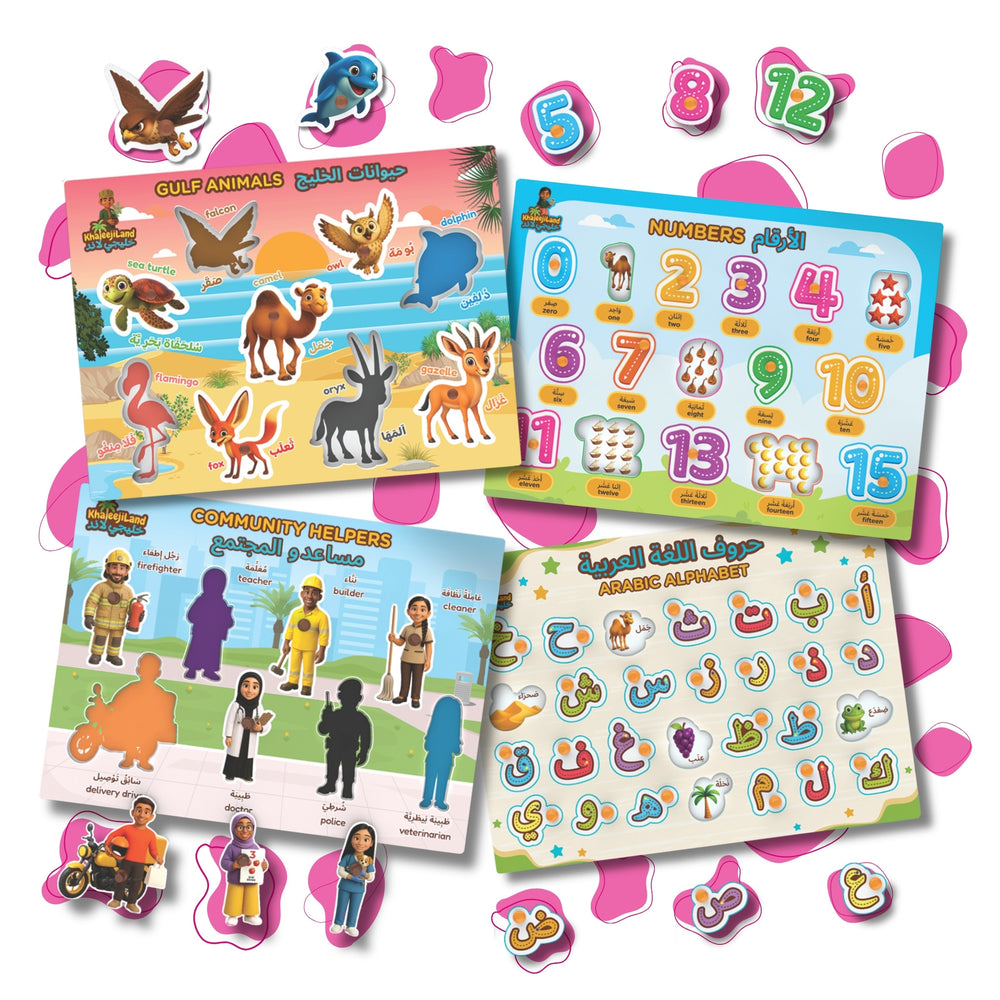
Our wooden peg puzzles are built around clear, focused skills: the Numbers 0-15 puzzle for early counting and number recognition, the Arabic Alphabet puzzle for letter recognition and early phonics, and the Community Helpers puzzle, which reinforces the familiar childhood theme of the people who help us through bilingual, culturally relevant play. They work without batteries, they're made to EN71 and carry the G-Mark, and they're designed for repeat play across the 3 to 5 range.
For cultural and money relevance specifically, the KhaleejiCash UAE Learning Money Set was the product that started the whole brand, built precisely because UAE play money didn't exist and children here deserve to learn about money using currency they recognise. And the UAE Map puzzle and Gulf Animals puzzle connect children to the geography and wildlife of where they actually live. If those fit your child's stage and your family's priorities, they're honest options. If they don't, the framework still stands on its own.
Frequently asked questions
At what age should I start buying educational toys for my child?
You can introduce simple educational toys from around 12 to 18 months, focusing on cause-and-effect, stacking, and sorting. Whatever the age, never give a child under three a toy marked 3+, and apply the same caution to hand-me-downs and gifts: if a toy's safety age grade is above your child's age, it isn't suitable yet, however sturdy or harmless it looks. From age three, children are ready for puzzles, early letters and numbers, and pretend play.
Are wooden toys better than plastic ones for learning?
Not necessarily. Material matters far less than design: wooden toys aren't always more durable, plastic toys can be just as tactile, and plenty of wooden toys come with lights and sounds too. What actually decides a toy's learning value is whether it builds a clear skill, suits your child's stage, and is properly safety certified. A well-designed plastic toy can easily beat a poorly designed wooden one.
How can I tell if a toy sold in the UAE is safe and certified?
Look for the G-Mark (Gulf Conformity Mark) and EN71 compliance, which are required for toys sold legally in the UAE. EN71 usually appears on the packaging as the CE mark. The quickest check is to use your phone to scan the G-Mark QR code on the packaging, which takes you to the official certificate and confirms whether it's valid. Be cautious of toys sold informally through social media or unregulated marketplaces, where certification is often absent.
Do expensive educational toys teach better than cheap ones?
Not automatically. Price may reflect materials, design, and safety testing, but not learning value on its own, and a thoughtfully designed affordable toy could outperform an expensive one with no real skill behind it. That said, a price significantly below the market often means a corner was cut somewhere, and it's likely that corner was the toy's safety certification.
|
Madhav is the co-founder of KhaleejiLand. He grew up at the intersection of Emirati and expat life, and would not have it any other way. That experience is why KhaleejiLand exists: so children grow up genuinely connected to the place they call home. |


