

The Importance of Cultural Representation in Children's Toys and Learning Materials
Cultural representation in children's toys matters because children tend to engage more with images, names, and stories they recognise from their own lives, and because seeing their world reflected back supports their sense of belonging. Toys that show a child's culture aren't just decoration. They can support identity, language, and engagement, all of which can make learning feel more relevant and easier to connect with.
|
Key takeaways • Children tend to engage more with toys and materials they recognise from their own lives. • Educators sometimes call this culturally responsive teaching: starting from what children already know from home and daily life. • Familiar local details, places, animals, language, and symbols, can make learning feel easier to connect with. • Seeing their own world reflected back can support a child's identity and sense of belonging. • Choosing culturally relevant toys is a practical decision parents and teachers can make, not an abstract value. |
What does cultural representation in toys actually mean?
It means a toy reflects the world a child lives in: the animals they might see, the places they know, the money their family uses, the languages spoken at home and at school. It's the difference between a counting toy printed with maple leaves and one printed with dates and dhows.
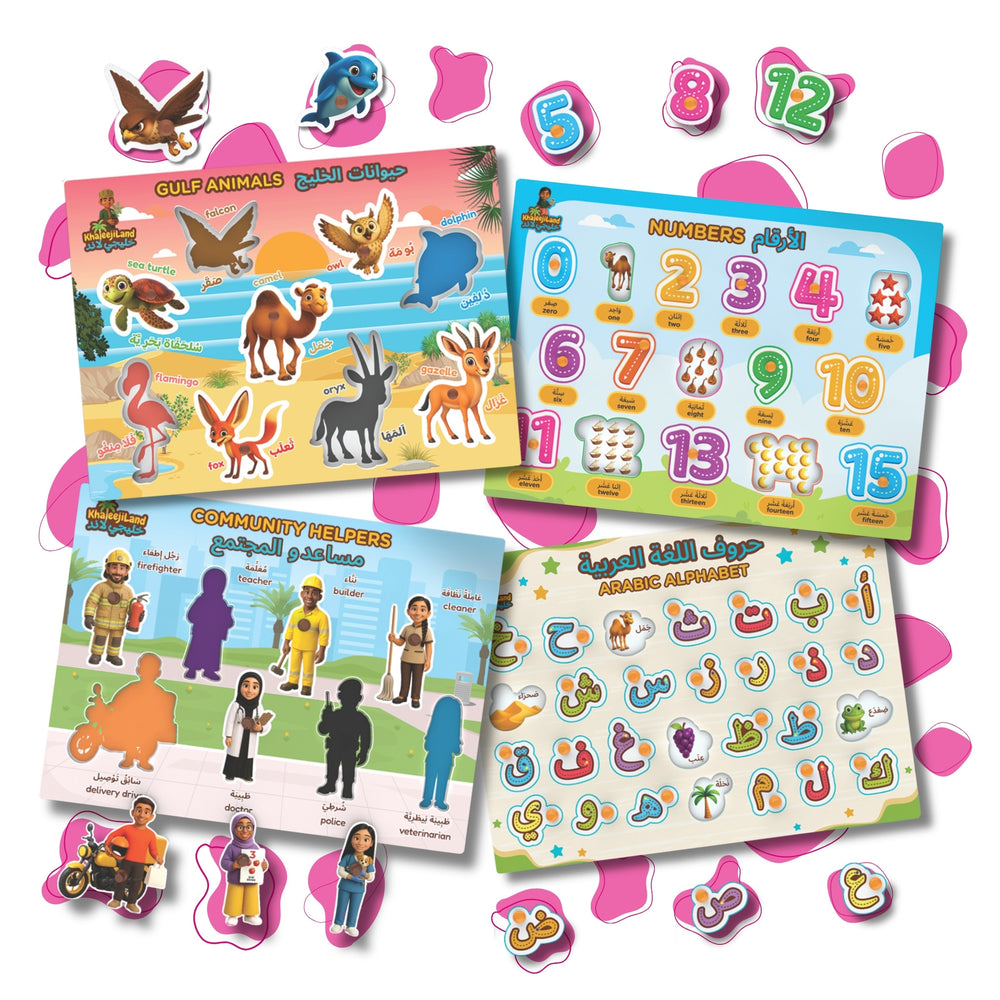
Many mass-market educational toys available in the Gulf were designed for other markets. The alphabet sets teach one language. The community helpers wear uniforms from another country. The animals are tigers and elephants rather than oryx and falcons. None of this is harmful on its own. But when almost everything a child plays with comes from elsewhere, they have fewer chances to connect learning with the world they see around them.
Once I started looking properly, I realised how much of the toy shelf came from somewhere else. A child in the UAE could practise counting, matching, sorting, or learning letters without ever seeing a dirham, a falcon, a ghaf tree, or the map of the country they live in. That felt like a missed opportunity, not because children should only see one culture, but because their own world should be part of the mix.
The fix isn't to reject toys from other places, which have their own value and their own windows into the wider world. It's to make sure a child also sees themselves.
Why does this help children learn, not just feel good?
Familiar details can make a child more willing to start. When something looks like the world they know, a camel, a fifty-fils coin, the map of the country they live in, they can put their attention into the new skill rather than into working out an unfamiliar object first.
This came up clearly when we were working on our play money set. A child can learn counting with dollars or pounds, of course. But if they live in the UAE, dirhams and fils already have meaning. They may have seen them in a parent's wallet, at the supermarket, or when buying a snack. That small bit of familiarity gives the activity a much easier starting point.
There's a name for this idea in education.
What is culturally responsive teaching?
Culturally responsive teaching means starting from what children already know from home and daily life, and using it as a starting point for learning, rather than treating it as separate from the classroom. The idea was developed by education researchers Gloria Ladson-Billings and Geneva Gay. It is one useful way educators think about making learning more connected to children's lives.
Educators often use the phrase “mirrors and windows” when talking about books and classroom materials. The same idea can help parents think about toys. Mirrors let a child see their own life reflected back; windows let them see into the lives of others (more on culturally responsive teaching, New America). For many children in the Gulf, imported books and toys already offer plenty of windows into other places. The missing piece is often the mirror: things that reflect the place they live.
As an educator, I'd add one thing: children are quicker to join in when an activity uses something they already know, a familiar place, a name, a festival they mark at home.
How does this connect to identity and belonging?
Seeing their own world treated as worth learning about can support a child's sense of belonging, and belonging matters for how confident and engaged a child feels. A child who recognises their surroundings in what they play with picks up the idea that they, too, belong in the place where learning happens.
This matters everywhere, but it carries particular weight in the Gulf, where families are raising children inside a real mix of cultures. The benefit looks a little different from family to family. For Emirati and GCC children, familiar local details can support pride, language, and family heritage. For expat children, they can support a respectful connection to the country they are growing up in, whether the family stays a few years or much longer. In both cases, toys that reflect Gulf life do real work: they show a child that this place, its language, its animals, and its symbols are part of the world they're growing up in.
How does this look in early years play?
In early years settings and at home, this kind of play tends to be simple and concrete. It's less about a special activity and more about giving children familiar things to notice, name, and talk about. A few examples:
• A child matches a UAE map puzzle and names places they've visited.
• A child sorts animals into desert, sea, and sky.
• A child uses familiar play money in a pretend shop.
• A child recognises a local landmark, animal, or object and talks about where they've seen it.
• Adults ask simple questions: “Have you seen this before?” “Where do we use this?” “What does it remind you of?”
This kind of play sits comfortably with early years practice, which places value on children making sense of their community and the wider world through lived experience, relationships, language, and play (EYFS statutory framework, UK Department for Education).
Is this part of education in the UAE?
In Abu Dhabi, connection to local culture in private schools is no longer just a value individual families hold. The Department of Education and Knowledge (ADEK) introduced the National Identity Mark, an annual rating of how well private schools build students' understanding of the UAE's traditions, customs, and values, across three domains: Culture, Values, and Citizenship.
The Mark measures school programmes, not toys. But at least in Abu Dhabi's private-school system, connection to local culture is being treated as part of a broader view of school quality. The simple idea behind it, that children benefit when their own culture is part of how they learn, is one families can support at home through the materials they choose.
What should parents and educators look for?
Look for toys where the local element is built in, not stuck on. There's a meaningful difference between a generic product with a flag printed on the box and one designed from the ground up around a child's world. A few practical questions help separate the two:
Does the content reflect things the child encounters, the local currency, real regional animals, the actual map of the country? Is it accurate rather than a cartoonish stereotype? If the toy is bilingual, is the Arabic correct and natural, or an afterthought? And does the local theme support the learning goal, or is it just decoration around a standard toy?
Avoid products where the cultural reference is only a flag, a camel, or an Arabic word added to an otherwise generic toy. The local detail should help the child understand, name, sort, count, match, build, pretend, or talk.
This is where I think parents and educators should be a little picky. A local theme is a good start, but it does not automatically make something educational. The best toys do both jobs at once: they reflect the child's world and give the child something meaningful to practise, build, sort, name, count, match, imagine, or talk about.
FROM OUR STORE
A UAE map puzzle is one simple example. It turns place, language, landmarks, and symbols into something a child can touch, move, and talk about. Our UAE Map Wooden Peg Puzzle was designed with that idea in mind, with labels in both Arabic and English. |

Try it at home
Want a simple way to start? Our free activity sheets help children explore Gulf animals, the UAE map, and everyday cultural themes through play, and they work on their own, with or without a toy. Visit the Activity Library and download one to try this week.
Frequently asked questions
Why is representation important in children's toys?
Representation matters because children tend to engage more with toys that reflect their own lives, and because seeing their culture treated as worth learning about can support their sense of belonging and identity. It also helps children develop respect for their own background alongside curiosity about others.
At what age does cultural representation start to matter for children?
It can matter from the earliest years. For KhaleejiLand's age range, roughly 3 to 8, the most useful approach is simple and concrete: familiar words, places, animals, maps, pretend play, puzzles, stories, and everyday conversations.
What are examples of culturally relevant toys for children in the UAE?
Examples include UAE map puzzles, Arabic alphabet toys, local animal puzzles, pretend play money using dirhams and fils, community-helper sets that reflect UAE life, and bilingual activities using Arabic and English.
Does choosing culturally relevant toys mean avoiding toys from other cultures?
No. The goal is balance, not exclusion. Toys from other cultures offer valuable windows into the wider world, and that exposure is healthy. The aim is to make sure a child also has mirrors, things that reflect their own world, rather than learning only ever happening through somewhere else.
How can I tell if a toy is genuinely culturally relevant or just marketed that way?
Look at whether the local element is built into the learning or just printed on the packaging. It shows up in accurate content, such as real local animals, the correct currency, and natural, correct Arabic, and in a theme that supports the educational goal rather than decorating a standard product.
|
Sara is a special educator based in the UAE, with a Master's in Special Education from Simmons University and nearly a decade in Abu Dhabi classrooms, from early years through special needs. She writes about the science of play, bilingual learning, and helping children thrive in UAE classrooms and beyond. |


