

Fine Motor Skills in Early Childhood: Why They Matter and How Play Builds Them
Fine motor skills are the small, precise movements of the hands and fingers that let a child grip a pencil, fasten a button, turn a page, or place a puzzle piece. They develop through repeated practice, and play is how young children get that practice without it feeling like work. Fine motor control supports writing, self-care, and classroom independence, especially when children have regular chances to practice through play.
|
Key takeaways • Fine motor skills in early childhood are the small hand, finger, and wrist movements children use for tasks such as drawing, cutting, threading, fastening buttons, turning pages, and using cutlery. • They develop in a roughly predictable sequence, but the timeline varies widely from child to child. • Most everyday play already builds them: threading, pinching, posting, building, drawing, and tearing. • Before formal letter formation, children need hand strength, finger control, shoulder stability, and plenty of mark-making practice. |
What are fine motor skills, exactly?
Fine motor skills in early childhood are the small hand, finger, and wrist movements children use for tasks such as drawing, cutting, threading, fastening buttons, turning pages, and using cutlery. They sit alongside gross motor skills, the large movements of the arms, legs, and trunk, and the two are more connected than they first appear.
A child can't use their fingers precisely if the rest of the arm is unstable. Children usually gain control from the center of the body outward (what specialists call proximal to distal). In simple terms, the shoulder and trunk need to be steady before the fingers can do small, precise work. This is why a toddler colors from the shoulder with the whole arm moving, while a five-year-old can rest a forearm on the table and move mostly the fingers.
When I worked with young children in Abu Dhabi, I learned that pencil control problems didn't always begin in the fingers. One four-year-old was being pushed toward more tracing, but he still needed bigger movement first: painting on a vertical surface, crawling games, pushing and pulling, and play that strengthened the shoulder. Once those foundations improved, table-top mark-making became less frustrating. When a child struggled to control a crayon, I learned to look beyond the fingers first. Was the shoulder stable? Could the child sit comfortably? Were they using the whole arm because the wrist and hand weren't ready yet?
Why do fine motor skills matter so much in the early years?
Because so much of a child's day depends on them. The obvious link is handwriting, but the reach is far wider: doing up a zip, using a fork, opening a lunchbox, managing buttons after PE, turning pages, using scissors. These are the tasks that determine whether a child can move through a school day independently, and independence feeds directly into confidence.
There's a cognitive layer too. Manipulating objects, sorting, posting, and building all support spatial reasoning, planning, and problem-solving. This is part of why hands-on play matters beyond the motor benefit, a theme I explore more fully in our overview of what play-based learning looks like in the classroom.
For writing specifically, research has linked early fine motor skills with later school readiness and achievement, alongside other important factors such as attention, early maths, language, and the child's wider learning environment (Grissmer et al., 2010, Developmental Psychology). The takeaway for practice is simple: time spent strengthening little hands at three and four isn't a distraction from academics. It's a foundation for them.
How do fine motor skills develop? A rough sequence, not a strict timetable
Children tend to move through similar stages, but the ages attached to them vary widely, and that variation is normal. These are broad examples, not screening criteria. Children develop at different rates, and a functional, comfortable grasp matters more than forcing every child into one perfect pencil grip.
• Around 12 to 18 months: raking and then picking up small objects, banging and dropping, an emerging pincer grasp between thumb and forefinger.
• Around 2 to 3 years: stacking a few blocks, turning chunky pages, holding a crayon in a fist, beginning to imitate vertical and circular scribbles.
• Around 3 to 4 years: threading large beads, snipping with child scissors, building taller towers, a more refined grasp on drawing tools.
• Around 4 to 5 years: cutting along a line, copying simple shapes, doing up large buttons, a more controlled and comfortable pencil grasp.
• Around 5 to 6 years: forming letters, using cutlery competently, managing most self-care fastenings.
In the UAE, many British-curriculum nurseries and early years settings use the EYFS as their reference point. The EYFS is an early years framework from England, but its Physical Development area is still a useful lens for understanding how gross and fine motor development support early learning (EYFS statutory framework, GOV.UK). Treat any sequence as an indicative timeline, not a deadline.
How does play build fine motor skills?
This is often reassuring for parents: you very rarely need to manufacture fine motor practice. Most of it is already embedded in good play. The job of the adult is to offer the right materials and then step back.
Pinching and pulling builds the same thumb-and-finger muscles used for a pencil grasp. Play dough, tongs picking up pompoms, peeling stickers, and tearing paper for collage are all pincer grasp activities that count.
Threading and posting develops bilateral coordination, the two hands working together with different jobs. Think threading beads, posting coins into a slot, or dropping pasta into a bottle.
Building and placing trains precision and the controlled release of an object, which is harder than it looks for a small child. Block towers, stacking cups, and placing puzzle pieces all rehearse it.
Drawing, painting, and mark-making develop grip and control, especially on a vertical surface like an easel or a wall-mounted sheet, which also strengthens the wrist and shoulder.
Self-care play in a home corner, dressing dolls, doing up real buckles on a busy board, threading laces, rehearses exactly the skills children need for their own zips and buttons.
Puzzles deserve a particular mention here, because they combine several of these at once: the pincer grasp on the knob or piece, the controlled placement, and the problem-solving of matching shape to space. That overlap is why they earn their place in so many early years settings, and it's the focus of a companion piece on how puzzles support cognitive development in children aged 3 to 6.

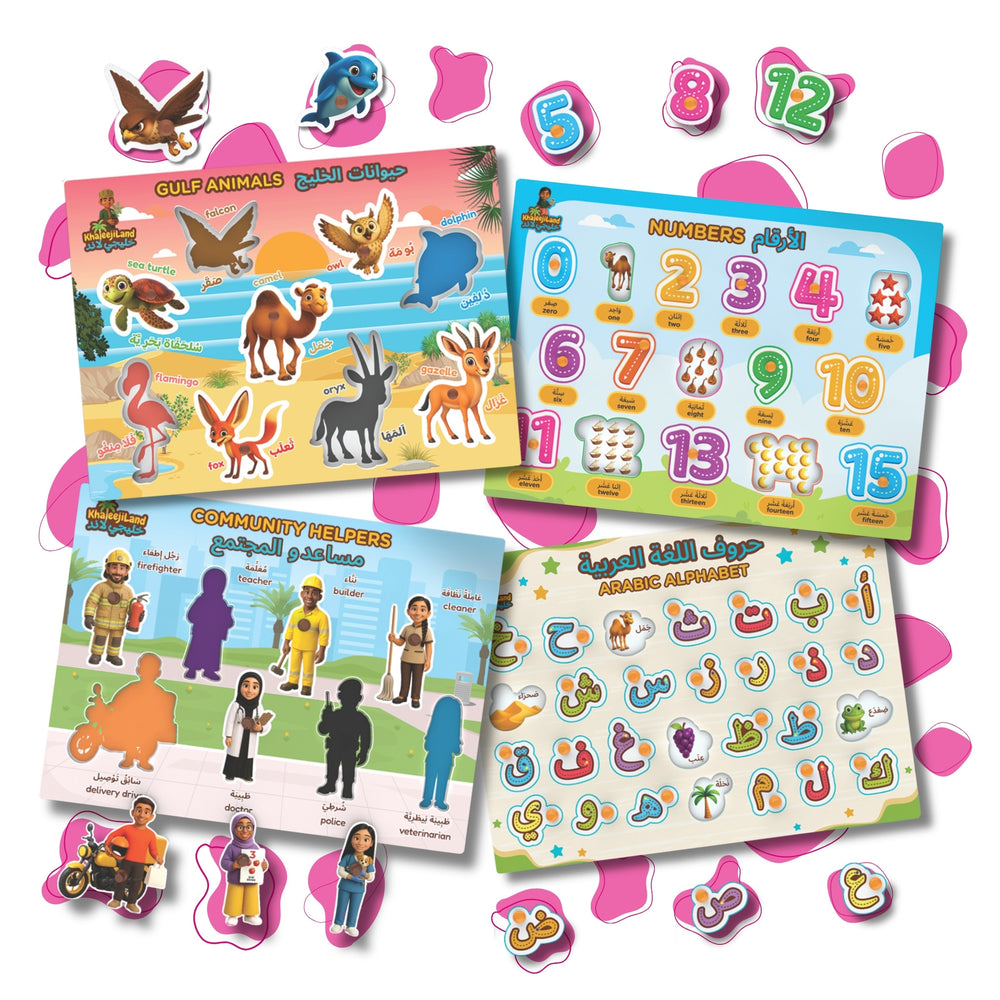
Wooden peg puzzles are a good example. The pegs give children practice at the pincer grasp, and the shape-matching adds a problem-solving layer, which makes them useful for short, repeated play. KhaleejiLand's wooden peg puzzle collection is one option for building this kind of practice at home.
How can teachers build fine motor practice into the classroom day?
Because this work is so easily woven into provision, it rarely needs a separate timetable slot. A few practical moves for the classroom:
• Put tongs, tweezers, pegs, beads, play dough, scissors, and posting activities into regular provision.
• Offer vertical mark-making at least some of the time, not only table writing.
• Keep writing tools available in role play, construction, and art areas, not just the writing corner.
• Use self-care routines as practice, including zips, lunchboxes, water bottles, and bags.
• Watch whether the child avoids the task, tires quickly, swaps hands often, or uses the whole arm because the wrist and fingers aren't yet stable.
In UAE classrooms, this also matters because children may be managing different languages, school routines, and expectations at once. A child who is still building hand strength may understand the task perfectly but struggle to show it on paper. That's one reason early years teachers need to look beyond the finished worksheet and notice the physical effort behind the task.
A few more principles hold up well in the classroom and at home alike. Choose short and frequent over long and occasional: five focused minutes of threading several times a week beats a single long, frustrating session, because little hands tire quickly and a tired child practises poorly. Resist doing it for them, too. When you fasten the button, open the packet, or place the piece, the child loses the rep, a point that sits at the heart of a separate post worth reading on why children learn more through trial and error.
It's also worth valuing the messy, low-cost activities. Tearing, scrunching, squeezing, and digging aren't filler. They're some of the most effective hand-strengthening work a young child can do, and they cost almost nothing.
Finally, watch for genuine red flags rather than ages on a chart. Persistent avoidance of fine motor tasks, a child who tires or complains of hand pain very quickly, an inability to hold any tool by school age, or a grasp that isn't maturing at all over many months are all worth a conversation with an occupational therapist. Variation is normal; a complete absence of progress is the thing to act on.
Bringing it back to the classroom
Fine motor development is rarely the headline when we talk about early learning, but it quietly underwrites a huge amount of what we ask children to do at school. For most children, the answer isn't more worksheets. It's more repeated, hands-on practice built into the day, with an adult who knows when to offer a material and when to sit on their hands. When the foundations are stronger, pencil grip, scissor control, and self-care tasks usually become easier to teach.
|
WANT A SIMPLE WAY TO START AT HOME OR IN THE CLASSROOM? Explore our Activity Library for free, low-prep fine motor activities for preschoolers, using things you already have, designed for children aged three to six. The activities are free to download and use, in the classroom or at home. |
Frequently asked questions
What are examples of fine motor skills activities for preschoolers?
Examples include play dough, threading beads, peeling stickers, using tongs, posting objects into containers, building with blocks, cutting with child-safe scissors, tearing paper, drawing on vertical surfaces, and doing up zips or buttons during everyday routines. Short, frequent sessions tend to work better than occasional long ones.
At what age should a child have good fine motor skills?
There's no single age, because fine motor development follows a sequence rather than a fixed timetable. Most children manage tasks like threading beads and snipping with scissors between three and four, and letter formation around five to six. Wide variation between children of the same age is completely normal.
What's the difference between fine motor and gross motor skills?
Gross motor skills are the large movements of the arms, legs, and trunk, such as running, climbing, and jumping. Fine motor skills are the small, precise movements of the hands and fingers, such as pinching, drawing, and doing up buttons. The two are linked, because stable large muscles support controlled small movements.
Are fine motor skills linked to handwriting and school readiness?
Hand strength and a controlled grasp are needed before a child can form letters comfortably, and early fine motor skills have been linked with later school readiness. Building hand strength early, through play rather than formal writing practice, supports handwriting when it begins.
|
Sara is a special educator based in the UAE, with a Master's in Special Education from Simmons University and nearly a decade in Abu Dhabi classrooms, from early years through special needs. She writes about the science of play, bilingual learning, and helping children thrive in UAE classrooms and beyond. |


