

How Puzzles Support Cognitive Development in Children Aged 3 to 6
Puzzles support cognitive development by giving children repeated, hands-on practice in problem-solving, spatial reasoning, visual discrimination, and working memory. As a child studies a piece, turns it, and tests where it fits, they are reasoning through a problem and checking their idea against what they see. Between ages 3 and 6, this kind of structured trial and error helps build the thinking skills that underpin early maths, reading, and self-regulation.
|
Key takeaways • Puzzles practice four cognitive skills at once: problem-solving, spatial reasoning, visual discrimination, and working memory. • The thinking happens in the trial and error, so some of the most valuable moments come while a child is still working a piece out, not when it slots in. • Puzzle play can support spatial skills, and spatial skills have been linked in research with early maths development. • Difficulty should sit just beyond what a child can already do alone, the principle Vygotsky called the zone of proximal development. • Puzzle type matters: peg puzzles, inset boards, and jigsaws each ask different things of a child at different stages. |
What do we mean by “cognitive development”?
In early years classrooms, cognitive development is what we see when a child remembers where a piece might go, compares two shapes, changes strategy, follows a pattern, or keeps trying after the first idea doesn't work. In simple terms, it is the development of attention, memory, reasoning, problem-solving, and flexible thinking.
These processes develop fast between the ages of 3 and 6, and they develop best through active, hands-on experience rather than instruction. This is the principle at the center of every play-based approach. The Early Years Foundation Stage is an early years framework from England, but it is widely used by British-curriculum nurseries and early years settings in the UAE. Its focus on learning and development from birth to 5 makes it a useful lens for understanding why hands-on play matters in the early years. Research on the UAE kindergarten curriculum also highlights the role of children's uniqueness, cultural identity, and cultural values in early learning (Alhosani, 2022, ECNU Review of Education).
A puzzle shows this well because the child can see the problem, test an idea, and get immediate feedback. The child does the cognitive work themselves.
Which cognitive skills do puzzles actually build?
A puzzle looks simple, but completing one draws on several distinct cognitive skills working together. Understanding puzzles and cognitive development starts with seeing what a single board is asking of a child.
Problem-solving and reasoning. Every puzzle is a problem with a solution the child has to find. They form an idea, test it, and adjust when it doesn't work. This is early reasoning: “I think it goes here. It doesn't fit. What else could I try?” It is one of the most transferable thinking skills a young child can practice.
Spatial reasoning. To place a piece, a child has to perceive its shape, picture how it needs to be turned, and rotate it in their mind before their hand follows. This is the heart of spatial reasoning in children. One study that observed children's puzzle play between the ages of 2 and 4 found it was related to their spatial transformation skill as preschoolers (Levine et al., 2011, Developmental Psychology). Spatial skills like these have also been linked in research with early mathematical understanding, which is one reason puzzle play matters beyond the puzzle itself (Verdine et al., 2014, Journal of Experimental Child Psychology).
Visual discrimination. Sorting pieces by color, edge, or pattern asks the child to notice fine visual differences and group by a rule. Visual discrimination activities like these build the careful looking that later supports children as they notice differences between similar letters, numbers, and Arabic letter forms.
Working memory. Holding an image of the finished picture in mind while searching for the next piece is working memory in action: the mental workspace where children keep information live while they use it.
Attention and persistence. A puzzle gives a child a reason to stay with a single task and see it through. That capacity to focus and persist is itself a developmental outcome, not just a personality trait.
As a teacher, I often used puzzles as a quiet way to see how a child solved problems. One child would try a piece, pause, turn it, compare it with the picture, and then say, “No, this one is for the corner.” That short sequence told me far more than a finished board did. It showed attention, visual discrimination, spatial reasoning, and persistence, all in a few seconds.
Why the moment of being almost stuck matters
Some of the most valuable thinking happens when the child is almost stuck but still engaged. When a piece won't fit, the child has to slow down, look again, and try a different approach. That is the reasoning happening. If an adult reaches in and places the piece, the puzzle gets finished but the thinking stops. We do the cognitive work for the child and remove the very thing the activity was for.
This is the same principle explored in why children learn more through trial and error. The most useful thing we can offer a stuck child is usually not the answer but a prompt: “What shape are you looking for?” or “Try turning it.” A little struggle is not automatically a sign the puzzle is too hard. If the child is still looking, trying, and adjusting, the puzzle may be doing exactly what it should.
Matching the puzzle to the child: the zone of proximal development
Puzzles only build thinking when the challenge is pitched correctly. Too easy, and a child completes it on autopilot. Too hard, and they disengage before any reasoning happens.
The sweet spot is the level just beyond what a child can already manage independently, but reachable with a little support. This is what Lev Vygotsky called the zone of proximal development, and it is one of the most practical ideas an educator can hold while choosing materials. As a child masters one level, the right next puzzle is one that adds a manageable new demand: more pieces, less color-coding, finer shape distinctions, or no picture underneath.
Puzzle play in early childhood also looks different at each age within the 3 to 6 range. A 3-year-old may be learning to match one piece to one space. A 4-year-old may start using color, picture, and edge clues together. A 5- or 6-year-old may be ready to plan, sort pieces first, and explain their strategy. Observing where each child sits, and offering the next step rather than buying by age label alone, is what keeps the challenge in that productive zone.
How puzzle type changes the cognitive demand
Different puzzles ask different things of a child, and the progression matters when you are building a classroom set or a home shelf.
Peg and inset puzzles suit the youngest children. Each piece has one home, the pegs support developing fine motor control, and a picture under each slot scaffolds the matching. The demand is mainly visual matching and one-to-one correspondence.
Knob and layered puzzles add a little more challenge: removing the color-coded base, or introducing pieces that look similar, pushes visual discrimination further.
Jigsaw puzzles are the step up in complexity. Pieces interlock, edges carry information, and the child has to use the relationship between pieces rather than a single fixed slot. This loads spatial reasoning and planning much more heavily, which is why jigsaws generally suit children who are already secure with inset puzzles. That progression matters. A child who is ready for an inset puzzle may not yet be ready for a jigsaw, and that is normal. We cover it in more detail in how to match puzzle type to age and stage.
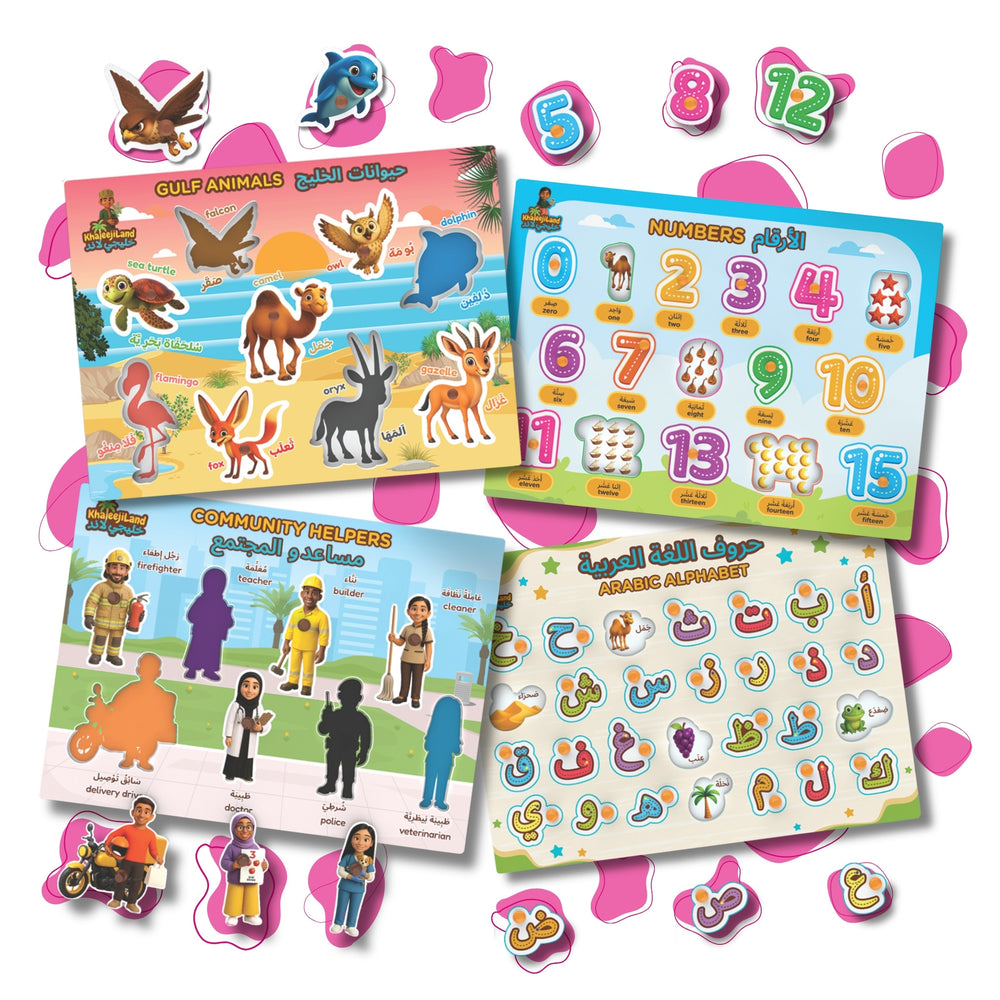
In UAE classrooms, locally familiar images can also help children stay with the task. A child who recognizes a camel, falcon, turtle, or community helper has more to say about the picture, which can support attention, vocabulary, and conversation while the puzzle work continues.
How this can look with a peg puzzle
A wooden peg puzzle can be a useful early step because each piece has a clear home, and the peg gives small hands something to grasp. With a KhaleejiLand Gulf Animals Wooden Peg Puzzle, children can practice matching, turning, placing, and naming familiar regional animals while they play. The adult role is to keep the challenge manageable: start with fewer pieces, wait before helping, and prompt the child to look again before giving the answer.
How can teachers use puzzles in early years classrooms?
Use puzzles as part of continuous provision, small-group observation, or a calm table activity. Rotate difficulty rather than putting every puzzle out at once. Watch how the child searches, turns, compares, asks for help, and responds to prompts. The process tells you more than whether the board is finished.
For children with additional needs, the same puzzle may place demands on attention, vision, fine motor control, language, and frustration tolerance all at once. If a child avoids puzzles completely, becomes distressed quickly, or cannot manage the motor demands, simplify the task before assuming they do not understand it. Often the thinking is there and it is one of the other demands getting in the way.
The link to fine motor development
Cognitive and physical development are closely connected at this age, and puzzles sit right at the join. Picking up, turning, and placing pieces strengthens the hand control and coordination children will later need for writing, while the brain is busy with the reasoning. We look at this physical side in detail in why fine motor skills matter and how play builds them.
This is why puzzles should not be treated as filler. Used well, they are a real thinking task, and they earn their place in a deliberate, play-based approach. If you want the wider evidence base for that approach, our main guide explains what play-based learning is and what it looks like in the classroom.
|
EXTEND THE LEARNING Looking for more screen-free activities that build the same problem-solving skills in early years? Our free Activity Library has printable puzzle, sorting, and matching activities you can use at home or in the classroom. No sign-up needed. |
Frequently asked questions
At what age can a child start doing puzzles?
Many children can manage simple peg or inset puzzles with one or two large pieces from around 18 months to 2 years, building up to boards with more pieces by age 3. The key is matching the number of pieces and the type of puzzle to the individual child rather than to a fixed age.
What type of puzzle is best for a 3-year-old?
Many 3-year-olds do well with peg puzzles, inset puzzles, or simple jigsaws with a small number of large pieces. The best puzzle is one the child can almost complete independently, with a little adult prompting if needed.
Are wooden puzzles better than cardboard ones for development?
Neither material is better for cognitive development; the skills come from the puzzle's design and difficulty, not what it is made of. Wooden peg and inset puzzles are often chosen for younger children because they are durable and easy for small hands to grip, while cardboard jigsaws suit older children working with interlocking pieces.
How do puzzles help child development and early maths?
Puzzles build spatial reasoning, the ability to perceive and mentally turn shapes and positions, and research has linked early spatial skills with early maths development. Sorting and matching pieces also practice the classification and one-to-one correspondence that support early number sense.
Should I help my child when they get stuck on a puzzle?
Offer support, not solutions. Rather than placing the piece for them, prompt their thinking with questions like “what shape are you looking for?” or “try turning it,” because the reasoning a child does while working a piece out is the most valuable part of the activity.
|
Sara is a special educator based in the UAE, with a Master's in Special Education from Simmons University and nearly a decade in Abu Dhabi classrooms, from early years through special needs. She writes about the science of play, bilingual learning, and helping children thrive in UAE classrooms and beyond. |


