

Gulf Animals Children Should Know: A Guide to UAE Wildlife and Heritage for Families
The Gulf animals most worth teaching young children are the ones they can connect to real life in the UAE: the oryx, falcon, camel, gazelle, houbara, flamingo, and sea turtle. Together, they introduce children to desert life, coastal habitats, Emirati heritage, and conservation. Some can be seen easily in person, while others are best introduced through reserves, heritage centres, books, puzzles, or conservation stories.
|
Key takeaways • Seven animals give children a strong first map of Gulf wildlife and heritage: oryx, falcon, camel, gazelle, houbara, flamingo, and sea turtle. • Several, like the Arabian oryx and the houbara, show children how conservation works in the UAE. • Some are easy to see in person, like the flamingos at Ras Al Khor; others are better met through reserves, books, and play. • Naming animals in both Arabic and English turns a nature walk into a bilingual learning moment. |
When my own connection to this place was forming, it wasn't through textbooks. It was through the animals you actually notice here: the falcon on official emblems and banknotes, the oryx on road signs and logos, the camels by the roadside on the way to Al Ain. Animals are one of the first ways a child reads the country around them, and the Gulf has a remarkable cast of them.
This guide covers the animals I think every child growing up here should be able to name and recognise, why each one matters, and, where possible, where you can go to meet it. It's written for parents and educators, and it pairs naturally with our wider guide to growing up in the Gulf and building cultural identity in children.
One of the first Gulf animals my nephew pointed at and named was a camel, from the back seat on the drive to Al Ain. He was five, and he had seen camels in books plenty of times, but the real one walking along the roadside got a reaction the books never did. My eight-year-old niece spent the rest of the journey listing every animal she could think of that lives in the desert.
That is the shift this guide is about: the moment an animal stops being just a picture and becomes part of a child's world.
Why teach children about Gulf animals at all?
Children learn the world in concrete pieces before they learn it in concepts, and animals are some of the most memorable pieces. An animal a child can name, describe, and recognise becomes an anchor for a much larger set of ideas: where it lives, what the land is like, why people care about it, and how it connects to the place they call home.
There's a cultural layer too. The falcon, the camel, and the oryx aren't only wildlife in the Gulf. They're part of how the region understands itself, and they turn up on emblems, in stories, and at heritage events all year round. A child who knows these animals has a head start on the symbols and pride around them, whether the family is Emirati, from elsewhere in the Arab world, or an expat household putting down roots here.
The seven Gulf animals children should know
1. The Arabian oryx (Al Maha)
If you teach your child one Gulf animal, make it this one. The Arabian oryx is a white desert antelope with long, straight horns, and it's the national animal of the UAE. Its comeback is one of the great conservation stories anywhere in the world. The species was hunted to extinction in the wild by the early 1970s, then saved through captive breeding and reintroduced across the Arabian Peninsula. In 2011 it became the first animal ever to move from “extinct in the wild” back up to “vulnerable” on the IUCN Red List. You can read the species assessment on the IUCN Red List entry for the Arabian oryx.
For a child, the simple version carries a lot: this animal had vanished from the wild, and people here brought it back.
2. The falcon (Saqr)
The falcon is the national bird of the UAE and probably its most recognisable cultural animal. It appears on official emblems and across most banknote denominations, and it sits at the heart of falconry, a tradition that remains part of Emirati heritage. Falcons are built for speed and precision, with extraordinary eyesight, and watching a trained falcon up close is something most children find thrilling.
Falconry connects the bird directly to the region's history, when these birds were working partners in the desert. Today the tradition continues alongside dedicated falcon hospitals and heritage events, which makes the falcon an easy way into talking about how old traditions carry on in a modern country.
3. The camel (Jamal)
The camel needs little introduction, but children should understand why it matters here specifically. The camel made life in this region possible long before cities and air conditioning: transport, milk, and companionship across an environment where almost nothing else could thrive. Its adaptations are a science lesson in themselves, from storing energy in its hump to closing its nostrils against blowing sand.
This is the animal your child is most likely to see by chance, on the road toward Al Ain or Liwa, or up close at a heritage village.
4. The Arabian sand gazelle
The Arabian sand gazelle is a slender, pale desert gazelle native to the region. It's less famous than the oryx but just as much a part of the desert ecosystem, and the two are often protected together on the same reserves. For children, the gazelle is a useful contrast to the oryx: both are desert antelopes, but the gazelle is smaller, faster, and more delicate. Spotting the difference is a nice early observation skill. It also appears on the 25 fils coin, which makes it easy to point out in everyday life.
The gazelle is woven into the map of the country too. The name Abu Dhabi means “father of the gazelle,” and the story behind it is that early settlers followed a gazelle to fresh water on the island where the city now stands. For a child, that's a memorable link: the animal in the puzzle is the same one the capital is named after.
5. The houbara bustard (Houbara)
The houbara is closely linked to falconry, but today it's also a conservation story. The bird has been affected by hunting, poaching, and habitat pressure, and UAE-led breeding and release programmes now work to support wild populations. The International Fund for Houbara Conservation is the main body behind this work, and it runs education resources for teachers and families.
For slightly older children, the houbara is a good example of how heritage and conservation sit side by side here: the same bird tied to traditional falconry is now the focus of one of the largest breeding programmes of its kind.
6. The flamingo
Flamingos surprise a lot of people, because they don't fit the desert image of the Gulf at all. Yet they gather in large pink flocks in the UAE's coastal wetlands, and they're one of the easiest spectacular animals to show a child in person. Their colour comes from their diet, which is a lovely, counterintuitive fact for children: they aren't born pink, they become pink from what they eat.
7. The sea turtle (hawksbill and green turtle)
The Gulf coast is home to sea turtles, including the hawksbill and the green turtle, and they bring the region's marine side into the picture. Turtles connect easily to ideas children already care about: oceans, beaches, plastic, and looking after habitats. Several rehabilitation and release programmes in the UAE care for injured turtles and return them to the sea, which gives the conservation message a hopeful, concrete ending.
Where to see Gulf animals with your family
Reading about an animal is good; meeting one is unforgettable. A few reliable options across the Emirates:
• Sir Bani Yas Island (Abu Dhabi): Free-roaming Arabian oryx, gazelles, and other wildlife across a large nature reserve, one of the best places to see desert species in something close to the wild.
• Al Wasit Nature Reserve (Sharjah): A coastal wetland with a visitor centre and bird hides, where flamingos and other water birds gather. An easy outing for families in the northern Emirates.
• Ras Al Khor Wildlife Sanctuary (Dubai): Free flamingo-viewing hides right inside the city, an easy half-hour visit that almost always delivers.
• Heritage festivals, camel farms, desert experiences, or supervised cultural activities: The most natural way to see camels up close and connect them to daily life and history.
• Turtle rehabilitation and release events: Periodically open to the public; worth following local listings for dates.
Always check current opening hours, seasons, and booking requirements before you go, as access changes through the year.
I took my niece and nephew to Al Wasit Nature Reserve in Sharjah one weekend, and what struck me was how unprepared they were for it to be real. Flamingos and water birds, wetlands and hides, a short drive from the city. We stayed far longer than I'd expected. It cost almost nothing, and it gave us something to talk about for days.
How to turn this into bilingual learning
The natural next step is to attach the Arabic names as you go. Even if Arabic isn't your strongest language, you can still introduce one or two animal names at a time, especially where the word is printed clearly in both Arabic and English. Pointing at a camel and saying both “camel” and “jamal,” or “falcon” and “saqr,” turns recognition into early vocabulary, and animals are some of the easiest words for young children to absorb because they're tied to something vivid.
A HANDS-ON WAY TO PRACTISE
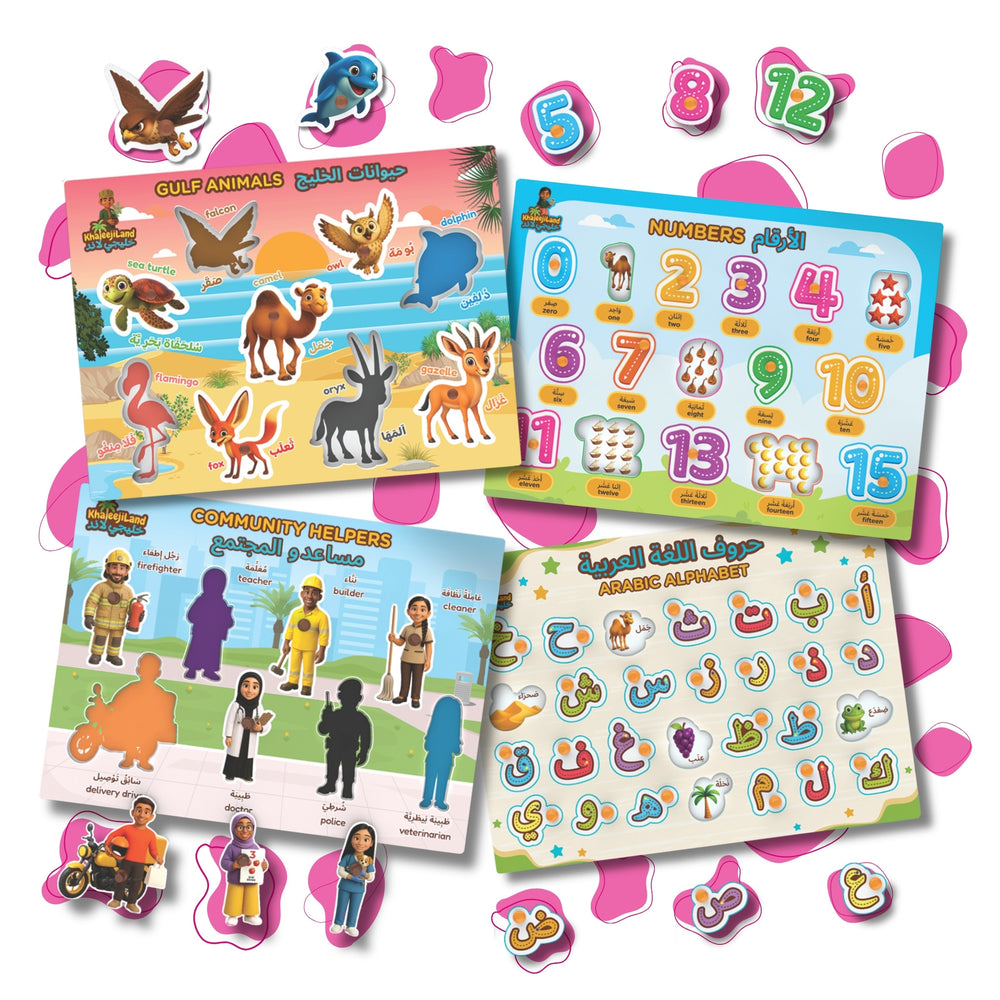
If you want a structured way to practise, our Gulf Animals Wooden Peg Puzzle introduces regional animals such as the Arabian oryx, falcon, camel, and flamingo with bilingual Arabic and English labels, so naming becomes part of play. It works well alongside the trips above: see the animal, name it in both languages, then reinforce it at home. |

Try this with young children
A few simple activities that suit early years learners and link directly to the EYFS “Understanding the World” area:
• Sort the animals into land, sea, and air.
• Compare two animals: “Which one has horns? Which one has wings?”
• Ask: “Where does this animal live?”
• Let your child draw one animal after seeing a photo or a puzzle piece.
|
TAKE THE LEARNING FURTHER To carry on at home, our free Gulf Animals activity sheet in the Activity Library helps children sort these animals by where they live: land, sea, and air. It works on its own as a rainy-day activity and doubles as a recap after a trip to one of the reserves above. |
Frequently asked questions
What is the national animal of the UAE?
The national animal of the UAE is the Arabian oryx, a white desert antelope known locally as Al Maha. It's celebrated partly because it was once extinct in the wild and was successfully reintroduced across the region, which makes it a symbol of conservation as well as heritage.
Where can I see Arabian oryx in the UAE?
Sir Bani Yas Island off the coast of Abu Dhabi is one of the best places, with free-roaming oryx across a large nature reserve. Several protected desert reserves in the UAE also manage oryx alongside gazelles. Check current access and booking before visiting, as availability varies by season.
Why is the falcon important in the UAE?
The falcon is the national bird of the UAE and is tied to falconry, a long-standing Emirati heritage tradition in which falcons were working partners for hunting in the desert. Today it appears on official emblems and across most banknote denominations, and the tradition continues alongside dedicated falcon hospitals and heritage events.
Are there flamingos in Dubai?
Yes. Ras Al Khor Wildlife Sanctuary sits inside Dubai and has free public viewing hides where flamingos gather in large numbers, especially in the cooler months. It's one of the easiest places in the country to show children spectacular wildlife close to the city.
|
Madhav is the co-founder of KhaleejiLand. He grew up at the intersection of Emirati and expat life, and would not have it any other way. That experience is why KhaleejiLand exists: so children grow up genuinely connected to the place they call home. |


