

When Every Toy Feels Boring: Helping Children Rediscover Screen-Free Play
When children say every toy is boring, the answer is usually not to buy more toys. Screens give fast rewards, while real play takes a few minutes to warm up. Start by putting fewer toys out, choosing toys that can be used in more than one way, and sitting with your child for the first five minutes before slowly stepping back.
What to try first tonight
• Put away half the toys.
• Choose one open-ended toy, one puzzle, one book, and one pretend-play item.
• Start the play with your child for five minutes.
• Step back before your child loses interest.
• Keep the screen out of sight during the transition.
|
Key takeaways • “I'm bored” is rarely about a lack of toys. It's often a child whose attention has gotten used to fast screen rewards. • Boredom is uncomfortable, but it's also where a lot of children's own play begins. • Rotating toys out of sight, rather than buying new ones, makes the toys you already own feel new again. • Open-ended toys with no single right answer hold attention far longer than single-use ones. • A few minutes of you starting the play is often enough to get a child going on their own. |
Why does my child say every toy is boring?
In most homes the answer isn't a shortage of toys. It's the kind of attention a child has gotten used to.
A screen delivers a reward every few seconds. Something bright moves, a sound plays, a level is won. Open-ended play does none of that. A wooden puzzle doesn't congratulate anyone. A basket of blocks does nothing until a child decides what it will become. After a stretch of fast, effortless stimulation, the quiet effort of self-directed play can feel flat by comparison. The toy hasn't changed. Your child's expectations may have.
This is especially familiar for UAE families, where outdoor play isn't always realistic in the heat and many children come home from nursery or school already tired. A screen can feel like the easiest answer. But a small basket of hands-on activities, kept visible and simple, can make the first step into play much easier. If you're searching for screen-free activities for children in Dubai or Abu Dhabi that work on a hot afternoon, the good news is that you probably already own most of what you need.
The American Academy of Pediatrics now encourages families to look beyond a simple screen-time number and ask what media is doing in a child's day: what it's used for, how it affects the child, and what it may be crowding out, such as sleep, family time, outdoor play, or hands-on activities (American Academy of Pediatrics, 2026). That framing is useful here. The goal isn't to panic about screens. It's to make sure screens aren't quietly replacing the slower, more effortful kind of play children still need.
The encouraging part is that attention isn't fixed. Many children do return to screen-free play when they're given consistent time, fewer distractions, and a little adult support at the start. It may take days or weeks, not one afternoon.
Is boredom actually bad for children?
No. Boredom is uncomfortable, but it's often the awkward bit before play begins.
When nothing is laid on for them, children are pushed to fill the gap themselves. That's the moment a cushion becomes a boat, or a row of blocks becomes a city. Boredom isn't magic by itself. What matters is what children learn to do with it. When children have some open time, they practice planning, problem-solving, flexibility, creativity, and self-direction (Child Mind Institute). A child who is never bored is rarely given the chance to build these skills.
So when “I'm bored” arrives, it doesn't always need a fix. Sometimes the most useful response is a calm “I know, what could you do about it?” and a little patience while they work it out.
How many toys should my child actually have out?
Fewer than you'd expect. A child surrounded by too many choices often plays with none of them well.
When everything is available at once, nothing holds much value, and children skim across the surface of the pile without settling. The simplest change most families can make costs nothing: put most of the toys away and leave only a small selection within reach.
This is the idea behind toy rotation. You divide the collection into a few sets, keep one set out, and store the rest out of sight. After a week or two, you swap. Toys that had been ignored come back out and feel new again, because they've been gone long enough to be missed. It's the same reason a forgotten toy at the bottom of a cupboard suddenly becomes fascinating the moment it reappears. In a smaller apartment, where storage is tight and everything tends to live in one or two boxes, this also keeps the play space calmer and easier to reset.
A few things make rotation work better:
• Keep the number of toys out small. A handful of options, not a wall of them.
• Mix the types. One building toy, one puzzle, one pretend-play item, one book.
• Store the rest where children can't see them, so the swap feels like a real refresh.
• Watch what gets used. If something is ignored across two or three rotations, it may not suit your child right now, and that's useful to know.
Which toys hold a child's attention the longest?
Open-ended ones. The toys that get called boring fastest are usually the ones that can only be used one way.
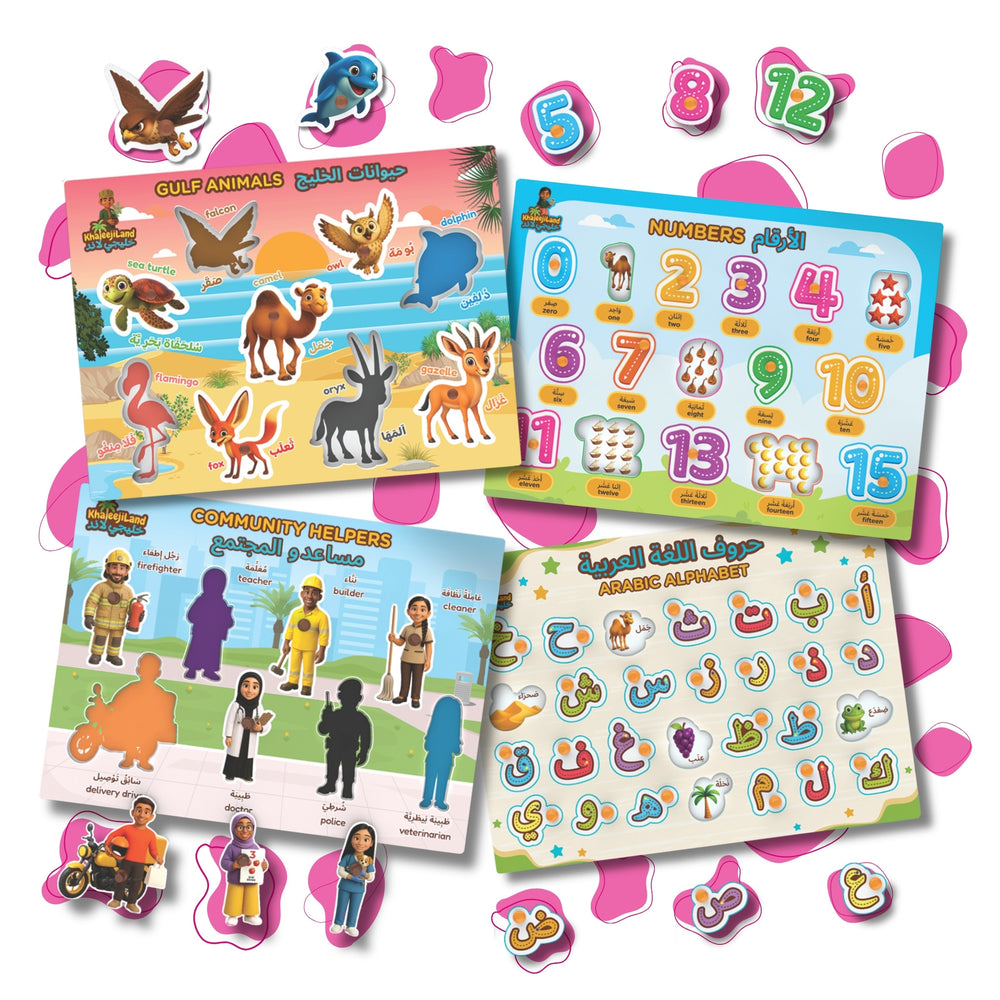
A toy with a single fixed outcome is, by design, finished once a child has done that one thing. Open-ended toys for 3- to 8-year-olds have no single right answer, so a child returns to them again and again and plays differently each time. Blocks, loose parts, simple figures, and play money all work this way: the child supplies the story, so the play changes as the child does. A puzzle sits slightly differently. The board is fixed, but the conversation around it doesn't have to be, which is why the same puzzle can be a quick sorting task one day and a naming game in two languages the next.
If you're deciding what to keep in the rotation, a quick test helps: can my child use this in more than one way, and would it look different in the hands of a younger and an older child? If yes, it will usually earn its place.
A simple toy to keep in rotation

Play money works well because children can use it in many different ways: a pretend shop, a restaurant, a ticket counter, a sorting game, or a simple counting activity. If you're using KhaleejiCash UAE, start with pretend shopping before moving into adding amounts. The point isn't to teach money formally every time. It's to give children a familiar object they can turn into play.
Does the same advice work for a 3-year-old and an 8-year-old?
Not quite. The principle is the same, but how much your child can do alone changes a lot across these ages.
For younger children, especially around ages 3 to 5, independent play may only last a short time at first. They often need an adult to help them start, name the play, and show one possible idea. Older children, around 6 to 8, can usually handle a longer challenge, such as building a shop, making tickets for a pretend journey, or creating their own puzzle rules.
Some children need more support with this transition, especially children with attention differences, language delays, anxiety, or sensory needs. For those children, “go and play” may be too open. A visual choice board, a timer, two clear options, or a first-then routine can make screen-free play feel more manageable.
How do I get my child to play without me hovering the whole time?
Start it with them, then step back. For many children, the missing ingredient isn't a better toy. It's a few minutes of an adult playing alongside them.
A child who has lost the thread of self-directed play often can't restart it cold. Joining in gives them a way back. Sit down, build the first tower, set up the shop, place a couple of puzzle pieces, and follow whatever they do next rather than steering it. A few minutes with you can be enough to get the play started. Once it has momentum, you can ease out. Move to the edge of the room, busy yourself nearby, and let them carry it. The aim isn't to entertain them the whole time. It's to help them get started, then slowly become less needed.
One afternoon a boy in my class, four years old, was drifting between the shelves touching everything and settling on nothing. His mum had told me at drop-off that mornings at home had become a fight over the tablet. I sat down on the floor near the blocks and started stacking them into a wobbly tower, not saying much. He watched, then came over and knocked it down, laughing. So we built it to knock it down again. After a few rounds I said, "I wonder if it can get taller than you," and moved back to tidy a shelf. He kept going for a good twenty minutes, measuring the tower against himself, roping in another child. I had barely done anything. I just gave the play somewhere to start.
There's also a quieter version of stepping back: resisting the urge to solve every small frustration. When a puzzle piece won't fit or a tower keeps falling, the temptation is to step in and fix it. Holding off, and instead asking “what could you try?”, is often what keeps a child in the play rather than ending it. We go deeper into this in our piece on why children learn more through trial and error, which sits closely alongside everything here.
What this looks like over a normal week
None of this needs to be a project. It's a handful of small habits: keep fewer toys out and rotate them, lean toward open-ended ones, treat boredom as a normal part of the day rather than an emergency, and start play with your child before quietly stepping back. The toys you already own are very likely enough. They just need a little room to become interesting again.
|
NOT SURE WHAT TO PUT OUT FIRST? Browse our free Activity Library. It's full of simple, no-prep screen-free play ideas using things you probably already have at home, sorted by age so you can pick something realistic for tonight. No sign-up needed. |
Frequently asked questions
At what age do children start saying they are bored?
Many children begin using words like “bored” in the preschool years, once their language and imagination are developing enough to describe that restless feeling. In younger children, “I'm bored” often means “I need help getting started,” not “I need something new.”
Is screen-free play realistic for busy working parents in the UAE?
Yes, and it doesn't require hours. The single most effective habit is a few minutes of starting play with your child, then stepping back while they continue on their own. Keeping fewer, well-chosen toys within reach also means children can begin playing without an adult setting everything up first.
How long should I wait before helping a bored child?
Longer than feels comfortable. Giving a child a few minutes to sit with “there's nothing to do” is often what prompts them to invent their own play. A calm prompt such as “what could you do about it?” usually works better than handing them an activity, because it puts the problem back in their hands.
Why does screen-free time matter so much in the early years?
The early years are a busy period for brain development, and a lot of that growth happens through hands-on, social, real-world play. Screens aren't all bad, but the American Academy of Pediatrics encourages families to make sure media isn't crowding out sleep, movement, conversation, and free play, which are where so much early learning happens (American Academy of Pediatrics, 2026).
Will my child fall behind if they play instead of using educational apps?
Not because they're playing. In the early years, hands-on play supports language, problem-solving, attention, and social interaction. Educational apps can have a place, but they shouldn't replace sleep, family time, movement, conversation, and real-world play.
|
Sara is a special educator based in the UAE, with a Master's in Special Education from Simmons University and nearly a decade in Abu Dhabi classrooms, from early years through special needs. She writes about the science of play, bilingual learning, and helping children thrive in UAE classrooms and beyond. |


