

Setting Up a Learning Corner at Home: Simple Ideas for UAE Families
A learning corner is a small, defined space at home where your child's books, activities, and a few well-chosen toys live within easy reach. You don't need a spare room or a big budget. A low shelf, a rug, and good light in a quiet part of your home are enough to give children a place they can return to, take ownership of, and learn in independently.
For many UAE families, especially those in apartments, a learning corner isn't a separate room. It's a small screen-free space in the living room, bedroom, or hallway where books, puzzles, drawing materials, and quiet activities are easy for your child to reach.
|
What you need |
Keep it simple |
|
Space |
One corner, wall, or low shelf |
|
Floor |
Small rug or foam mat |
|
Storage |
Open baskets or child-height shelf |
|
Materials |
Books, puzzle, drawing item, one open-ended toy |
|
Rule |
Fewer things out, more things stored away |
|
Rhythm |
10 to 15 minutes at the same time most days |
|
Key takeaways • A learning corner works because it's defined, child-height, and consistent, not because it's big or expensive. • Display fewer things, not more. A handful of accessible activities gets used far more than an overflowing shelf. • Let your child reach everything themselves. Independent access is what turns a corner into a habit. • Rotate materials every couple of weeks to keep the space interesting without buying anything new. • In a bilingual home, the corner is a natural place to give Arabic a visible, everyday presence. |
What is a learning corner, and why does it work?
A learning corner is a small area of your home set aside for your child to read, play, and explore on their own terms. The way the space is set up matters more than parents often realize. In early years education, the environment is treated as a real teaching tool, not just a backdrop. The Early Years Foundation Stage framework, used by many British-curriculum early years settings, treats the environment as an important part of learning. One of its four guiding principles is “enabling environments,” the idea that children learn well when spaces respond to their needs, interests, and stage of development (Department for Education, EYFS statutory framework).
You don't need to recreate a classroom. What a good learning corner borrows from one is the idea that a calm, organized, child-accessible space invites children to engage by themselves. When children come back to a space day after day, they begin to build attention, confidence, and independence.
In school settings, I often saw how quickly children responded to the way a shelf was arranged. If too many baskets were out, children would pull things down, move between activities, and lose focus. When the shelf had fewer choices at child height, with space around each activity, the same children were more likely to settle and stay with what they had chosen. The lesson carries straight home: it's rarely about having more, and almost always about how the few things you have are presented.
Where should you put it?
Choose a quiet corner that's part of family life, not hidden away. Children are far more likely to use a space they can see you near. A corner of the living room or a wall in their bedroom works well; a spare room is a bonus, not a requirement.
In many UAE homes, the most realistic learning corner is shared with family life. It may sit beside the sofa, near the dining table, or in a child's bedroom. That's fine. Children often use a space more when an adult is nearby, especially after school or during hot afternoons when outdoor play isn't practical.
Three practical points matter in UAE homes specifically. First, light. Many apartments here get strong afternoon sun, so position the corner where your child can see without squinting through glare, and away from the harshest direct light. Second, floor comfort. Tiled and marble floors are common and hard to sit on for long, so a small rug or a foam mat defines the space and makes it usable. Third, keep it away from the television. A learning corner is most valuable as a screen-free space, somewhere that offers a real alternative when your child reaches for a tablet out of habit.
One practical detail I often point out to families in the UAE is the floor. Many homes have beautiful tile or marble, but young children don't always want to sit there for long. A small rug or foam mat can make the space feel defined, comfortable, and more inviting.
What goes in it?
Less than you think. The most common mistake is putting out too much. It looks generous, but young children often use less when they're given too many choices. Aim for a small, rotating selection rather than everything you own on display.
A simple starting set: a few books facing cover-out so children can choose, two or three open-ended activities such as puzzles or building toys, a small basket for loose parts, and a clear surface to work on. That's enough. Storage should be low and open, baskets and low shelves rather than tall cupboards or lidded boxes, so your child can see what's available and reach it without help. The moment a child needs an adult to fetch every activity, the corner stops being theirs.
This isn't about creating a perfect Instagram corner. It's about making it easy for your child to choose something useful without needing you to set up a full activity every time.
For some children, especially those with sensory needs, attention differences, or anxiety, the corner may need to be even simpler. Too many colors, sounds, labels, or choices can make a space harder to use. Start with two or three familiar activities, keep the area visually calm, and build slowly.
In a bilingual home, this is also the easiest place to give Arabic a visible, everyday presence. A few Arabic books alongside English ones, or a poster of the alphabet at child height, signals that Arabic belongs in daily play rather than only in the classroom. If you're supporting Arabic at home and don't speak it confidently yourself, the corner does some of that work for you just by keeping the language in view. Our guide on how to support your child's Arabic learning at home if you don't speak Arabic yourself covers this in more depth.
How do you keep it interesting without buying more?
Rotate. This is the technique that does the most work for the least money. Instead of leaving every toy out permanently, keep most of them stored away and put out only a small selection at a time. Every week or two, swap a few items for ones your child hasn't seen in a while. Toys that had been ignored often regain their appeal for having been out of sight, and the corner feels fresh without a single new purchase.
Follow your child's interest when you rotate. If they're fixated on animals one week, bring the animal puzzles and books forward. If they've moved on to numbers, swap those in. You're not trying to cover everything at once; you're keeping the space matched to where their curiosity is right now.
Do not make it so perfect that your child feels they can't touch it. A learning corner is meant to be used, which means it'll look used. The goal is a space your child returns to willingly.
A simple shelf option

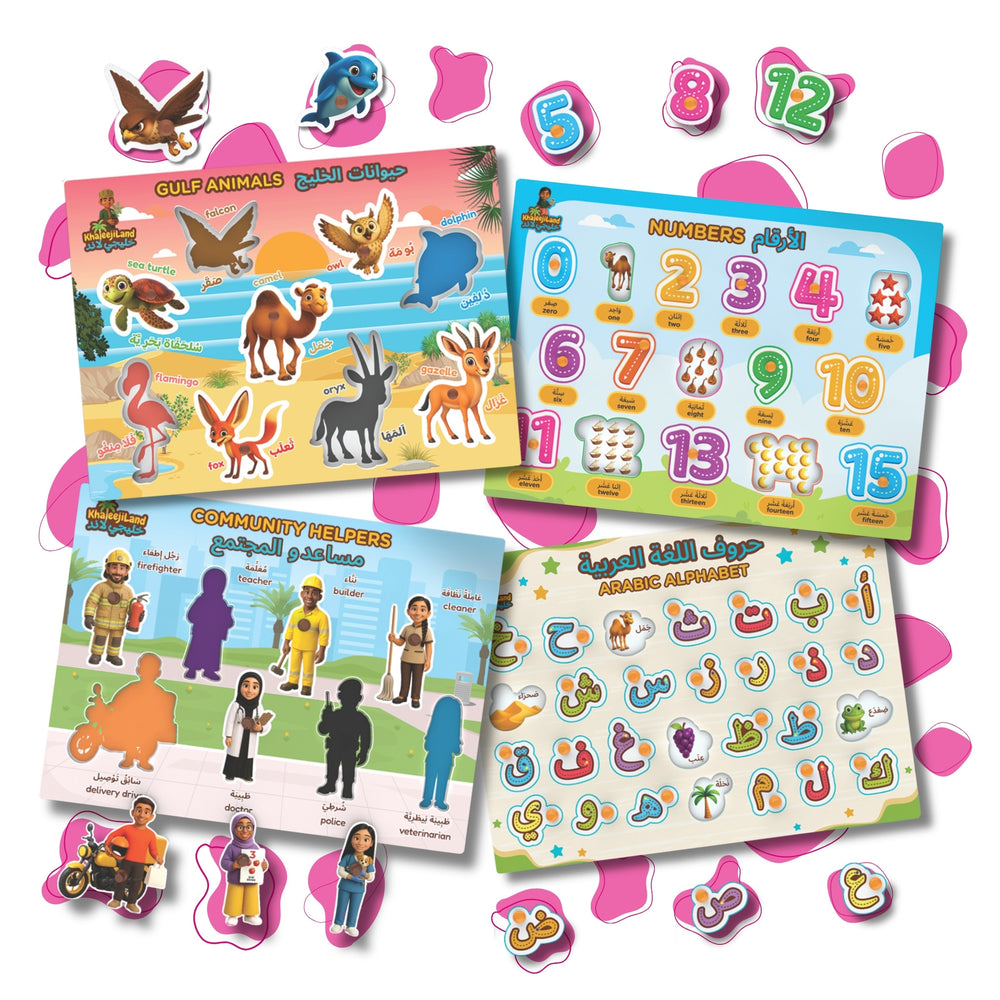
Puzzles work well in a learning corner because children can take them out, complete them, and pack them away with minimal adult help. A small rotation of peg puzzles can support fine motor control, matching, vocabulary, number recognition, and quiet focus. KhaleejiLand's bilingual wooden peg puzzles can sit naturally on a low shelf, but the key is not to display everything at once. Choose one or two, then rotate them.
How do you get your child to actually use it?
Set it up with them, not for them. Children take ownership of spaces they helped create, so let your child choose where a basket goes or which books face out. Then build a light, predictable rhythm around the corner: a regular time each day, even ten or fifteen minutes, when this is where you head. Consistency is what turns a nice-looking shelf into a real habit.
Sit nearby, especially at first. You don't need to direct the play; your presence is often enough to anchor your child in the space. Over time, as the corner becomes familiar, many children begin taking themselves there without prompting, which is exactly the independence the space is designed to build.
Frequently asked questions
At what age should I set up a learning corner for my child?
You can start a very simple version from toddler age: a few board books, one or two sturdy toys, and a soft place to sit. For toddlers, think of it as a small book-and-play spot rather than a formal learning corner. From around 3 to 6, the space can become more independent because children can choose, complete, and tidy simple activities with less help.
How much space do I need for a learning corner in an apartment?
Very little. In a UAE apartment, one low shelf, a basket, and a small rug can be enough. The corner works because it's consistent and easy to access, not because it's large.
What is the difference between a learning corner and a play area?
A play area can hold many toys. A learning corner is usually smaller and calmer, with a few activities chosen on purpose: books, puzzles, drawing, sorting, building, or Arabic and English resources.
How often should I change what is in the learning corner?
Every one to two weeks is a good rhythm for most young children. Rotate a few items at a time based on what your child is currently drawn to, rather than changing everything at once, which keeps the space familiar enough to feel like theirs while staying fresh.
|
EXPLORE MORE ACTIVITIES Looking for things to put in your corner? Browse the KhaleejiLand Activity Library for free printable activities you can rotate in alongside books and toys. |
|
Sara is a special educator based in the UAE, with a Master's in Special Education from Simmons University and nearly a decade in Abu Dhabi classrooms, from early years through special needs. She writes about the science of play, bilingual learning, and helping children thrive in UAE classrooms and beyond. |


