

From School to Home: How UAE Parents Can Extend Learning Through Everyday Play
You extend school learning at home by turning everyday moments into low-pressure play: measure and pour as you cook, count real coins at the shop, read together daily, and let your child try and fail without rescue. A few minutes woven into your normal routine reinforces what nurseries and KG classrooms teach.
|
Key takeaways • Home learning works best in small, regular, playful moments, not scheduled lessons. • Children learn by playing and exploring, staying engaged, and thinking for themselves, the habits early years educators look for. • Everyday routines (cooking, shopping, tidying, the school run) are ready-made learning opportunities. • School readiness is mostly about independence and curiosity, not drilling academics early. • Stepping back and letting children struggle a little is one of the most useful things a parent can do. |
Why does extending learning at home matter so much?
Children spend only a few hours a day at nursery or school, so most of their waking life happens at home with you. What you do in those hours, even informally, has a direct effect on how confidently your child learns. The good news is that this does not require buying a curriculum or running lessons at the kitchen table. It mostly requires noticing the learning that is already there in your daily routine.
UAE early years settings, whether they follow the EYFS framework common in British and many international schools or the Ministry of Education's national curriculum, treat parents as partners in a child's development rather than passive observers. The EYFS framework is explicit that simple activities at home such as reading, talking, playing, and exploring reinforce what children experience in their setting (Department for Education, EYFS statutory framework). When parents and teachers are aligned, children make faster, more secure progress.
At a parent-teacher conference, one mother apologised to me that she had not enrolled her daughter in any tutoring or one of the fancy maths programmes. She wanted to do what was best, she said, but between their weekly visits to the grandparents, Tuesdays volunteering together at the animal shelter, Wednesdays at the park, and Thursdays spent doing chores and the grocery shopping, she did not know where she would find the time. What she had not realised was that her daughter did not need tutoring at all. Her week was already full of rich learning, she was just not calling it that.
How do young children actually learn?
Young children learn through doing, not through being told, which is why play matters so much in the early years. Educators using the EYFS framework describe three “characteristics of effective learning” that show up whenever real learning is happening, and you can recognise all three at home.
The three characteristics are:
• Playing and exploring: a child investigates, has a go, and finds things out.
• Active learning: a child concentrates, keeps trying when something is hard, and enjoys getting it right.
• Creating and thinking critically: a child has their own ideas, makes links between things, and works out how to do something.
You do not need the terminology to use it. When your child stacks cushions to reach a shelf, that is creating and thinking critically. When they insist on doing up their own shoes even though it takes five minutes, that is active learning. The everyday ideas below all work because they give children room to do these three things.
What everyday routines can I turn into learning?
Almost any daily routine becomes a learning opportunity if you slow down and involve your child in it. You do not need new activities; you need to notice the ones you already do. Here are the routines parents in the UAE tell me work best, and what each one builds.
|
Everyday routine |
What it builds |
How to make it count |
|
Cooking and baking together |
Counting, measuring, sequencing, vocabulary |
Let them pour, count scoops, and predict what happens next |
|
Shopping and paying |
Money sense, number recognition, decision-making |
Hand over coins, compare prices, let them pay |
|
Tidying and sorting |
Categorising, matching, early maths |
Sort toys or laundry by colour, size, or type |
|
The school run or a walk |
Observation, language, curiosity |
Name what you see, ask “why do you think...?” questions |
|
Mealtimes |
Conversation, listening, turn-taking |
Talk about the day; let everyone have a turn to speak |
|
Bath and bedtime |
Language, story sense, calm focus |
Read together; talk about the pictures, not just the words |
The thread running through all of these is conversation. Talking with your child while you do ordinary things, and giving them time to answer, is the single most powerful thing you can do for their language and thinking. It costs nothing and works in any language you speak at home.
How do I support my child's Arabic if I don't speak it?
You can support your child's Arabic learning meaningfully even if you do not speak a word of it yourself, because your role is to show that the language matters, not to teach it. Many expat parents in the UAE worry about this, especially when they cannot help with Arabic homework the way they can with English.
In Dubai, Arabic provision is mandatory in all settings caring for children from birth to six, including private schools and early childhood centres, with the language treated as a first language for native speakers and an additional language for everyone else (KHDA, Policy on Arabic Language Provision in Early Childhood Education). For families who do not speak Arabic at home, that can feel intimidating. But children take their cues from you. If they see that you value Arabic, treat it as useful, and celebrate the words they bring home, they will approach it with confidence rather than dread.
A few things that help:
• Ask your child to teach you the Arabic words they learned today. Flipping the roles cements their learning and shows you value it.
• Label a few household objects in Arabic together.
• Point out Arabic on signs, packaging, and number plates when you are out and about.
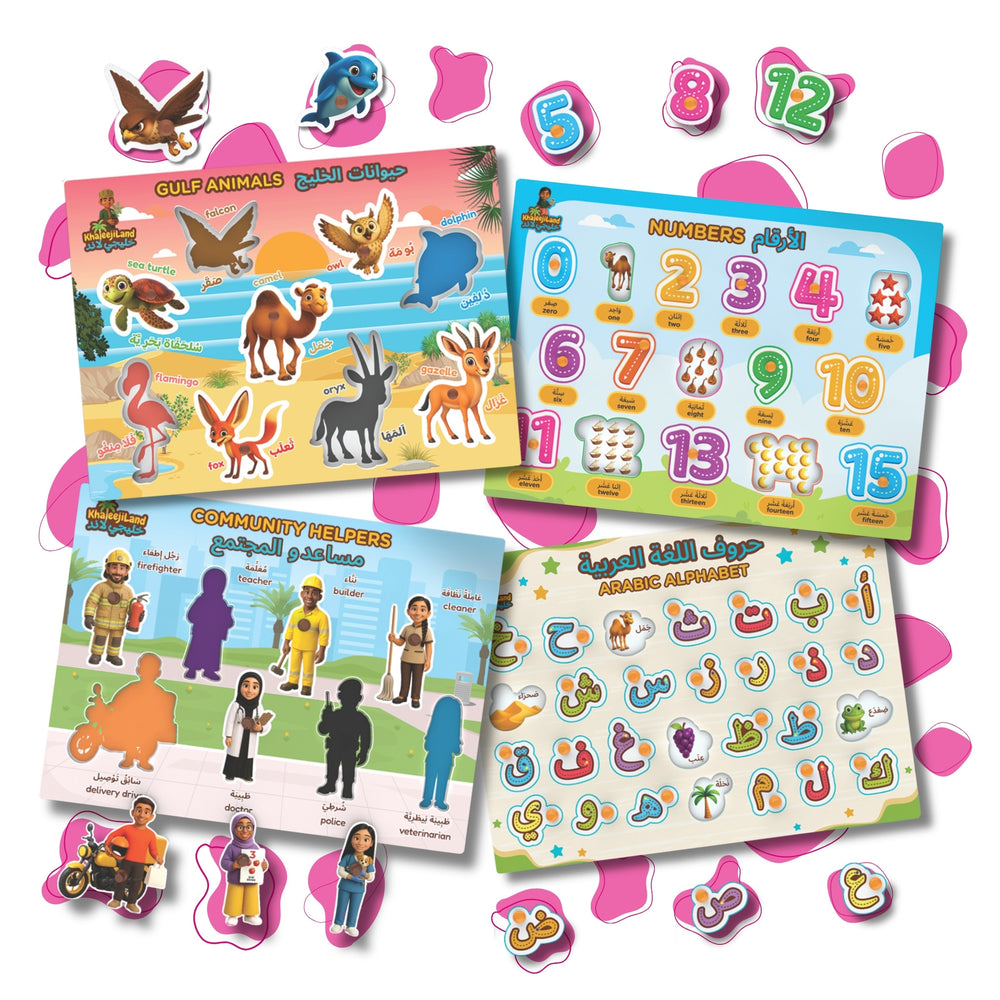
• Let bilingual toys, songs, and stories do some of the work.
You are not the Arabic teacher. You are the person who makes Arabic feel welcome at home. For a fuller treatment, see how to support your child's Arabic learning at home if you don't speak Arabic yourself.
BRING IT HOME
Hands-on tools make abstract concepts concrete. A set of UAE-themed play money lets children handle, sort, and “spend” Dirhams and Fils the way they will in real life, turning a trip to the shop into a maths lesson they enjoy. See the KhaleejiCash UAE Learning Money Set. |

When should I start preparing my child for KG, and how?
You can start preparing your child for kindergarten from toddlerhood, but “preparing” means building independence and curiosity, not necessarily drilling academic skills. Schools in the UAE are not expecting children to arrive reading and writing. They are looking for children who can manage themselves, follow simple instructions, and want to find things out. The Ministry of Education's own Kindergarten Parent Guide describes the KG day as built on learning through play, exploration, and interactive experiences, and offers parents guidance on supporting that learning at home.
The UAE structures early schooling into kindergarten (KG1 and KG2) followed by Cycle 1 from Grade 1. Before KG, the most useful things you can help your child develop are practical and social:
• Using the toilet independently
• Putting on their own shoes and bag
• Separating from you calmly
• Sharing and taking turns
• Sitting to listen to a short story
• Speaking up to ask for what they need
• Responding to and recognising their own name
That last one matters more than parents expect. A surprising number of children start school not recognising their own name, simply because the family uses a nickname at home, so do use your child's given name sometimes too. Together, these are the foundations that let academic learning take hold once school begins.
Where you do touch on early academics, keep it playful and embedded in real life: counting steps as you climb them, spotting the first letter of their name on a sign, talking about more and fewer at snack time. A child who has counted real things in real situations understands numbers far more deeply than one who has only recited them. For more on this stage, see school readiness in the UAE: what children need to know before starting KG.
Why should I let my child struggle instead of helping?
Letting your child struggle with something just within their reach is one of the most valuable things you can do, because the effort of working it out is where the learning actually happens. Rescuing too quickly, however kindly meant, takes that learning away.
I understand the instinct completely; it is hard to watch your child struggle and not step in. But when you do up the zip, finish the puzzle, or supply the answer, your child learns that difficulty is a signal to wait for an adult, not a problem they can solve. When you hold back, offer a hint rather than the solution, and let them get there themselves, they learn persistence and they experience the genuine satisfaction of having done it independently. Praise the effort and the strategy (“you kept trying different pieces until one fit”) rather than the result.
I see this often in special education. Many children with additional needs have one-to-one support, and well-meaning learning support assistants sometimes do everything for the child, not realising where help stops and hindrance begins. The result is what we call prompt dependence: the child looks as though he cannot do something himself, when in fact he has simply learned to wait for an adult to do it. With a little training, the assistants I have worked with quickly learn when to pause and give the child a chance to respond on his own. Over time the prompt dependence fades and the child grows genuinely more confident doing things independently. The same principle applies at home: the pause is where the learning happens.
You can read more about this in our learning blog: resist the rescue: why children learn more through trial and error.
What if my child finds every toy boring?
When children seem bored with their toys, it usually means the play has become passive, not that they need more toys. The fix is rarely a new purchase. More often it is a different kind of engagement, and the right kind of toy. Rotating what you already have, joining in, and offering open-ended toys that can be used in more than one way will revive interest faster than a shelf of new things that each do only one thing.
Try rotating toys so only some are available at a time, which makes the rest feel new again when they reappear. Offer open-ended items that spark imagination: a cardboard box, wooden blocks, some cushions, things that can become anything rather than items that do only one thing. Join in whenever you can, too. A parent who plays alongside, even for ten minutes, transforms how absorbing an activity feels.
If screens have become the default, expect a short adjustment period. Children who are used to constant stimulation often complain of boredom at first, and that is normal; they are relearning how to entertain themselves, and it passes. The harder discipline is on us as parents: resist the urge to fill every quiet moment for them. Boredom is uncomfortable, but it is often the doorway to imagination, and a child left to their own devices for a while will usually find something to do. For practical ideas, check out when every toy feels boring: helping children rediscover screen-free play.
How do I set up our home so learning happens naturally?
You set up a home for learning by making a few good materials easy to reach and keeping the environment calm and uncluttered. You do not need to build a classroom. Children engage best when they can access things independently, in a predictable and structured way, and when there are not so many options on offer that they tip into choice-overload and cannot settle on anything.
A simple, low shelf with a handful of well-chosen activities that your child can take out and put away themselves encourages independence and focus. Keep most toys stored and rotate them in. Make a cosy, comfortable spot for reading together. And accept that learning is messy: a child who is allowed to pour, build, sort, and make a reasonable amount of mess is a child who is learning. The aim is not a picture-perfect playroom but a space where your child feels free to explore. For a step-by-step approach, see setting up a learning corner at home: simple ideas for UAE families.
Frequently asked questions
How much time should I spend on learning activities at home each day?
There is no fixed amount, and you do not need to set aside dedicated “learning time” at all. This is good news for busy parents: weaving short moments of talk, counting, and reading into the day you already have works better than a scheduled session your child comes to dread. Ten focused minutes of reading together at bedtime is worth more than an hour of reluctant drilling.
Is screen time always bad for young children's learning?
Not all screen time is equal, but for young children, time spent playing, talking, and exploring in the real world builds language and thinking in ways screens cannot replace. The concern is mainly that screens displace those richer experiences. If screens are used, keeping them limited and choosing slower, interactive content is better than fast, passive viewing.
What are good screen-free activities for a 4-year-old at home?
Some of the best activities are the ordinary ones: cooking together, sorting laundry by colour, building with blocks or boxes, puzzles, drawing, and helping with simple chores. At four, children are learning through doing, so anything hands-on that lets them pour, build, match, or pretend is doing real work. The aim is not to keep them busy but to let them explore, so leave room for unstructured play rather than scheduling every minute.
Do educational toys actually help, or is it just marketing?
A well-designed toy can genuinely support specific skills, but a toy alone does not teach a child; the interaction around it does. The most useful toys are open-ended or hands-on and invite a child to do, sort, build, or solve rather than just watch. What matters most is that an adult or another child engages with the child during play.
|
Sara is a special educator based in the UAE, with a Master of Education in Special Education from Simmons University and nearly a decade in Abu Dhabi classrooms, from early years through special needs. She writes about the science of play, bilingual learning, and helping children thrive in UAE classrooms and beyond. Read more from Sara. |


