

More than Words: How Visuals Support Bilingual Learning
Visual supports are pictures, symbols, gestures, and real objects paired with words to make meaning clearer. For bilingual children, one picture can give Arabic and English a shared anchor. A child can connect “apple” and “تُفّاحة” (tuffāḥah) to the same object or image, instead of relying only on translation.
|
Key takeaways • A picture gives both languages something concrete to attach to, so a child can build meaning directly instead of translating. • Pairing a clear word with a clear image is well supported by research on how we learn from words and pictures together. • Visual supports help many children, not only those with additional needs, and they're especially handy when a parent and child don't yet share a confident first language. • You don't need special software. Real objects, photos, and simple labels around the home do most of the work. • Keep visuals clear and uncluttered. One word, one image, one idea works better than a busy page. |
What are visual supports, and why do they help bilingual children?
A visual support is anything you can see that carries meaning alongside a word: a photograph, a drawing, a symbol, a gesture, or the real object itself. We already use them all day: the lift button, the toilet sign at the mall, the picture on a cereal box, the photo on a toy basket. None of these need translating. That's why they matter so much for a child learning two languages at once.
When a child is monolingual, a new word attaches to a meaning they may already hold. When a child is bilingual, they're often building two labels for one idea. If the only route to the Arabic word runs through the English one, the child is doing two jobs: remembering the word, and translating it. A picture can reduce that middle step. The image holds the meaning, and both “duck” and “بَطّة” (Batta) can attach to it directly. Over time, the child can begin linking each language directly to the object or idea. For parents using Arabic and English at home, visual supports can make new vocabulary easier to see, hear, repeat, and use.
This is also why visuals help in homes where the parent and child don't yet share a first language with confidence. A parent who is still building their own Arabic can point to a picture or object, say the word, and learn alongside the child. The image supports the meaning while the adult models the word.
What does the research say about pairing words with pictures?
The idea that pictures strengthen learning is not new or unproven. Research on multimedia learning supports the idea that words and pictures can work better together than words alone, especially when the image and word are clearly connected and the page is not cluttered. A word you only hear leaves one trace. A word you hear and also see a picture of leaves two, and the two can reinforce each other. For parents, the practical takeaway is simple: pair one clear image or object with one useful word, then use it in real interaction.
This does not mean every picture helps. Decorative or cluttered visuals can distract. The useful visual is the one that clearly supports the word or idea being taught.
Guidance for young dual language learners often recommends using concrete cues such as pictures, gestures, objects, and familiar materials alongside language. For a home setting, that means visuals should support real interaction, not replace it. (National Academies, Promoting the Educational Success of Children and Youth Learning English)
When I worked with children in Abu Dhabi schools, I used pictures constantly because they helped children join in before they had all the words. If we were learning food words, a clear photo of an apple or cup gave everyone the same starting point. Some children named it in English first, some in Arabic, and some just pointed. The picture helped us begin from shared meaning.
Do visual supports only help children with additional needs?
Much of the best-known visual-support software comes from the special education and communication world, and that can give the impression these tools are only for children who are struggling. They're not.
Many families first hear about visual supports through special education, speech and language therapy, or autism support. They're essential for some children, but the basic idea is useful much more widely. Many children remember new words more easily when the word is paired with a clear image, object, gesture, or action, and any child learning two languages benefits from an anchor that doesn't belong to either language. A visual timetable helps an autistic child understand what happens next; it also helps a three-year-old who simply finds the morning easier when they can see what happens next. The tool is the same. The need is shared more widely than people assume.
What special education got right, and got right early, is the discipline of keeping a visual clear. One idea per image. No clutter. A clean picture a child can read at a glance. That discipline is what makes a visual support work for any learner, in any language.
What tools can parents and educators use to make visual supports?
You can do a great deal with nothing but the things already in your home, and I'd always start there before buying anything. Real objects, family photos, and a few hand-drawn or printed labels stuck to the fridge, the toy box, and the bedroom door will teach more than any app, because the child meets them in real life all day long.
Schools and therapists may use symbol tools such as Widgit, InPrint, or Boardmaker. They can be useful, but most families don't need paid software to start. At home, real photos and simple labels are usually enough. If you'd like something printed and consistent, free tools such as ConnectABILITY, a Canadian non-profit, and Canva, which has a large free tier, let any parent lay out a clean card with a clear image and a single word in both scripts. Some of the tools used in schools and therapy settings are also available to families.
For Arabic labels, keep the script large, clear, and properly proofread. Avoid decorative fonts for early learners, because children need to see the letter shapes clearly.
The most important point is not which tool you choose. It's the principle behind all of them: one clear image, one word, presented together, often enough that the child meets it naturally. A printed photo taped to the toy shelf follows that principle. So does a paid school software tool. Start with what you have.
How do I use visual supports well at home?
A few simple habits make the difference between visuals that work and visuals that become wallpaper:
• Label the real world. Put a card with a picture and both words on the things the child uses daily: the door (باب bāb), the cup (كوب Kūb), the bed (سرير sareer). Daily contact is what makes vocabulary stick.
• Keep it to one idea. One word, one image, one card. A busy page split across many pictures asks the child to work out where to look before they can learn anything.
• Pair the picture with the object and the word together. Hold the apple, show the picture, say the word in both languages. The three together are stronger than any one alone.
• Let the picture carry the meaning, not the translation. Point to the image and name it in each language separately. Avoid “apple means تُفّاحة.” You want each word linked to the apple, not to the other word.
• Rotate them. When a set of labels has been mastered and the child no longer looks at them, swap in new ones. Visuals do their job and then step aside.
Here is a quick reference for the kinds of visual support you can use and how to put each one to work:
|
Visual support |
Example |
How to use it |
|
Real object |
Cup, apple, shoe |
Hold it, name it in Arabic and English, then use it naturally |
|
Photo |
Child's bed or toy box |
Add a simple label and point to it during the routine |
|
Picture card |
Animal, food, clothing |
Use one card at a time for naming, matching, or sorting |
|
Visual routine |
Morning or bedtime steps |
Point to each step as your child completes it |
|
Puzzle or matching game |
Animal or letter puzzle |
Name the piece while your child touches and places it |
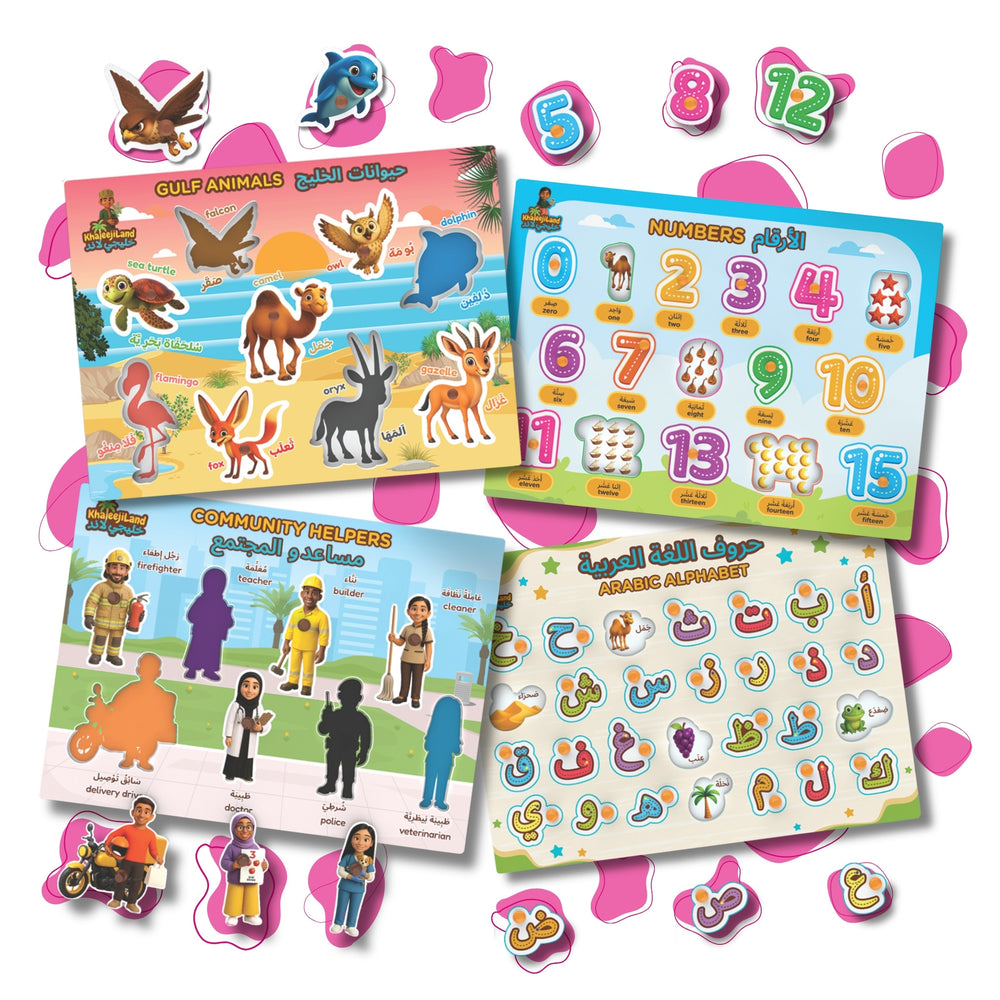
FROM THE KHALEEJILAND SHOPA bilingual puzzle can work as a simple visual support because the child can see, touch, name, and match at the same time. The Gulf Animals Wooden Peg Puzzle pairs each animal with its Arabic and English name, giving you an easy reason to talk about the words during play. |

Frequently asked questions
At what age should I start using visual supports with my child?
You can start in the toddler years, once your child is noticing pictures, objects, and simple labels. For babies, real objects, songs, gestures, and repeated words are more useful than formal picture cards. There's no upper limit either: visuals stay helpful through the early school years and any time a child is learning new vocabulary in a second language.
Will using pictures slow down my child's reading or make them rely on images?
Pictures don't need to replace words. Used well, they help children understand the meaning first, then connect that meaning to the spoken and written word. Visuals are naturally rotated out as a child masters each set, so the picture stays a bridge to the word rather than a substitute for it.
Do I need to buy special software to make visual supports at home?
No. Real objects, family photos, and simple printed or hand-drawn labels do most of the work, because the child meets them in everyday life. Free tools such as Connectability and Canva let you make clean picture cards at no cost if you prefer something printed and consistent.
My child mixes Arabic and English in the same sentence. Do visual supports help with that?
Mixing languages is a normal and healthy part of growing up bilingual, not a problem to fix. Visual supports can gently strengthen vocabulary in whichever language is used less, by giving the child more practice with the words they reach for less often, without making either language feel like a correction.
|
Sara is a special educator based in the UAE, with a Master's in Special Education from Simmons University and nearly a decade in Abu Dhabi classrooms, from early years through special needs. She writes about the science of play, bilingual learning, and helping children thrive in UAE classrooms and beyond. |


