

Screen-Free Arabic Learning at Home: Simple Ideas that Actually Work
A simple screen-free way to build Arabic at home is to weave it into daily routines through talk, play, songs, books, and hands-on activities instead of formal lessons. Short, frequent moments work better than long sessions for most young children. Name objects, read together, sing, and use toys or real objects to prompt Arabic words in context.
|
Key takeaways • Little and often beats long lessons: a few minutes of Arabic woven through the day builds more than one weekly sitting. • Young children need responsive interaction for language growth; passive viewing should not be the main Arabic-learning strategy. • You don't need to be a fluent Arabic speaker to support your child's Arabic at home. • Physical, hands-on materials give children a reason to use Arabic words in real context. • Consistency and a relaxed, low-pressure tone matter more than getting every word perfect. |
Why screen-free Arabic activities matter at this age
Young children usually learn language best through responsive, back-and-forth interaction with the people around them. A screen can support exposure in some families, but passive viewing is not a substitute for shared talk, play, books, and songs. A device can show an Arabic cartoon, but it can't notice what your child is looking at and name it for them in the moment.
This is also where the health guidance lands. The World Health Organization recommends no sedentary screen time for 1-year-olds, and no more than one hour a day for children aged two to four, with less being better. It also points caregivers toward reading, storytelling, and play instead (WHO guidelines on physical activity, sedentary behaviour and sleep for under-5s). For Arabic at home, that gives parents a useful direction: the same kinds of activities recommended for young children, reading, storytelling, movement, play, and caregiver interaction, are also strong opportunities for language exposure.
In the classrooms I worked in, I often noticed that the children who were most willing to try Arabic weren't always the ones who knew the most words. They were the ones who had heard Arabic in relaxed, everyday moments before. A greeting, a song, a familiar object, a word from home: those small moments made the language feel less intimidating.
Build Arabic into routines you already have
You don't need to carve out a new slot in a busy week. A practical approach is to attach Arabic to things that happen anyway: getting dressed, setting the table, the drive to nursery, bath time, tidying up. These moments repeat daily, which is exactly the kind of repetition young children need.
Pick two or three routines to start, and keep the same few Arabic words attached to each one. At breakfast you might name the foods. While tidying, you might count the toys going back in the box. The point is not to translate everything, but to make Arabic a normal, expected part of the moment. A child who hears the same handful of words in the same context every day is more likely to understand them, remember them, and eventually try using them.
Here is a simple starting grid you can adapt to your own day:
|
Routine |
Arabic idea |
Keep it screen-free by |
|
Breakfast |
Name one food or drink |
Repeating the same word daily |
|
Getting dressed |
Name colors or clothing |
Letting the child choose and say it |
|
Car ride |
Sing one Arabic song |
Repeating a short rhyme |
|
Tidying up |
Count toys in Arabic |
Turning clean-up into a game |
|
Story time |
Name pictures in Arabic |
Letting the child point and choose |
Read together every day if you can
Shared reading is one of the most powerful things you can do for any language. With Arabic, a few minutes of reading a day gives your child exposure to vocabulary and sentence patterns they won't always hear in conversation. Board books with clear pictures work well for toddlers, because you can point, name, and let your child point back.
You don't have to read every word as written. With younger children, talk about the pictures, name what you see, and let them turn the pages. Ask simple questions and leave a pause for them to fill in. The interaction around the book matters as much as the text itself.
For non-Arabic-speaking parents, dual-language books can help. You can talk about the pictures in English, repeat one Arabic word, or let a teacher-recommended pronunciation guide you. The aim is shared attention, not perfect reading.
I often suggested that families keep Arabic books where children could actually reach them. A few board books in a basket, rotated every week or two, usually worked better than a full shelf that looked beautiful but was never touched.
Sing, rhyme, and play with sound
Songs and rhymes are a gift for language learning. The rhythm, repetition, and tune make words easier to join in with, even before a child fully understands them. Simple Arabic nursery songs, counting rhymes, and call-and-response games all build the sound patterns of the language in a way that feels like play, not study.
Action songs are especially useful, because the movement gives meaning to the words. When a child does the action while singing the word, they're connecting sound to meaning physically, which helps it stick. Sing in the car, in the bath, while walking. None of this requires a screen, a worksheet, or a quiet room.
Use physical toys and objects as language prompts
Hands-on toys give children a concrete reason to use Arabic words. When a child is holding an object, sorting it, or fitting it into place, naming it in Arabic happens in context, which helps the word stick. The object is not the lesson. The adult-child interaction around the object is where the language happens.
Everyday objects work perfectly. Name the fruit while you cook, the animals in a picture, the colors of the blocks. You can also use the Arabic that is already around you in the UAE: point out Arabic on signs, lift buttons, supermarket labels, and school bags, and let your child spot letters they recognize.

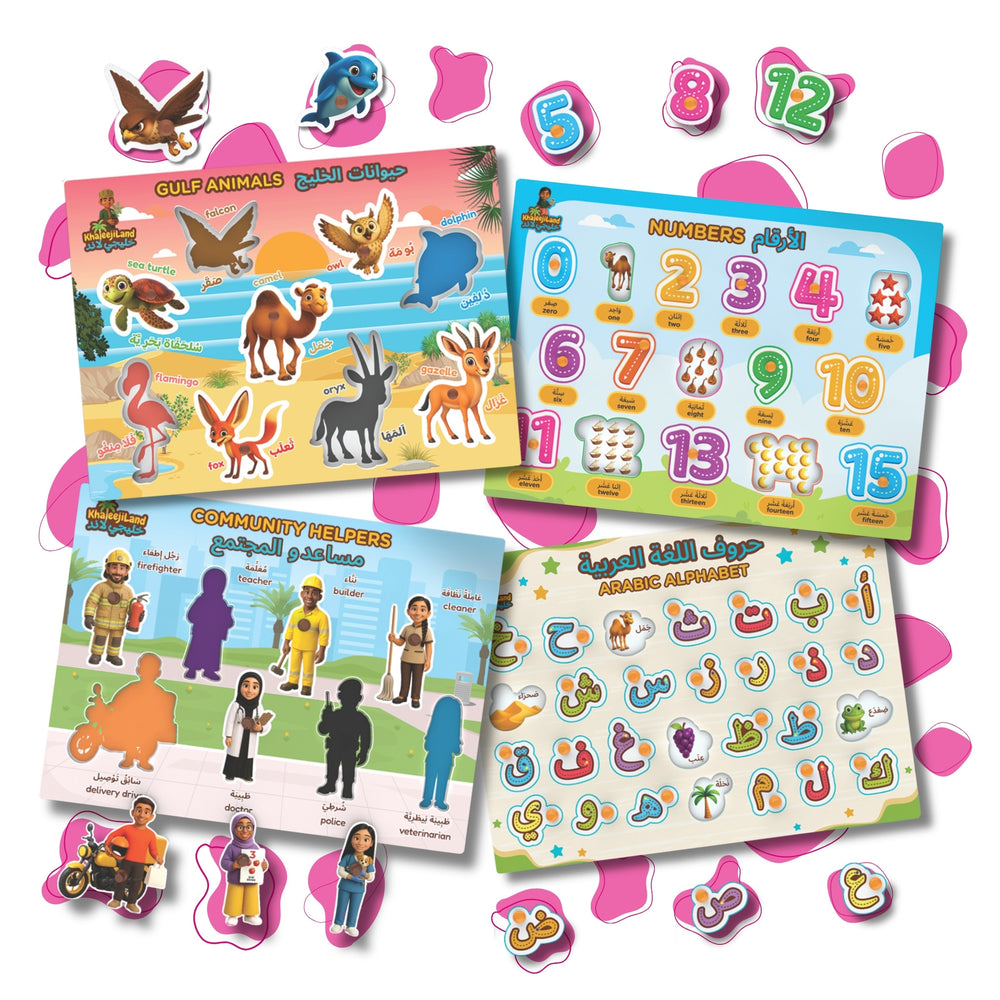
A puzzle can help because it gives you something concrete to talk about. For example, with KhaleejiLand's bilingual Gulf Animals wooden peg puzzle, your child can place the animal, hear the Arabic and English words, and talk about what they notice. The puzzle is the prompt; the conversation is the learning. For early letter recognition, our Arabic Alphabet wooden peg puzzle works the same way, giving you an easy reason to name letters and sounds together.
You don't need to be fluent yourself
Many parents in the UAE worry that they can't support Arabic at home because they aren't confident speakers themselves. You can, and even small efforts can help. Learning a few words alongside your child sends a powerful message: that Arabic matters and that learning is something you do together.
Start with the words attached to your chosen routines and build slowly. Let your child hear you trying, getting things wrong, and trying again. Children who see a parent learning are more relaxed about their own mistakes. If you'd like a fuller approach to this, we cover it in depth in how to support your child's Arabic learning at home if you don't speak Arabic yourself.
Which Arabic should we use at home?
For most UAE families, the answer is simple: use the Arabic you can use consistently. If your child is learning Modern Standard Arabic at school, books, songs, alphabet puzzles, and simple first words can support that. If your family speaks Emirati, Levantine, Egyptian, Gulf Arabic, or another dialect at home, that also has value. Young children benefit from hearing Arabic used naturally, and it doesn't need to sound like a school lesson.
If your child has additional needs
If your child has speech, language, attention, sensory, or learning needs, keep Arabic exposure low-pressure and predictable. Use the same few words in the same routines, watch for frustration, and coordinate with your child's teacher, SENCO, speech and language therapist, or other relevant professional if Arabic is becoming a source of stress. The goal is for Arabic to be something your child meets calmly and often, not something that adds pressure to the day.
A quick word on Arabic in UAE schools
If your child is in or heading to a UAE private school, Arabic is likely to be part of their school life, but the exact requirements depend on the emirate, regulator, curriculum, age group, and whether your child is treated as a native or non-native Arabic learner (UAE Government portal on curricula and language of instruction). In Dubai, KHDA has introduced Arabic provision for children from birth to six, with rollout phased by age group across KHDA-licensed early childhood settings and private schools. At home, your role is not to recreate school Arabic. It's to make Arabic feel familiar, useful, and positive outside the classroom.
Keep it small, keep it familiar
The families who make Arabic feel normal at home are rarely the ones doing the most. They're the ones doing a little, consistently, in a relaxed way. Five minutes of singing, one shared book, a few named objects at dinner: repeated daily, this adds up to far more than an hour-long session once a week that everyone dreads.
If a particular activity isn't landing, drop it and try another. The goal is for Arabic to be part of family life, something you use rather than something you test. Children notice whether Arabic feels tense, fun, rushed, or relaxed. Make it light, make it regular, and let it grow.
Frequently asked questions
How do I teach Arabic at home without screens?
Weave it into daily routines through talk, shared books, songs, and hands-on play rather than formal lessons. Keep the same few Arabic words attached to the same moments, like breakfast or tidy-up time, so your child hears them often and in context. Short, frequent exposure works better than long sessions at this age.
At what age should I start Arabic with my child at home?
You can start gentle exposure from birth through songs, talk, stories, and hearing Arabic around the home. This doesn't mean lessons for babies; it simply means letting Arabic be something your child hears naturally at home. Babies tune into the sounds of language long before they speak.
Will learning Arabic at home confuse my child if we also speak another language?
Bilingual exposure does not, by itself, cause language delay. Mixing languages is also common in bilingual development and is not usually a sign of confusion. Young children are very capable of learning more than one language at once.
What if I don't speak Arabic well myself?
You can still support your child's Arabic meaningfully. Learn a few words alongside them, lean on songs and dual-language books, and let them see you trying. Your involvement and encouragement matter more than perfect pronunciation.
|
Sara is a special educator based in the UAE, with a Master's in Special Education from Simmons University and nearly a decade in Abu Dhabi classrooms, from early years through special needs. She writes about the science of play, bilingual learning, and helping children thrive in UAE classrooms and beyond. |


