

How Bilingual Children Learn: What the Research Says for UAE Families
Bilingual children can learn Arabic and English without becoming confused, and bilingualism itself does not cause language delay. What parents often notice, such as mixing languages, understanding one language but replying in another, or having uneven vocabulary across Arabic and English, can be part of normal bilingual development. The key is to look at your child's communication across both languages, not just one.
|
Key takeaways • Bilingualism itself does not cause language delay, but bilingual children may show uneven strengths across their two languages depending on exposure, use, and context. • Mixing Arabic and English in one sentence is usually part of normal bilingual development, not a sign of confusion. • To understand a bilingual child's vocabulary more fairly, look across both languages rather than judging only one in isolation. • Children need consistent, interactive exposure to each language; passive screen time should not be treated as a substitute for real interaction. • Most children in the UAE grow up with structured exposure to both Arabic and English, which is an advantage worth supporting. |
Do children get confused learning two languages at once?
Research does not support the idea that hearing two languages automatically confuses children. Bilingual children aren't using a separate or unusual learning system. Babies can be sensitive to differences in language sounds and rhythms well before they say a first word, and bilingual infants develop their two languages as distinct systems through their first year. The review by Byers-Heinlein and Lew-Williams, Bilingualism in the Early Years: What the Science Says, is a clear, parent-facing summary of this evidence.
The worry that two languages “compete” and slow a child down comes from an older, intuitive idea that the brain has limited room for language. That isn't how it works. A bilingual child isn't splitting one capacity in half. They are building two languages, and what they learn in one can often support the other.
I often saw parents worry when their child used Arabic and English in the same sentence. In the classroom, that mixing didn't automatically tell me a child was struggling. I paid more attention to whether the child understood, joined in, communicated their needs, and kept building language over time.
Do bilingual children talk late, and does bilingualism cause speech delay?
This is the worry I take most seriously, because it's where parents are most likely to either panic or, occasionally, miss a real need. Here's the honest answer. Bilingualism itself does not cause speech or language delay, but bilingual children may not look exactly like monolingual children if you measure only one language. The American Speech-Language-Hearing Association states clearly that being multilingual is not a cause of speech or language disorders, while noting that a child's languages can differ in dominance and that assessment should consider all the languages a child uses (ASHA, Spoken Language Disorders).
The real point is what you measure. If you count only a bilingual child's English words against a monolingual English speaker's, the bilingual child can look behind. But that's the wrong comparison. A bilingual child is learning two labels for many things and splitting their exposure across two languages. Research with Spanish-English bilingual toddlers found that bilingual children can look behind if only one language is counted, but their vocabulary looks much more comparable when words across both languages are considered (Core, Hoff, Rumiche & Señor, 2013).
So before you panic that your child's English vocabulary at three looks smaller than the neighbor's, add up what they know in Arabic and English together. That total is the more honest measure of how their language is developing.
|
Parent worry |
What research suggests |
What to do at home |
|
“My child mixes Arabic and English.” |
Mixing can be a normal part of bilingual development. |
Model the missing word gently. |
|
“My child understands Arabic but replies in English.” |
Understanding can be stronger than spoken use. |
Create real reasons to answer in Arabic. |
|
“Their English vocabulary seems smaller.” |
Counting across both languages gives a fairer picture. |
Track Arabic and English together. |
|
“They seem to be talking later.” |
Bilingual exposure by itself is not a cause of a disorder; look at the whole picture. |
Check milestones across both languages, and seek advice if other signs are present. |
Why does my child mix Arabic and English in one sentence?
Usually because they're drawing on both languages they know. Mixing two languages within a sentence or conversation is called code-switching, and research on bilingual children's language use has described it as a patterned feature of bilingual development rather than random confusion. Children often mix more with people who understand both languages, and they may borrow from the language that comes more easily in that moment.
When your child says a sentence that starts in Arabic and finishes in English, they're choosing from two languages they know and combining them in a way that still makes sense. Adult bilinguals across the world, including most bilingual adults here in the UAE, do the same thing in relaxed conversation.
There's one practical caveat. Young children sometimes borrow a word from their stronger language because they haven't yet learned it in the other one. That's a gap to fill with exposure, not a mistake to correct. If your child reaches for the English word for “lion” because they don't yet know أسد, the answer is more Arabic input.
What about Modern Standard Arabic and spoken Arabic?
In many UAE schools, children meet Modern Standard Arabic through books, songs, letters, and formal learning. At home, they may hear Emirati Arabic, Gulf Arabic, Levantine Arabic, Egyptian Arabic, or another spoken variety. That isn't a problem. For young children, hearing Arabic used naturally by real people is valuable. School Arabic and home Arabic don't need to be identical for both to support your child's relationship with the language.
Does one language come at the expense of the other?
The two languages develop largely on their own, but they aren't sealed off from each other. Skills transfer between them. A child who learns that print carries meaning, that stories have a beginning and an end, or that you can sound a word out doesn't learn those things twice. Once the underlying concept is in place in one language, it's available to the other. This idea of skills transferring across a bilingual child's languages comes from Cummins' work on linguistic interdependence and a common underlying proficiency (Cummins, 1979, Linguistic Interdependence and the Educational Development of Bilingual Children).
For an Arabic-English family, this means time spent building your child's Arabic isn't time taken from their English. A strong home language can support wider communication, confidence, and later learning; it does not need to be sacrificed for English.
What do bilingual children actually need to learn both languages well?
Two things, repeated consistently: enough exposure to each language, and that exposure delivered through real interaction.
Exposure is the input a child gets in a language: hearing it, being spoken to in it, having books read in it. Children need a meaningful share of their waking input in each language they're expected to learn. A language a child hears for only a few hours a week, with no one expecting them to respond in it, tends to become a language they understand but don't speak. Hoff and colleagues' research links the amount and quality of exposure in each language to children's outcomes in that language (Hoff et al., 2012, Dual Language Exposure and Early Bilingual Development).
Interaction is the part parents underestimate. Language is learned through back-and-forth exchange with people. Kuhl and colleagues found that infants learned new speech sounds from a live person, but not from the same content delivered by audio or video alone (Kuhl, Tsao & Liu, 2003, PNAS). That study is about young infants and a specific learning task, so the honest takeaway isn't that screens teach nothing. It's that passive screen time should not be treated as a substitute for real interaction. An Arabic cartoon playing in the background isn't the same as a person speaking Arabic to your child and waiting for them to answer.
The families I saw build the most consistent Arabic habits weren't always the ones with the most resources. They were the ones who chose simple routines and kept them going: Arabic words at the dinner table, English bedtime stories, or one relative who mostly used Arabic with the children. Consistency was easier to sustain than intense bursts that disappeared after a week.

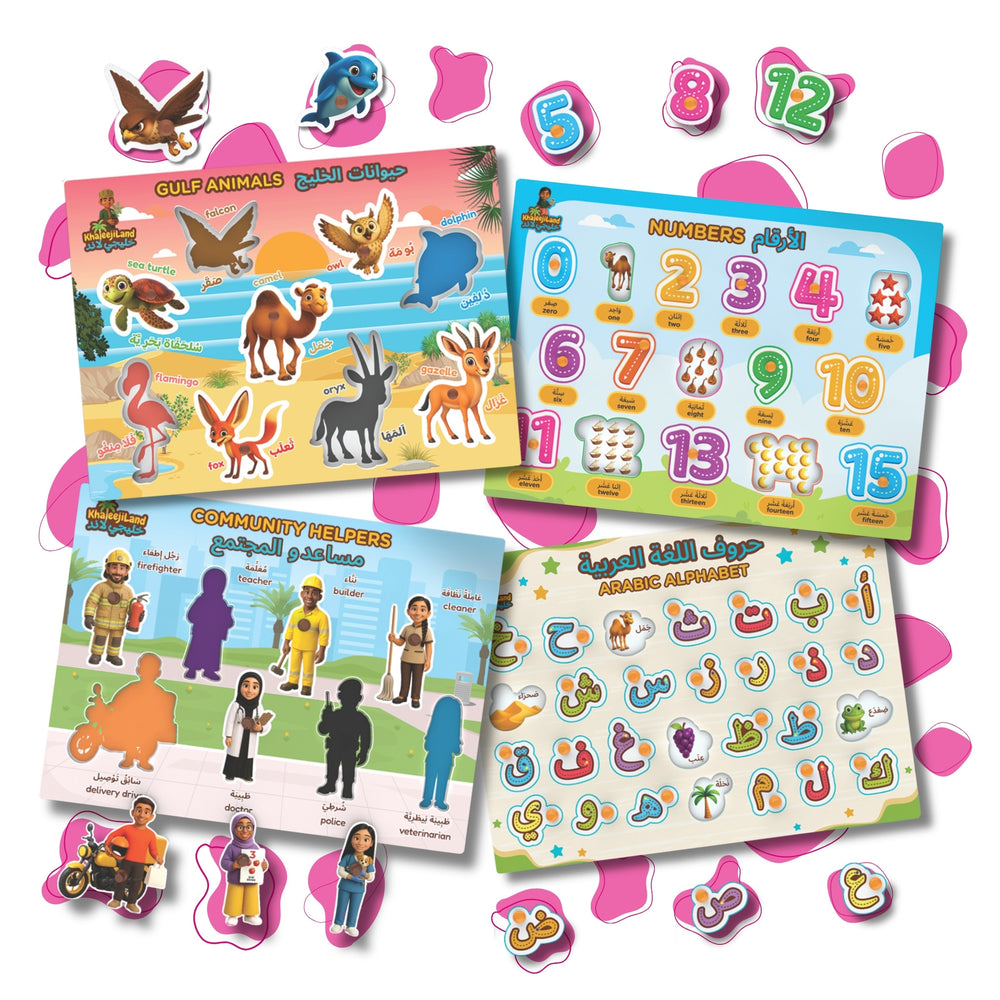
This is where hands-on, screen-free play can help. A puzzle, matching game, pretend shop, or set of picture cards gives your child something to touch, name, sort, and talk about. If you use a KhaleejiLand bilingual puzzle, like our Gulf Animals Puzzle, the toy isn't the “teacher.” It's the prompt for the conversation between you and your child.
When should parents seek support?
Mixing languages is usually not a concern on its own. But if your child isn't communicating as expected across both languages, has lost words they used to use, rarely responds to people, struggles to understand simple everyday instructions, or you just feel something isn't right, speak to your child's teacher, pediatrician, or a speech and language therapist. Bilingualism isn't the cause of a language disorder, but bilingual children can still have language needs, and those needs show up across both of their languages, not just one.
What does this mean for families in the UAE specifically?
Many children in the UAE have regular access to both Arabic and English, especially through school and community life, but they still need meaningful chances to use each language.
In UAE private schools, Arabic is part of school life for most children, but the exact requirements depend on the emirate, regulator, curriculum, year group, and whether the child is learning Arabic as a first or additional language. In Dubai, KHDA has introduced Arabic provision for children from birth to six across KHDA-licensed private schools and early childhood centers, phased in from September 2025 starting with ages four to six. This sits under the Loughat Al Daad programme, part of Dubai's Education 33 strategy (KHDA, Policy on Arabic Language Provision in Early Childhood Education).
The opportunity for parents is to make sure home reinforces whichever language needs it. For an expat family whose child gets English everywhere, that often means deliberately protecting Arabic time at home. For an Arabic-speaking family worried about English, school may provide strong English exposure, while home can help keep Arabic rich, confident, and natural. Either way, the research points to the same action: consistent, interactive exposure to the language you want your child to use more confidently.
|
EXTEND THE LEARNING AT HOME Our free downloadable worksheets give children a simple, screen-free way to practice both languages through play. Explore our Activity Library and try it this week as a short, screen-free language moment at home. |
Frequently asked questions
Is it ever too late to raise a child bilingual?
It's not too late to start. Children and adults can learn a second language at many ages, though pronunciation, confidence, fluency, and literacy may develop differently depending on exposure, motivation, instruction, and use. If you haven't started Arabic or English at home yet, starting now is better than not starting.
Should each parent speak only one language to the child?
You can, and the “one parent, one language” approach works well for many families, but it isn't the only method that succeeds. What matters more than the exact rule is that your child gets consistent, meaningful exposure to each language. A clear routine your family can actually keep up is better than a strict system you abandon after a month.
My child understands Arabic but answers in English. Is something wrong?
This is very common, and it's usually about exposure and need rather than ability. Children tend to speak the language they most need to use and hear most often. To encourage spoken Arabic, increase the situations where Arabic is the natural choice, such as time with relatives who speak mainly Arabic, and gently keep the conversation in Arabic rather than switching to English to make it easier.
Will learning two languages affect my child's reading later on?
Bilingual children generally learn to read on a typical timeline, and skills learned in one language's reading support the other. Knowing that print carries meaning and that words can be sounded out transfers across both languages, so early literacy work in either Arabic or English is rarely wasted (Cummins, 1979, Linguistic Interdependence and the Educational Development of Bilingual Children).
|
Sara is a special educator based in the UAE, with a Master's in Special Education from Simmons University and nearly a decade in Abu Dhabi classrooms, from early years through special needs. She writes about the science of play, bilingual learning, and helping children thrive in UAE classrooms and beyond. |


