

When English Is Everywhere, Where Does Arabic Fit? A Guide for UAE Parents
Arabic does not need a dedicated hour to matter. In a home and city where English is everywhere, Arabic often fits best in small, consistent moments: greetings, counting, mealtimes, play, and bedtime words. Children do not keep their languages in separate boxes. Steady, low-pressure exposure helps Arabic feel familiar and useful.
|
Key takeaways • English being highly visible in UAE daily life is common, and it does not mean Arabic is lost, though Arabic still needs regular, meaningful moments to grow. • Children often mix and move between languages. This can be part of normal bilingual development, not a sign of confusion. • Arabic fits into existing routines rather than competing with English for a separate slot in the day. • Consistency matters more than volume. A few Arabic words used every day are often more useful than a longer session used occasionally. • You do not need to speak fluent Arabic yourself to give your child a meaningful head start. |
For many parents raising Arabic-English bilingual children in the UAE, the question is not whether English has value. It is how to keep Arabic strong when English is already everywhere.
Why does English feel like it is everywhere?
Because, for most families in the UAE, it is. English is the working language of much of the country, the language of many playgrounds, screens, supermarkets, and clinics, and the main language of instruction in a large share of private schools.
One pattern I saw in UAE classrooms was that children often followed the language with the most daily use. If English was the language of school, friends, and entertainment, children naturally reached for it more. The helpful response was not guilt. It was creating small, repeatable moments where Arabic had a real place.
This matters because many parents read their child's pull toward English as a personal failure, or a sign that Arabic is disappearing. It usually is not. It is a predictable response to how much exposure each language gets. Once you see it that way, the question shifts from “How do I give Arabic enough space?” to a calmer, more practical one: which moments in our day can hold a little Arabic?
Do children get confused when languages mix?
No. This is one of the most persistent worries parents raise, and the reassuring news is that mixing languages is part of how bilingual children communicate.
Children growing up with more than one language routinely blend them in a single sentence, borrow a word from one language while speaking the other, and switch depending on who they are talking to. Linguists often describe this kind of language mixing as code-switching. A related idea, translanguaging, looks at how bilingual children use their full language repertoire to make meaning. Research describes code-switching as a common feature of bilingual language use that can begin early, and it does not automatically mean a child is confused or delayed.
What this means in practice is freeing. You do not have to enforce a strict “Arabic only” rule at the dinner table for Arabic to take root. If your child counts “one, two, ثلاثة, four,” they are not making a mistake. They are using everything they have to communicate, and that flexible thinking is part of what makes bilingual children such confident communicators over time.
Where does Arabic actually fit in a normal day?
In the gaps you already have. The most sustainable approach is not adding a new commitment to a full schedule. It is attaching Arabic to routines that happen anyway.
|
Daily moment |
Simple Arabic habit |
Why it works |
|
Morning |
Use one Arabic greeting |
It repeats every day |
|
Mealtime |
Name one food or drink |
The object is right there |
|
Lift ride |
Count floors in Arabic |
Short, predictable practice |
|
Bath time |
Name body parts or actions |
Words connect to movement |
|
Bedtime |
Use one Arabic goodnight phrase |
It becomes part of the routine |
The thread running through all of these is consistency over volume. Ten Arabic words your child hears every day will do more than a concentrated session that happens when everyone remembers. Little and often is what builds a foundation that lasts.
If your child has speech, language, attention, or learning needs, keep Arabic routines short and predictable. Use the same words in the same moments, and speak with your child's teacher, SENCO, or speech and language therapist if language is becoming stressful.
What if I do not speak Arabic well myself?
You can still do a great deal, and this is true for a large number of UAE families. That includes families where Arabic is understood but not always used as actively at home, and parents starting from scratch.
You do not need fluency to make Arabic more present at home. Start with a small set of words and phrases you feel comfortable repeating, plus a willingness to learn alongside your child. Many children enjoy seeing a parent learn alongside them, especially when the mood stays relaxed, and learning a handful of words together can become its own shared ritual. Tools that carry the correct pronunciation for you, such as bilingual audio products, songs, and labeled toys, take the pressure off getting every sound perfect on your own. If this is your situation, our guide on supporting your child's Arabic when you don't speak it yourself goes much deeper into practical options.
For Arabic-speaking families, the goal may not be introducing Arabic from zero. It may be protecting richer Arabic conversation, stories, family phrases, and everyday vocabulary before English becomes the easier default.
The point is not to become a teacher overnight. It is to make Arabic a normal, present, low-stakes part of home life, so Arabic does not become something your child only meets in school lessons.
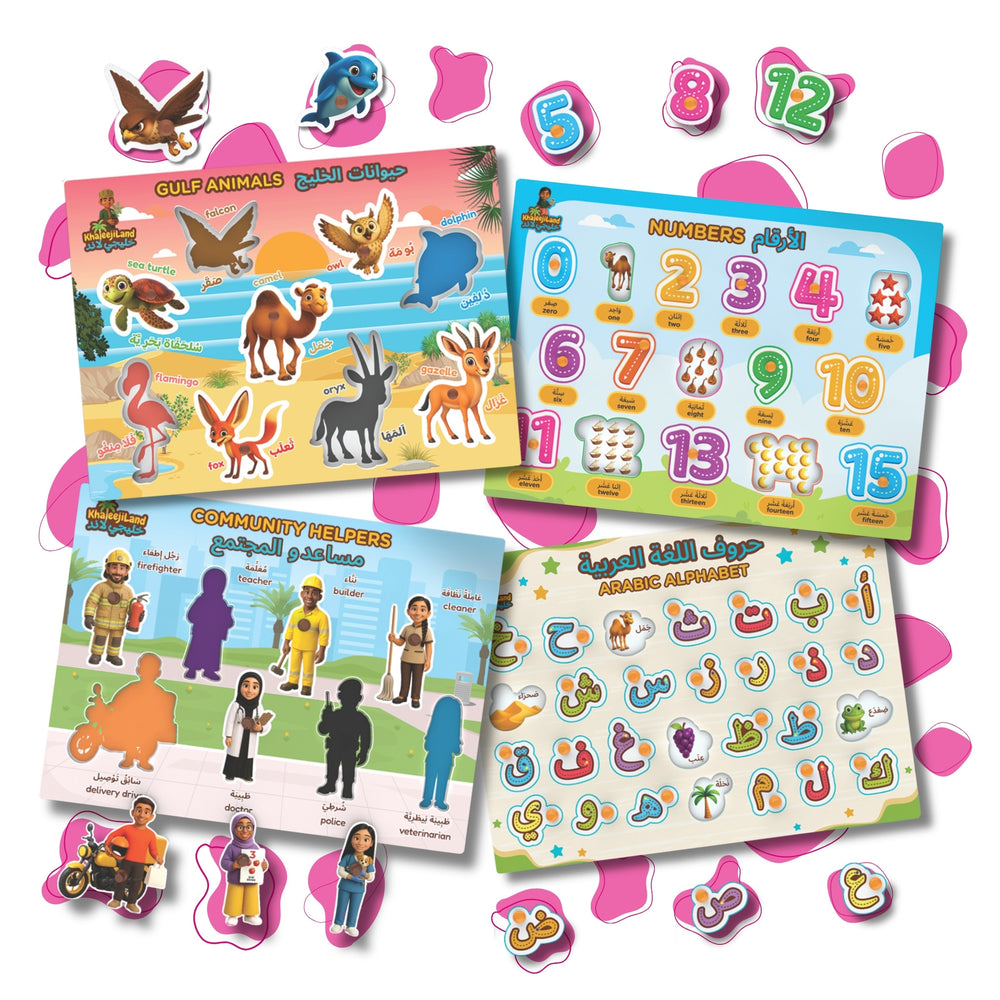
FROM THE KHALEEJILAND SHOPIf you want a simple, hands-on way to bring Arabic into daily play, the Arabic Alphabet Wooden Peg Puzzle pairs each letter with a familiar word and picture. It gives children a reason to touch, name, match, and repeat letters during short play moments. |
|
LOOKING FOR MORE IDEAS YOU CAN USE AT HOME? Explore our free Activity Library for printable activities and play ideas that bring Arabic and English into everyday routines, at no cost and with nothing to sign up for. |

Frequently asked questions
Will my child fall behind in English if we use more Arabic at home?
Supporting Arabic at home does not mean taking English away. In many UAE families, English already has strong exposure through school, friends, media, and daily life. Adding Arabic routines gives your child more balance, not less English.
Is it too late to introduce Arabic if my child already prefers English?
It is not too late. Children continue building language skills well into their school years, and a preference for English reflects exposure rather than a closed door. Adding regular, enjoyable Arabic moments can gradually rebalance the time each language gets.
Should we have one parent speak only Arabic and the other only English?
That approach, often called one-parent-one-language, works well for some families but is not the only effective method. What matters most is consistent, meaningful exposure to each language; you can read more in our guide on how bilingual children learn. Choose the structure your family can keep up day to day.
Is it bad if my child mixes Arabic and English in the same sentence?
Not at all. Mixing languages is a normal, well-documented part of growing up bilingual and is not a sign of confusion. Over time, children learn to adjust which language they use depending on who they are speaking to.
|
Sara is a special educator based in the UAE, with a Master's in Special Education from Simmons University and nearly a decade in Abu Dhabi classrooms, from early years through special needs. She writes about the science of play, bilingual learning, and helping children thrive in UAE classrooms and beyond. |


