

How to Support Your Child's Arabic Learning at Home If You Don't Speak Arabic Yourself
You don't need to speak Arabic to support your child's Arabic learning at home. Your job isn't to teach the language yourself, but to make Arabic visible, welcome, and part of ordinary family routines. This is a common worry for UAE parents, especially in families where Arabic is part of school life but not part of home conversation. The goal isn't to become your child's Arabic teacher overnight. It's to make Arabic feel normal and supported at home.
|
Key takeaways • You're a learning partner, not a second teacher. Your interest matters more than perfect pronunciation. • Short, regular exposure beats occasional long sessions. Ten minutes most days works. • Let your child teach you. Being the learner is one of the most powerful things you can do. • Lean on resources that carry the language for you: audio, bilingual toys, and worksheets. • Talk to your child's teacher early. They expect this question from non-Arabic-speaking families. |
What to try this week
|
Day |
Small Arabic habit |
|
Sunday |
Ask your child to teach you one Arabic word from school |
|
Monday |
Put Arabic audio on in the car for 10 minutes |
|
Tuesday |
Label 3 objects at home in Arabic |
|
Wednesday |
Look for Arabic letters on shop signs or packaging |
|
Thursday |
Do Arabic homework together, without correcting everything |
|
Friday |
Let your child “test” you on the week's words |
Can I help my child learn Arabic if I don't speak it?
Yes, and you're far from alone. Arabic is part of school life in the UAE, which means a large share of children learning Arabic come from homes where no one speaks it, including many expat families, bilingual families, and families where English is the stronger home or school language. Many non-Arabic-speaking parents are trying to support Arabic learning at home, even when they don't read or speak the language themselves.
The instinct to worry is understandable. But language learning at home doesn't depend on the parent being a teacher. It depends on the language feeling normal, useful, and connected to people the child loves. That's something any parent can create, and it's the heart of supporting Arabic without speaking Arabic.
What does “Arabic learning” actually mean?
It helps to know that Arabic learning can mean several different things: hearing the sounds of the language, learning everyday words, recognizing letters, reading simple words, or completing school Arabic homework. A young child doesn't need to master all of these at once. If your child is in the early years, start with listening, naming, songs, visuals, and playful repetition before expecting reading or writing.
Many UAE children hear different forms of Arabic around them: Modern Standard Arabic at school, Emirati Arabic from locals in the community, and numerous other dialects from friends, teachers, or caregivers. That isn't a problem, but it does mean it's worth asking the teacher which words, sounds, or letters your child is expected to practise at home, so your effort lines up with theirs.
Why your attitude matters more than your Arabic
Children read how we feel about things long before they understand what we say. If Arabic is treated at home as a difficult subject to survive, that's the message a child absorbs. If it's treated as interesting and worth knowing, that lands too.
This is why your role is mainly emotional and practical, not linguistic. What parents can influence most is the home environment: whether the language is treated positively, whether the child has regular exposure, and whether practice feels safe rather than stressful. Research on bilingual development by Byers-Heinlein and Lew-Williams points to the amount and quality of language input a child receives as a key shaper of their language outcomes, which is exactly the part a supportive home can add to.
A few things make a real difference: showing interest in what your child learned today, never apologizing for your own Arabic in front of them, and reacting to their Arabic words with warmth rather than correction.
When I worked with children and families in Abu Dhabi, I saw how much difference a parent's attitude could make. Some parents couldn't read the Arabic homework, but they still sat beside their child, praised the effort, played audio clips, and asked what the words meant. That kind of support helped children feel that Arabic mattered at home too.
Practical ways to build Arabic into your home
You don't need a lesson plan. You need a handful of small habits that repeat.
Make your child the teacher. Ask them to teach you one Arabic word a day, then use it back to them. It's fine to get it slightly wrong. Children often love correcting adults, and explaining the word helps them remember it.
Let audio handle the pronunciation. This is the single most useful thing for a non-Arabic-speaking parent, because it solves the accent problem. Arabic songs, audiobooks, and talking toys give your child correct pronunciation that you can't. Put it on in the car or during play, with no pressure to perform.
Label a few things at home. Sticky notes with the Arabic word on everyday objects, the door, the fridge, a favorite chair, build recognition through repetition. Let your child help write them.
Keep it short and frequent. Ten minutes most days does more than an hour on a Sunday. Language sticks through regular contact, not intensity.
Use the Arabic that's already around you. Written Arabic is everywhere in the UAE: shop signs, packaging, road signs, menus, receipts, and school notices. Arabic doesn't have to stay inside the homework folder. Even if you can't read every word, you can ask, “Do you recognize any letters?” or “Did your teacher say this sound?”
How to support a child with additional needs
If your child has speech and language delay, attention differences, dyslexia-type difficulties, or broader learning needs, keep Arabic practice shorter and more visual. Use the same small set of words repeatedly, pair words with pictures or objects, and avoid turning every session into recall. For some children, recognizing and enjoying the sound of Arabic is a meaningful first step, and that counts.
What to do about homework and reading you can't read
This is the worry I hear most, and the honest answer is that you can support the habit without understanding the content.
Sit alongside your child while they do Arabic homework, the same way you would for any subject. You're providing focus and encouragement, not answers. For reading, let the audio or a talking resource model the sounds, and let your child follow along. If a sheet comes home and you can't tell whether it's done correctly, that's fine to leave for the teacher. Your contribution is the routine and the calm, not the marking.
When in doubt, ask the school. Arabic teachers in the UAE work with non-Arabic-speaking families all the time, and most can point you to recordings, apps, or simple at-home routines suited to your child's level. For families wanting to understand how Arabic fits alongside English more broadly, our guide on raising bilingual children at home covers the bigger picture, and screen-free Arabic learning at home has more low-tech ideas.
A hands-on way to make Arabic visible

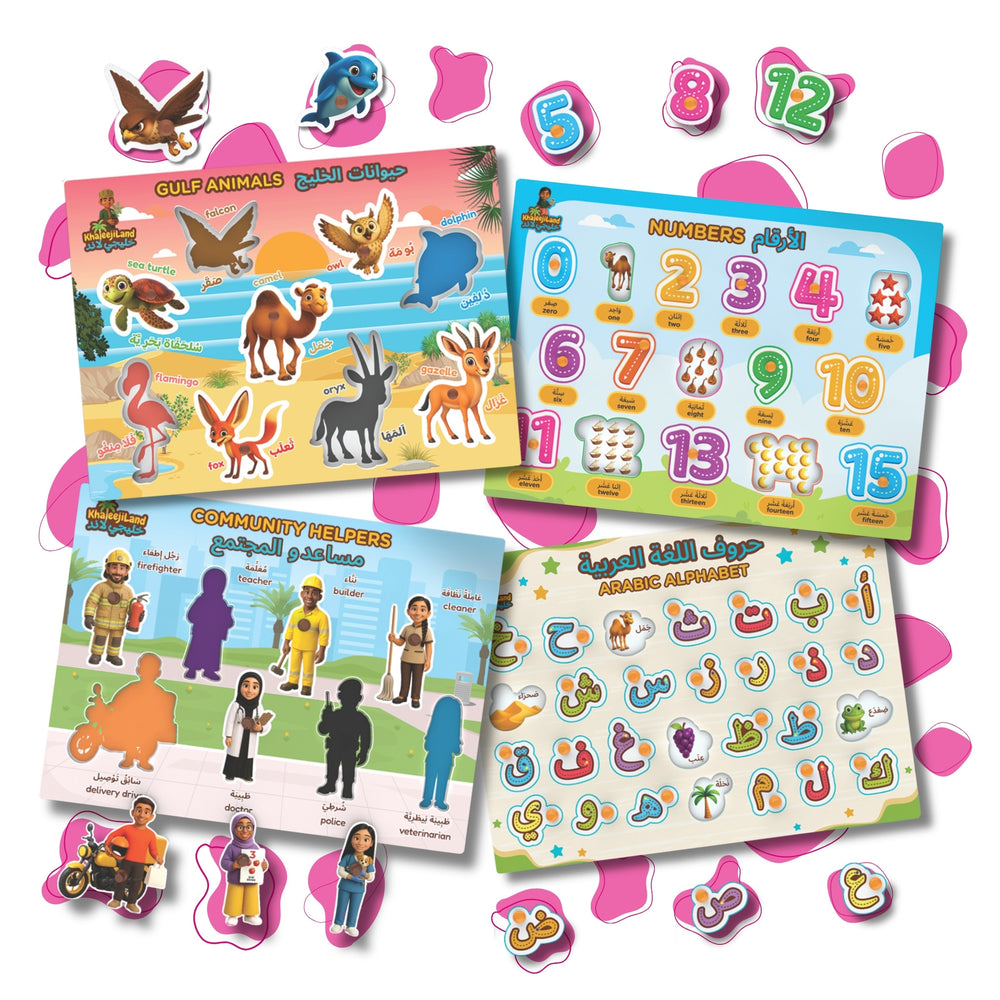
When you don't speak the language, the right tools matter more, because they carry the parts you can't. A letter puzzle can help children see, touch, and match Arabic letters without turning practice into a worksheet. KhaleejiLand's Arabic Alphabet Wooden Peg Puzzle gives children a shared activity around letter shapes, pictures, and early sound awareness. If you don't read Arabic yourself, use it alongside school words, teacher guidance, or audio so your child also hears the correct pronunciation.
|
EXTEND THE LEARNING WITH A FREE WORKSHEET Download our free bilingual learning worksheets from the KhaleejiLand Activity Library for simple, parent-friendly activities you can use at home. |
Frequently asked questions
Is it too late to support my child's Arabic if I waited until they started school?
No. Start with a small routine now: one word from school, 10 minutes of audio, or one simple worksheet together. Consistency matters more than starting early and then stopping.
Should I learn Arabic alongside my child?
You don't have to, but learning together can be powerful if you enjoy it. It signals that the language matters and lets your child take the lead. Just avoid making your child responsible for teaching you everything, and keep it light, letting the school guide the formal learning.
Will speaking English at home harm my child's Arabic?
No. Speaking English, or any strong home language, doesn't harm Arabic learning. Children benefit from rich language at home. Arabic can be supported separately through school, audio, visuals, songs, and short daily routines.
My child mixes Arabic and English in one sentence. Is that a problem?
Mixing languages can be a normal part of bilingual development, especially when a child knows a word in one language before the other. If your child is communicating clearly and developing across languages, this usually isn't a problem. If you have concerns about speech or language development, ask the school or a qualified speech and language therapist.
|
Sara is a special educator based in the UAE, with a Master's in Special Education from Simmons University and nearly a decade in Abu Dhabi classrooms, from early years through special needs. She writes about the science of play, bilingual learning, and helping children thrive in UAE classrooms and beyond. |


