

The Best Wooden Puzzles for Kids in the UAE: What to Look For and Why They Work
The best wooden puzzles for children aged 3 to 6 usually have chunky pieces, clear inset slots, simple artwork, and safe, non-toxic finishes. For beginners, look for peg or inset puzzles with around 6 to 12 pieces. Older or more confident children can move towards 12 to 16 or more pieces, map puzzles, or early jigsaws.
The other thing to check, and the one parents most often skip, is safety: proper toy safety testing and the right conformity marking for toys sold here in the UAE. More on that below.
|
Key takeaways • For young children, the piece matters more than the picture. Chunky pegs or thick inset pieces are what build the grip and coordination. • Match the piece count to the stage, not just the age on the box. Start lower and move up as your child gets faster. • Non-toxic finishes and proper safety certification are not optional, because puzzle pieces end up in mouths. • Most wooden peg puzzles are designed for ages 3 and up. For younger children, a chunky single-shape puzzle is the safer choice. • Familiar, bilingual artwork gives your child more to talk about, which is where a lot of the learning happens. |
Over the last two years, I've looked at more wooden puzzles than I ever expected to: checking the thickness, turning pieces over, testing how they sit in the board, and reading the safety documents that usually stay behind the scenes. A lot of what gets sold as “educational” is a printed picture cut into pieces. The difference between a puzzle a child grows with and one that ends up at the back of a cupboard usually comes down to a few specific things. Here's what I look for.
Quick checklist: how to choose a good wooden puzzle
If you only remember one thing from this guide, make it this list. A good wooden puzzle for a child in the UAE should tick most of these boxes:
• Age suitability: designed for your child's age, with a clear age grade on the box.
• Piece size and grip: pieces a small hand can pick up and hold comfortably, pegs included.
• Piece count: enough to challenge, not so many that your child gives up.
• Inset fit: each piece sits in its own clearly defined slot, not a vague printed outline.
• Safety certification: proper toy safety testing and the right conformity marking for the UAE.
• Artwork clarity: simple, recognisable images, one clear object per piece.
• Language and cultural relevance: themes and labels your child recognises, ideally bilingual.
• Success without rescue: your child can get pieces in and out themselves, without an adult doing it for them.
The rest of this guide walks through the ones that need a bit more explaining.
Why are wooden puzzles good for young children?
Wooden puzzles are useful because they give a child a small, clear problem to solve with their hands. The piece either fits or it doesn't, and that immediate feedback helps children adjust, try again, and build confidence.
There's a nice bit of hidden value in how a child handles the pieces. When a child lifts a peg, steadies the board with one hand, and turns the piece with the other, they're practising the same small-hand control they'll later need for drawing, writing, buttons, and zips. It's one simple way to practise the kind of finger control children later use for early writing.
There's also a rough developmental order to this, which is part of why these puzzles are graded for three and up rather than younger. The fine finger control that lets a child place a piece by looking, rather than by trial and error, keeps developing across the preschool years. More refined, pencil-style grips tend to appear closer to ages 3 to 5, as children gain control over individual finger movements and better coordination between the fingers, hand, and wrist. A peg puzzle can sit nicely in that window, especially when the piece count and theme match the child.
I noticed this with my nephew when we were trying one of the number puzzle samples. At first, he treated it like a guessing game: pick up a piece, try a slot, try another slot, then laugh when it finally dropped in. A few rounds later, he'd changed strategy completely. He started looking at the shape first, then the number, then the space on the board. That's the part adults sometimes miss. The learning isn't only in getting the answer right; it's in the child slowly working out how to approach the problem.
What should I look for in a wooden puzzle?
A few things separate a good wooden puzzle from a cheap printed board with pieces cut out of it. I check all of them before I'm willing to put our name on a product, and you can check most of them in a shop or from good product photos.
The pieces. Pieces should be solid and easy to grip. Peg puzzles add a small knob to each piece, which gives a child something straightforward to hold and place, and is part of what makes them work well for the 3 to 6 range. The pieces should be thick enough to feel substantial and sit flush in the board.
The board and the fit. Each piece should drop into a clearly defined recess, the inset, not a vague printed outline. The fit should be snug enough to give feedback when a piece is right, but loose enough that a child can get it out again without a struggle. A piece that needs an adult to remove it will frustrate a young child quickly.
The finish. Look for non-toxic, child-safe inks and coatings. This isn't marketing language; it's a measurable safety requirement, and I'll come back to how you can check it below.
The artwork. Simpler is better for this age. One clear object per piece, recognisable colours, and not too much visual clutter. Artwork your child already recognises from daily life gives them more to name and talk about, and the talking is where a lot of the value sits.
The piece count. This is the one parents most often get wrong, so it gets its own section.
How many pieces should my child's puzzle have?
Match the piece count to your child's stage, not just the age printed on the box. The box tells you the suitable range; your child tells you where to start within it.
For children new to puzzles, start simpler, then work up to more pieces as their skills grow. A rough guide that's held up well in practice for the 3-plus range:
|
Child's stage |
Suggested piece count |
Best puzzle type |
|
New to puzzles / around 3 years |
6 to 9 pieces |
Simple peg or inset puzzle |
|
Building confidence / 3 to 4 years |
9 to 16 pieces |
Peg puzzle with clear individual slots |
|
More confident / 4 to 6 years |
12 to 16+ pieces |
Detailed inset puzzle or early jigsaw |
|
Older child / 6+ years |
More detailed scenes or maps |
Map puzzles, inset puzzles, jigsaws |
If your child finishes a puzzle confidently three or four times, they're ready for the next step up. If they lose interest within seconds and walk away, it's usually too hard, not that they “don't like puzzles.” Drop down a level and the interest tends to come back.
Which wooden puzzle should I choose?
Once you've matched the piece count to the stage, the theme is what holds your child's attention. A quick way to decide:
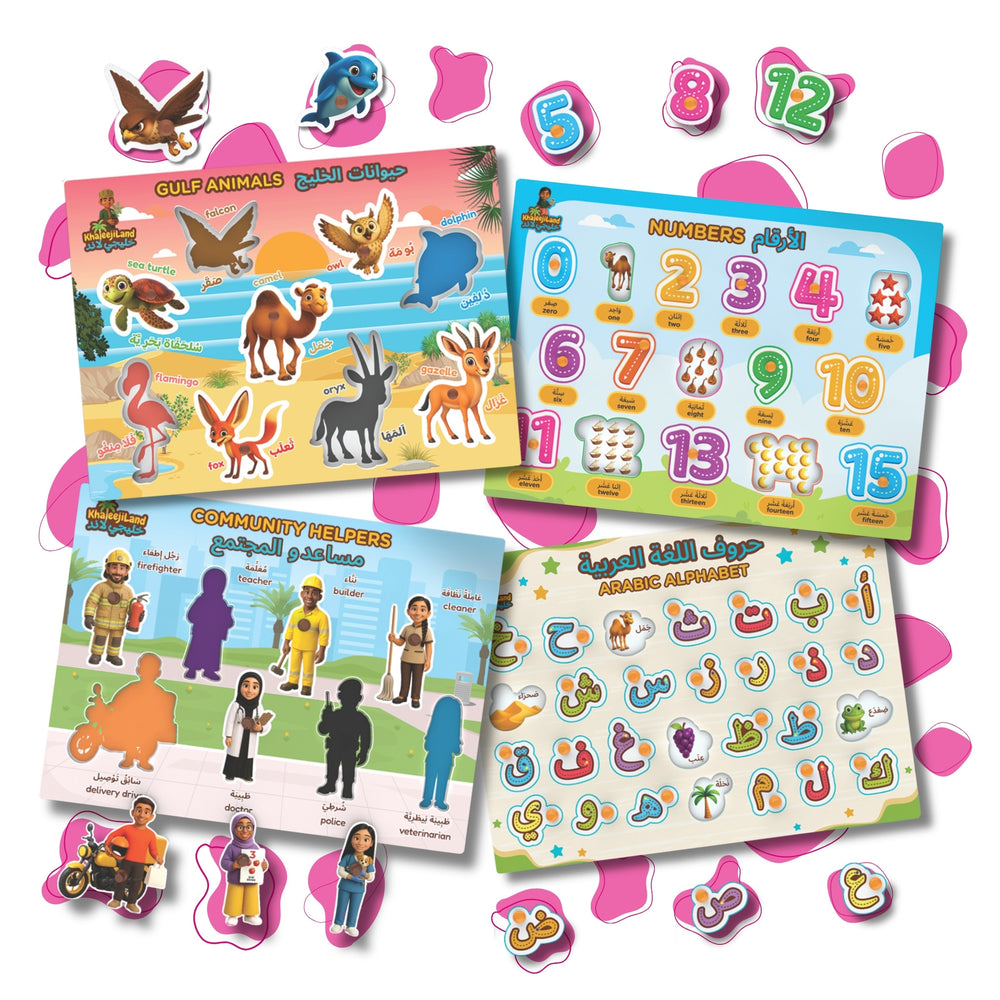
• For a first peg puzzle: fewer pieces and familiar objects. The eight-piece Community Helpers wooden peg puzzle is a gentle starting point.
• For children who love naming and pretend play: community helpers or animals. The Gulf Animals wooden peg puzzle gives them plenty to talk about.
• For number or Arabic exposure: the Numbers wooden peg puzzle or the Arabic Alphabet wooden peg puzzle, which ask for more matching and sequencing.
• For older or more confident children: the UAE Map wooden peg puzzle, which is more advanced and works well right up to age eight.
• For under-threes: peg puzzles are still great, just choose ones made for this age group. Developmentally, look for large pieces, 3 to 8 in total, with chunky knobs and no small parts. Under-threes explore with their mouths, so the puzzle needs to be made and safety-tested for that age. Our KhaleejiLand range is graded 3 and up because of the smaller pegs, so for a younger child, look for a simpler peg puzzle designed for their stage.
As a practical example of how this works, this is why our own peg puzzles aren't all the same difficulty. Community Helpers is easier, with fewer pieces and very familiar images. Numbers and Arabic Alphabet ask for more matching and sequencing. UAE Map is the most advanced, because the shapes and positions need more visual thinking. The idea is that a child can move up through them rather than outgrow them all at once.
For more on how the formats differ as children get older, see our guide to peg puzzles vs jigsaw puzzles.
Why does safety certification matter, and how can I check it?
Young children still mouth their toys, and small pieces are exactly the kind of thing that ends up tested against teeth. That's why certification matters, and why I treat it as a baseline rather than a selling point.
In practice, I look for two things: proper toy safety testing, such as relevant EN 71 testing, and the required GCC conformity route for toys sold in this market. EN 71 is the toy safety standard series, where Part 1 covers mechanical and physical properties, Part 2 covers flammability, and Part 3 covers the migration of certain elements. In plain terms, that means checks for sharp edges, small parts, and durability, plus limits on toxic elements such as lead and cadmium leaching out of the material if a child mouths it.
For toys sold in the UAE and the wider Gulf, the route that actually matters is the GCC one. Toys must comply with the GCC Technical Regulation on Children's Toys and display the Gulf conformity mark, the G-Mark, which applies to all toys for children under 14. Toys that conform to the relevant Gulf standards are presumed to meet the regulation's safety requirements, and a Gulf Conformity Tracking Symbol, a QR code, is used to show compliance and traceability. So a seller here should be able to explain both: that the toy has been properly tested, and that it carries the right Gulf conformity marking.
If a listing says nothing about testing, age grading, or safety warnings, pause before buying. Proper testing costs money. A very cheap toy may still be fine, but the seller should be able to explain how it was checked.
This is also why most wooden peg puzzles, including ours, are graded for ages 3 and up and carry a choking-hazard warning. The small pegs that make these puzzles work for little fingers are the same reason they aren't designed for under-threes. The age guidance is there to help parents choose safely, not to limit the value of the toy.
If you want the longer version, including why a cheap toy can end up being the more expensive choice, see why cheap educational toys often aren't.
Do bilingual or Gulf-themed puzzles actually help?
They can, and the reason is less about language drills and more about familiarity and conversation.
A puzzle becomes more useful when it creates conversation. Naming the picture, comparing shapes, asking “where does this go?”, and switching between Arabic and English can turn a simple matching activity into a language-rich moment. In early childhood settings, building on what children already know from home and community is treated as a genuine educational asset, what educators sometimes call children's “funds of knowledge.” A camel, a falcon, or a UAE map isn't automatically “better” than a generic theme, but for a child living here, it can give them something real to recognise, name, and talk about.
Bilingual labelling adds a second layer. A child doesn't need to “study” Arabic from a puzzle; they just see the Arabic and English side by side as a normal part of play, which is how comfortable bilingual familiarity starts. Our Gulf Animals wooden peg puzzle and UAE Map wooden peg puzzle were both built around this: animals children may recognise from the UAE and Gulf region, and the seven Emirates, labelled in both languages, so the cultural content and the language exposure come along while the child is just playing.
One honest note: no puzzle is going to teach Arabic from the shelf. It still needs an adult, a sibling, a teacher, or a bit of repeated conversation around it. It's a small, useful, repeated bit of exposure, not a curriculum.
When is a wooden puzzle not the right buy?
Since I help make educational toys, I should also be clear about when I wouldn't buy a peg puzzle.
If your child is under three, peg puzzles aren't the right choice, and not just because of the age label. The pegs are small parts, and the puzzles are pitched at hand skills that are still developing at that age. For under-threes, look for chunky single-shape puzzles or simple shape sorters with large pieces made for that stage. If, on the other hand, your child is already breezing through detailed inset puzzles and early jigsaws, they may have outgrown peg puzzles and be ready for proper jigsaws with smaller, interlocking pieces. And if a child simply finds a particular theme boring, the format isn't the problem; a different subject will often re-engage them faster than a different type of toy.
Puzzles also aren't a substitute for the messier, open-ended play that young children need just as much. They're one good tool among several, best used in short, low-pressure sessions rather than as a daily drill.
Frequently asked questions
What age are wooden peg puzzles for?
Most wooden peg puzzles are designed for children aged 3 and up, because the pieces are sized for developing hand control and the small pegs make them unsuitable for younger children. More detailed puzzles, such as a UAE map, often suit children up to around seven or eight. Always check the age guidance and safety warning on the specific product.
Are peg puzzles better than jigsaw puzzles for young children?
For children at the younger end of the 3 to 6 range, generally yes. The peg gives small hands something easy to grip, and each piece has its own slot, which is more forgiving than a jigsaw where pieces only connect to each other. Jigsaws tend to suit children from around five or six upwards, once their hand control and visual matching have developed further.
How do I know if a wooden puzzle is safe?
Look for proper toy safety testing, such as relevant EN 71 testing, and the right GCC conformity marking (the G-Mark) for toys sold in the UAE, along with non-toxic finishes, clear age grading, and any necessary choking-hazard warning. A seller who can't tell you whether a toy has been safety tested is a seller to be cautious with.
My child loses interest in puzzles quickly. What am I doing wrong?
Probably nothing. In most cases, the puzzle is simply too hard, too busy, or not interesting enough yet. Drop to a lower piece count so your child can succeed, keep sessions short, and sit with them rather than leaving them to it. Interest usually returns once the puzzle is at the right level and the activity feels social rather than like a test.
Choosing your first puzzle
If you're choosing a first wooden puzzle, start with the one your child can talk about most easily. You can browse KhaleejiLand's wooden peg puzzles by age, theme, and difficulty, or try our free activity downloads first if you'd like to explore the learning theme before you buy. The downloads are free to use and don't ask for anything in return.
|
Madhav is the co-founder of KhaleejiLand. He grew up at the intersection of Emirati and expat life, and would not have it any other way. That experience is why KhaleejiLand exists: so children grow up genuinely connected to the place they call home. |


