

School Readiness in the UAE: What Children Need to Know Before Starting KG
School readiness in the UAE is less about reading and writing and more about whether a child is beginning to manage the routines, separation, communication, and independence expected in a classroom: following simple instructions, taking turns, using the bathroom alone, and saying goodbye to a parent without too much distress. The latest Ministry of Education guidance sets the KG1 entry age at four by 31 December, but being old enough for KG does not automatically mean a child is ready for the day-to-day experience of school.
For many UAE parents, school readiness becomes urgent in the months before nursery, FS2, or KG1 applications. The question is usually not “Can my child read?” It is “Will my child cope with the school day?”
|
Key takeaways • Readiness is mostly social, emotional, and physical, not academic. Confident separation, communication, and independence matter more than knowing letters. • For AY 2026-2027 onward, schools starting in August or September use 31 December as the age cut-off, so a child must turn four by 31 December to enter KG1. Some transition-year cases may have placement flexibility, but parents should confirm directly with the school and regulator guidance. • The skills that help most are the ones you can build through everyday routines at home, not flashcards. • Letters and numbers matter, but they are not the best measure of readiness. A child who feels secure and capable settles into school more easily. |
What does school readiness actually mean?
School readiness means a child has the foundational skills to cope with, and benefit from, the structured environment of a classroom. It is a developmental state, not a checklist of facts a child has memorized. In practice, most early years educators look hardest at the “prime” areas of development that everything else is built on: communication and language, physical development, and personal, social, and emotional development. These three are the foundation of the Early Years Foundation Stage framework used by many British-curriculum schools across the UAE. The specific areas, literacy, mathematics, understanding the world, and expressive arts and design, build on top of them.
Working with young children in UAE classrooms, I often saw the first few weeks come down to practical skills, not academics. A child might recognize numbers but struggle to ask for help opening a lunch box, wait for the toilet, or manage a goodbye at the door. Those moments shaped the school day far more than whether they knew every letter. The reassuring part is that these skills can be taught, and they are far better built gently at home over months than crammed in the fortnight before school starts.
Some children need more time or more structured support, especially children with speech and language delays, sensory needs, anxiety, attention differences, or broader developmental delays. Readiness should never be judged by one difficult drop-off or one weak skill. Look for patterns over time, and speak to the school if you are unsure.
When can my child start KG in the UAE?
The UAE Ministry of Education has confirmed the age cut-offs for kindergarten and Grade 1, applying from the 2026-2027 academic year. For schools and kindergartens whose academic year starts in August or September, the cut-off is now 31 December. A child must have completed four years of age by 31 December of the admission year to enter KG1, five years by 31 December for KG2, and six years for Grade 1. You can read the official announcement on the Ministry of Education website.
Schools whose academic year starts in April, including many Indian-curriculum schools, continue to use the 31 March cut-off under their existing system. If your child is in an April-start curriculum, confirm the relevant date directly with the school.
There may be transition-year flexibility for some children affected by the change from the previous 31 August cut-off, but this should not be treated as a blanket rule. If your child is close to the cut-off, speak directly to the school and ask how they assess developmental readiness, current enrolment status, and year-group placement.
Because UAE age rules can differ by curriculum start date and by a child's individual situation, treat the Ministry guidance and your chosen school's admissions team as the final source before making a placement decision.
What skills should I focus on before KG?
If you want a short list, focus on independence and communication. These carry more weight in the first term than any academic skill. These are the skills children need during the first few weeks.
The table below covers the readiness areas that matter most and how to build each one at home.
|
Readiness area |
What to look for |
How to practice at home |
|
Separation |
Can say goodbye with support |
Short separations with trusted adults |
|
Self-care |
Toilet, handwashing, lunch box |
Practice during daily routines |
|
Communication |
Can ask for help |
Model simple phrases |
|
Listening |
Can follow one to two steps |
Give small jobs at home |
|
Social skills |
Can wait and take turns |
Board games, pretend play, sharing tasks |
|
Fine motor |
Can grip, place, open, press |
Puzzles, playdough, threading, drawing |
None of these require a worksheet. They are built through daily life: letting your child dress themselves even when it is slower, having them pack away their own toys, and resisting the urge to step in the moment something gets difficult.
There is a strong temptation, especially among parents new to the UAE system, to drill letters and numbers in the months before KG. It often adds pressure without solving the real first-term challenges. Letters and numbers matter, but they are not the best measure of whether a child is ready for KG. A child who can ask for help, follow a simple routine, and recover after a difficult goodbye is in a much stronger position to learn once school begins. If you want to support early numeracy, do it through play rather than drill. Counting steps on the way to the car, sorting socks by color, or playing shop with real coins teaches number sense in a way a child this age can absorb.
How can I prepare my child emotionally for school?
Emotional readiness comes down to one thing above all: your child trusting that when you leave, you come back. This is built long before the first day, through consistent routines and small, low-stakes separations.
Practice separation in advance. Leave your child with a trusted relative or friend for short periods so that being apart from you becomes familiar and unalarming. Talk about school positively and concretely in the weeks beforehand: who the teacher will be, what the classroom looks like, that there will be other children, and that you will be back at the end of the day. Many UAE schools run orientation visits and settling-in sessions to ease this transition, so take them up on every one offered.
In the UAE, readiness can also be affected by very practical things: early wake-ups, school transport and long drop-offs, lunch boxes and water bottles, uniforms, and a child moving from home or nursery care into a much bigger school environment. It also helps to get the practical rhythm right before term starts. Shift bedtimes and wake times to the school schedule a week or two in advance, and practice the morning routine so it is not a shock on day one. A child who is rested and unhurried copes with everything else better.
Building readiness through everyday play
You do not need to recreate a classroom at home, and you should not try to. The most effective preparation is woven into ordinary days. Independence grows when children are allowed to do things for themselves. Communication grows through conversation, stories, and being listened to. Confidence grows when a child is allowed to struggle a little and then succeed.
Play is doing real cognitive work here, not filling time. When a child completes a puzzle, packs away their pieces, or negotiates whose turn is next, they are practising the same focus, fine motor control, and social give-and-take that a classroom will ask of them. If you would like a simple structure for this, setting up a small, defined space at home helps a child build the habit of sitting down to an activity and seeing it through. I have written a separate guide on setting up a learning corner at home that walks through how to do this without spending much or taking over a room.
A simple readiness activity

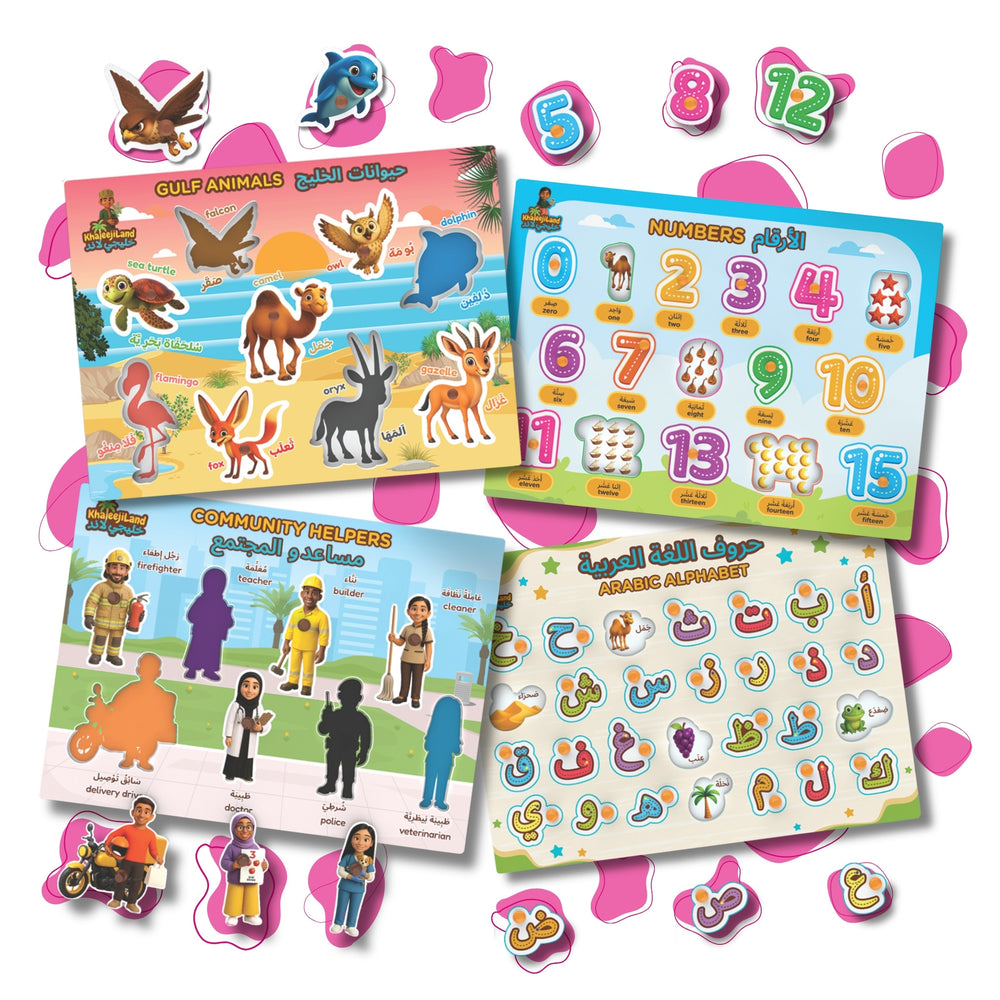
If you want to support early number recognition without pressure, use hands-on activities rather than drills. A peg puzzle, counting game, or sorting tray lets children match numbers, move pieces, and practice fine motor control at the same time. KhaleejiLand's Numbers 0-15 Wooden Peg Puzzle can support this kind of play, but the goal is not to teach maths early. The goal is to build confidence, attention, and coordination through a familiar activity.
A final reassurance for parents who do not speak Arabic and worry about the language side of readiness: your child does not need to arrive at KG already speaking Arabic, and you do not need to teach it to them yourself. Schools build Arabic from the start, and there is plenty you can do to support it without being a speaker. I cover this in supporting your child's Arabic learning when you don't speak it yourself.
Try a readiness activity at home
For simple, no-pressure activities that build the focus, fine motor control, and confidence children draw on in their first weeks of school, browse our free Activity Library.
Frequently asked questions
What age does KG start in the UAE?
For schools starting in August or September, the updated UAE rule for AY 2026-2027 onward is that children must be four by 31 December of the admission year to enter KG1. Schools starting in April continue to use the 31 March cut-off, so always confirm with the school before applying.
Should my child be able to read and write before starting KG?
No. Reading and writing are taught at school, and KG is where formal literacy begins for most children. What matters far more before KG is that your child can communicate their needs, follow simple instructions, manage basic self-care, and separate from you calmly.
My child was born between September and December. Should they start KG1 or KG2?
Some children close to the transition cut-off may have placement flexibility, depending on their birth date, current enrolment status, curriculum, and school guidance. Do not decide by birthday alone. Ask the school how they assess readiness and what options apply to your child specifically.
How do I know if my child is ready for school?
Look at independence and social skills rather than academic ability: can they use the bathroom alone, ask an adult for help, take turns, and cope without you for a few hours? A child who is socially and emotionally secure often has an easier transition, even if the first few days are still emotional.
|
Sara is a special educator based in the UAE, with a Master's in Special Education from Simmons University and nearly a decade in Abu Dhabi classrooms, from early years through special needs. She writes about the science of play, bilingual learning, and helping children thrive in UAE classrooms and beyond. |


