

Dubai and Abu Dhabi's New Arabic Language Policy: What It Means for Your Child at Home
Both Dubai and Abu Dhabi have introduced new early-years Arabic requirements for private schools and nurseries. In Dubai, the KHDA is phasing in Arabic for young children, starting with ages four to six. In Abu Dhabi, ADEK now requires structured Arabic in kindergarten. Your child will meet Arabic earlier than before, and a little support at home helps that learning take root.
|
Key takeaways • Dubai (KHDA) and Abu Dhabi (ADEK) have both brought in new early-years Arabic requirements, phased in from the 2025/2026 school year. • The requirements cover private schools and early childhood settings, and include both native and non-native Arabic learners. • Your child's Arabic pathway may differ depending on whether they're treated as a native (A) or non-native (B) learner. • You don't need to speak Arabic yourself to support it at home. • Short, playful, regular exposure matters more than formal lessons at this age. |
The policy at a glance
|
Emirate |
Regulator |
Applies to |
What the policy covers now |
|
Dubai |
KHDA |
Private schools and early childhood centres; phased birth–6 policy |
Phase 1 live: Arabic for ages 4-6, play-based; younger ages to follow |
|
Abu Dhabi |
ADEK |
Private and charter schools, Pre-KG/FS1 to KG2/Y1 |
Arabic across KG, 200 min/week rising to 300 by AY 2027/28 |
What exactly has changed?
For years, formal Arabic in many private schools didn't begin until around age seven. Both emirates have now moved to introduce it earlier, in the years when children pick up language through play rather than study.
In Dubai, the Knowledge and Human Development Authority (KHDA) introduced a policy requiring private schools and early childhood centres to bring in Arabic for young children. The policy's scope runs from birth to six, but it's being introduced in stages. It rolls out in three phases: Phase 1 for children aged 4 to 6, Phase 2 for children aged 3 to 4, and Phase 3 for children from birth to three. Phase 1 is the part in effect now; the later phases for younger children follow after Phase 1 has been evaluated. Changes take effect from September 2025 for schools on a September academic year, and April 2026 for schools on an April year. The wider initiative is called Loughat Al Daad (“the language of Daad,” after a letter distinctive to Arabic), under Dubai's Education 33 strategy.
In Abu Dhabi, the requirement sits in the ADEK School KG Arabic Curriculum Policy, part of the broader KG MoE Subjects Policy. Arabic is taught for 200 minutes a week (40 minutes a day, five days a week), increasing to 300 minutes a week by the 2027–28 academic year. Lessons are split into two streams: Arabic A for Arab nationals and native speakers, and Arabic B for non-Arab nationals learning Arabic as an additional language.
You can read both directly: the KHDA policy on Arabic in early childhood education and the ADEK education policies page.
Does this apply to my child?
For most families with young children in private education here, yes. In Dubai, the policy applies to KHDA-licensed private schools and early childhood centres serving children from birth to six, with the phased rollout above. In Abu Dhabi, the current ADEK KG policy applies to private and charter schools from Pre-KG/FS1 to KG2/Y1. The curriculum your school follows doesn't exempt it.
The requirement applies across these settings, but your child's Arabic pathway may differ depending on whether they're treated as a native or non-native Arabic learner. In Abu Dhabi, placement is into Arabic A or Arabic B, and switching streams is governed by set conditions: non-Arab national students can switch on parental request and school approval based on proficiency. If you've worried about your child meeting Arabic with no preparation later on, this earlier, gentler start is designed to ease exactly that.
Why start so young?
The early years are a strong window for building language confidence, sound awareness, and positive associations with Arabic. Young children absorb the rhythm and sounds of a language with an ease that takes more effort later. Both authorities lean on this deliberately. KHDA's approach prioritizes play-based and inquiry-driven methods over formal instruction, and ADEK's policy is built around songs, stories, and exploration rather than rote learning. The goal at this stage isn't reading and writing. It's a warm, low-pressure relationship with the language that later study can build on.
With older primary children, I sometimes saw Arabic come with a sigh before the lesson had even started. That wasn't always about ability. Often it was about confidence. The early years give us a chance to make Arabic feel familiar before children start seeing it as another subject they can be “good” or “bad” at.
What can I do at home?
Your job at home isn't to teach Arabic. It's to make Arabic feel present, normal, and positive. School handles instruction; you handle exposure and attitude. What that looks like depends a little on your own home.
If Arabic is spoken at home: keep it present and active. Use it in stories, play, family conversations, and everyday routines rather than treating it as something that happens only at school. Children who hear Arabic used naturally by the people they love build a much stronger foundation than lesson time alone can give.
If Arabic isn't spoken at home: focus on exposure and attitude rather than instruction. School words, greetings, songs, books, labels around the house, and a positive, curious tone all help. You don't need to be a teacher; you need to keep the door open.
A few things work well in either case:
Let your child be the teacher. Children love knowing something a grown-up doesn't. Ask what new Arabic word they learned today and have them show you. Try the word with them and let them correct your pronunciation; being shown by your child builds their confidence faster than almost anything.
Build it into daily routines. A few Arabic words used consistently beat a formal lesson nobody enjoys. Counting steps on the stairs, naming colors, a greeting at breakfast. Repetition in a real context is how vocabulary sticks.
Keep it playful and short. Five engaged minutes are worth more than thirty reluctant ones. If your child resists, stop and try again another day. The thing you most want to protect at this age is the sense that Arabic is enjoyable.
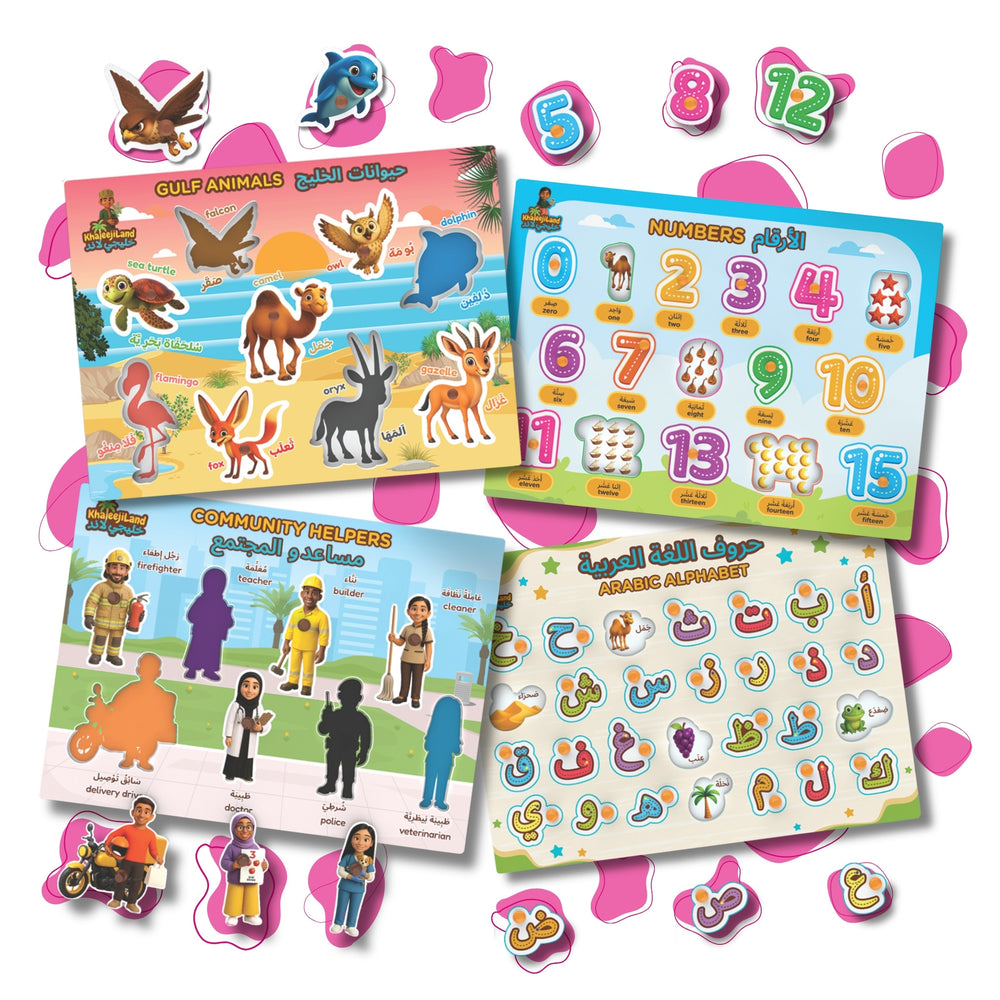
Letter recognition often starts in very ordinary moments: a child matching the first letter of their name, spotting a familiar shape on a sign, or asking why two letters look alike. That's why Arabic resources work best when they're part of play rather than stored away for “lesson time.”
FROM KHALEEJILAND
|

What this policy is not
This isn't a move to push English aside, and it isn't an expectation that your four-year-old will be fluent or reading in Arabic. KHDA has framed the aim as making Arabic enjoyable and supporting bilingualism alongside cognitive and cultural development. The destination is a confident bilingual child who feels connected to the country they're growing up in. At home, you're supporting that by keeping the language present and the mood around it warm.
Frequently asked questions
When does the new Arabic policy actually start?
For schools on a September academic year, including most UK and IB schools, Dubai's Phase 1 began in September 2025. Schools on an April year, including many Indian-curriculum schools, follow from April 2026. Abu Dhabi's kindergarten policy applies from the 2025/2026 academic year.
Does the policy apply to non-Arabic-speaking and expat families?
Yes. Both Dubai and Abu Dhabi include children learning Arabic for the first time, with a separate stream (Arabic B in Abu Dhabi) from native speakers. Your child doesn't need any prior Arabic, and you don't need to speak it at home for them to take part.
Do I need to speak Arabic to help my child at home?
No. The most useful things you can do, asking your child to teach you words, using a few Arabic terms in daily routines, and keeping bilingual books and toys around, don't require any Arabic of your own. Your role is exposure and a positive attitude.
Will learning Arabic slow down my child's English?
Research indicates that bilingual children are not more likely than monolingual children to have language delays, and early exposure to a second language is generally well tolerated alongside a first (American Speech-Language-Hearing Association, on bilingual service delivery). At this stage the Arabic provision is light and play-based, designed to sit alongside the rest of the curriculum.
|
WANT A SIMPLE WAY TO START AT HOME? Check out our Activity Library, full of free worksheets to help you bring language into playtime this week. They work alongside whatever your child is learning at school. |
|
Sara is a special educator based in the UAE, with a Master's in Special Education from Simmons University and nearly a decade in Abu Dhabi classrooms, from early years through special needs. She writes about the science of play, bilingual learning, and helping children thrive in UAE classrooms and beyond. |


