

Peg Puzzles vs Jigsaw Puzzles: Which is Right for your Child's Age and Stage?
Peg puzzles and jigsaw puzzles support different stages. Large knob or chunky inset puzzles usually come first for younger toddlers, if they are designed and age-graded for that stage. Wooden peg puzzles generally suit children from around age three, when they have stronger finger control and can safely handle smaller parts. Jigsaw puzzles come next, once a child is ready to connect pieces to each other rather than place each piece into its own slot. The right choice depends less on your child's birthday and more on what they can almost do.
Quick answer: choose a peg or inset puzzle if your child is still learning to grip, match, and place individual pieces. Choose a jigsaw puzzle if your child can already complete inset puzzles and is ready to connect pieces together to make a larger picture.
|
Key takeaways • Inset puzzles come first: a child places each piece into its own matching space, with a peg or knob to grip. • Interlocking jigsaw puzzles come next: pieces connect to one another, which needs more reasoning and finer control. • Peg puzzles can practise the thumb-and-finger control children later use for drawing and early writing. • Match the puzzle to what your child can almost do, not to an age printed on a box. • Always follow the age grading and safety label on the specific puzzle in front of you. |
Which puzzle is best for which age?
Here is the short version before the detail. Use it as a starting point, then read your own child.
|
Puzzle type |
Usually best for |
Main skill |
|
Large knob / chunky inset puzzle |
Younger toddlers, if age-appropriate and safely sized |
Grasping, matching, simple placement |
|
Wooden peg puzzle |
Often 3+, depending on product safety guidance |
Pincer grip, hand-eye coordination, vocabulary |
|
Simple jigsaw puzzle |
Around 3+ once inset puzzles are easy |
Visual reasoning, persistence, whole-picture thinking |
|
Larger jigsaw puzzle |
Older or more confident children |
Problem-solving, spatial thinking, patience |
If you are looking specifically for first wooden peg puzzles, the KhaleejiLand peg puzzle range sits in the 3+ inset-puzzle stage.
What is the difference between a peg puzzle and a jigsaw puzzle?
The difference is how the pieces relate to the board and to each other. A peg puzzle (sometimes called an inset puzzle) gives each piece its own cut-out space on a tray. The child looks at a shape, finds its home, and drops it in. Many pieces have a small wooden peg or a larger knob on top to hold. Nothing connects to anything else, and each piece is solved on its own.
A jigsaw puzzle works the opposite way. The pieces interlock, so a piece is only correct in relation to the pieces around it. There is no individual slot guiding each one. The child has to read the picture, the shape of the edges, and the way pieces fit together to build the whole.
That sounds like a small distinction. Developmentally it is a large one. An inset board lets a child succeed one piece at a time. A jigsaw asks the child to hold the whole picture in mind while working out where a single piece belongs. That is why a child who can finish an inset puzzle easily may still find a jigsaw hard at first. It is not just more pieces; it is a different kind of thinking.
Which comes first, and at what age?
Inset puzzles come first, then jigsaws. A safer progression looks like this:
• Under 3: large, age-appropriate knob or chunky inset puzzles designed for toddlers, with no small removable parts.
• Around 3+: peg or inset puzzles, especially if the child is ready to practise more precise finger control.
• Around 3 to 5+: simple interlocking jigsaws, starting with very few pieces.
• Around 5 to 6+: more detailed jigsaws, shaped puzzles, maps, and scenes.
Treat those ages as a guide, not a rule. Children move through this at very different speeds, and a child who has done little puzzling will start further back whatever their age. The signal to watch for is not the calendar. It is whether your child finishes their current puzzles easily and looks ready for more of a challenge. When an inset board has become routine, a first jigsaw is the next step.
One practical note for families building a collection: a child who enjoys jigsaws will still happily return to peg puzzles, and that is fine. Offering both is not babying an older child. It lets them choose the level they want on a given day, which is good for confidence.
I noticed this while testing samples for our wooden range. Younger children were mostly focused on gripping a piece, finding the matching space, and getting that little “it fits” moment. Older children wanted more from the puzzle: a picture to build, pieces that connected, and a reason to keep going after the first match. That changed how I thought about the range. Peg puzzles and jigsaws are not really competitors; they solve different stages.
So which one should I buy first?
If your child is under three, start with large, age-appropriate knob or chunky inset puzzles designed for toddlers.
If your child is three or older and still new to puzzles, start with a peg or inset puzzle.
If your child already finishes inset puzzles confidently, try a simple jigsaw.
If your child gets frustrated quickly, go easier, not harder. Confidence is what keeps them coming back.
If you are buying as a gift and you are not sure of the child's puzzle experience, choose slightly easier rather than harder. A puzzle the child can complete with confidence will get more use than an impressive-looking puzzle that needs an adult to finish it.
What does each type actually teach?
Both formats build fine motor control, hand-eye coordination, and problem-solving. They emphasise different things.
Peg and inset puzzles are strong on grip and placement. Pinching a peg between thumb and finger uses the pincer grip. That thumb-and-finger control is one of the fine-motor skills children use later for drawing, mark-making, buttons, zips, and early writing. Inset puzzles also teach shape recognition and, in a themed board, vocabulary, since the child names what they place. That is one reason inset puzzles earn their place in early years classrooms, not just because they keep children busy.
Jigsaw puzzles lean harder on visual reasoning and persistence. The child has to scan, compare, test a piece, and accept that it might not fit, then try another. That trial-and-error loop is where a lot of the value sits, and it is worth resisting the urge to jump in and place the piece for them. The struggle is the learning, a theme we explore in why children learn more through trial and error. Jigsaws also build the ability to see how parts make a whole, an early step toward spatial thinking.
For a deeper educator-led look at the learning side, Sara has written separately about how puzzles support cognitive development in children aged 3 to 6.
The UAE angle: theme matters as much as format
For UAE families, theme matters as much as format. A puzzle about animals, community helpers, Arabic letters, numbers, or the UAE map gives the adult something natural to name in Arabic and English while the child plays. That turns a quiet activity into a language moment without any extra effort.
It also helps in the situations specific to life here: families buying gifts across a wide age range, and nurseries or schools buying puzzles for mixed-ability groups, where having both inset and jigsaw formats on the shelf covers more children. Gulf themes give you conversation starters that many children living in the UAE can recognise and talk about.
How do I choose the right level within each type?
The rule I keep coming back to is to match the puzzle to what your child can almost do. A puzzle that is too easy is finished once and abandoned. A puzzle that is too hard produces frustration and a child who decides puzzles are not for them. The sweet spot is a small, beatable challenge.
In practice that means:
• For inset puzzles, move from fat knobs to slim pegs, then from few pieces to many, then from boards where the picture sits under each piece to boards that are plain underneath, which makes the child rely on shape alone.
• For jigsaws, hold the piece count steady until your child can complete it confidently and fairly independently, then step up. Mastering a twelve-piece puzzle before reaching for twenty-four matters more than rushing to the bigger number.
For a wider checklist on judging quality and fit beyond piece count, see our guide to choosing educational toys that actually teach something.
What should I look for in a well-made puzzle?
This is where product photos can mislead you. Two puzzles can look almost identical online and feel completely different in a child's hands. A few things worth checking:
• Piece fit. Inset pieces should sit cleanly in their slots, not jam or rattle. Jigsaw pieces should hold together without needing force.
• Material and finish. Solid, well-finished wood with smooth edges lasts through siblings and survives the floor, the mouth, and the occasional throw. Inks should be non-toxic.
• Safety. Look for clear age grading, safety warnings, non-toxic finishes, and evidence that the toy has been tested and certified for the market where it is sold. A “peg puzzle” is not automatically suitable for toddlers just because it looks simple. We go into what the certifications mean, and why a low price sometimes hides a real cost, in why cheap educational toys often aren't.
• A picture worth talking about. A puzzle your child wants to discuss is a puzzle that gets used. Familiar, relevant images hold attention longer than generic ones.
Early in our sourcing, I compared sample puzzles from several factories that looked almost identical on a spec sheet. The difference only showed up when I handled them. One had pegs that wobbled. Another had pieces that did not sit flush in the board. That is the kind of thing a parent often feels in a shop but cannot see in a listing photo, and it is a large part of why we became fussy about who we work with.
Peg or jigsaw: a quick decision guide
|
If your child... |
Start with |
Why |
|
Is under 3 and new to puzzles |
Large, age-graded knob or chunky inset puzzles |
Big pieces, an obvious grip, one-piece-at-a-time success |
|
Is around 3+ and ready for finer control |
Peg or inset puzzles |
Builds grip precision and matching |
|
Is 3+ and finishing inset puzzles easily |
Simple interlocking jigsaws, very few pieces to start |
Adds visual reasoning and persistence |
|
Gets frustrated quickly |
Drop back a level |
Confidence first; step up once the current level is easy |
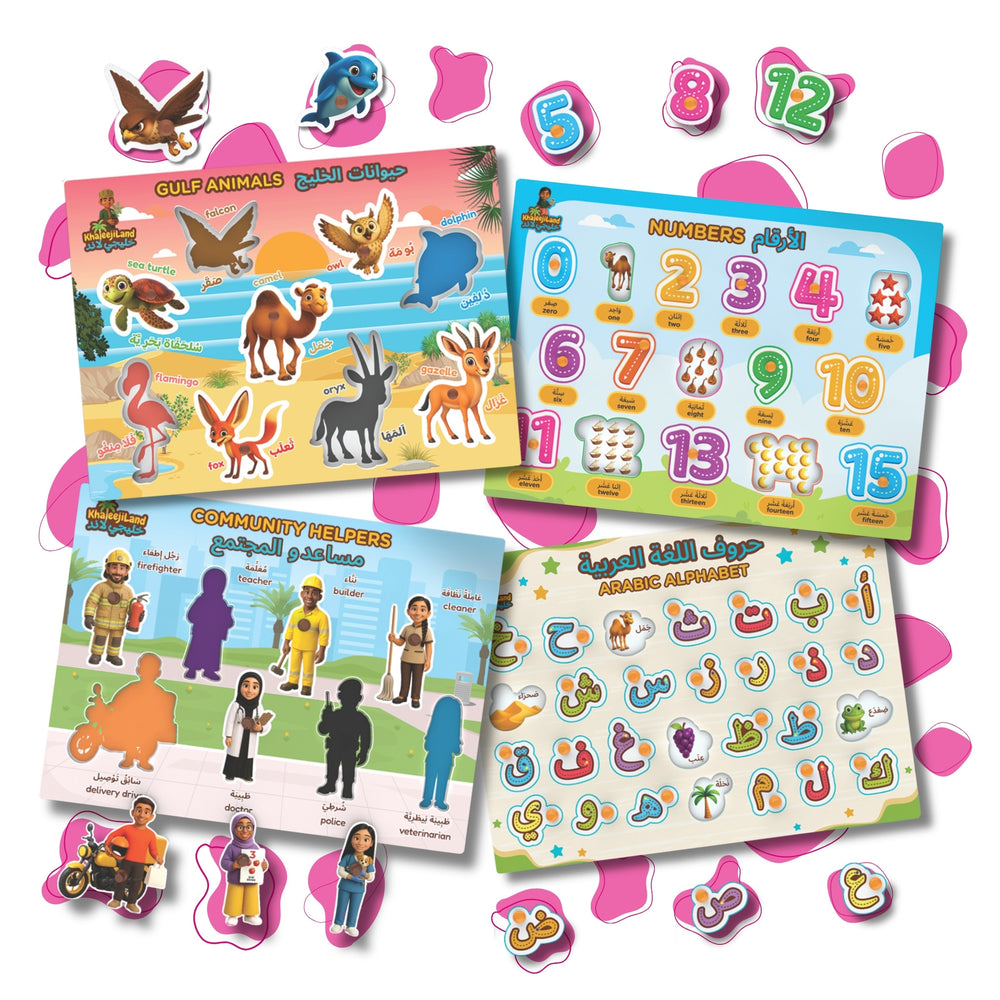
In the KhaleejiLand range, the wooden peg puzzles sit at the inset stage: Arabic alphabet, numbers, Gulf animals, community helpers, and the UAE map.
The shaped puzzles are the next step up: Falcon, Camel, and Turtle jigsaws with interlocking pieces.
For young children specifically, our guide to the best wooden puzzles for kids in the UAE goes deeper on what to look for at that age.
A simple way to extend the play
If you already have puzzles at home, our free activity sheets give you a simple way to extend the play with naming, matching, colouring, or counting after the puzzle is finished. Browse the KhaleejiLand Activity Library.
Frequently asked questions
At what age can a child start doing jigsaw puzzles?
Many children manage simple two- to four-piece interlocking jigsaws from around age three, once they are comfortable with peg and inset puzzles. Some are ready a little earlier and some later. Readiness shows in whether your child finishes their current puzzles easily, not in their exact age.
Are wooden peg puzzles better than cardboard jigsaw puzzles?
Neither is better overall, as they suit different stages. Wooden peg puzzles are well suited to younger children who need a sturdy piece to grip and their own slot to aim for, while cardboard or wooden jigsaws suit older children ready to connect pieces and reason about a whole picture.
How many puzzle pieces are right for a 3- or 4-year-old?
There is no single number, because experience matters more than age. A good approach is to keep the piece count steady until your child can complete a puzzle confidently and largely on their own, then increase it, for example moving from a finished twelve-piece puzzle up to twenty-four.
Do puzzles really help with school readiness?
Puzzles can support school readiness when they are age-appropriate and used through play, not pressure. They give children practice with finger control, hand-eye coordination, shape recognition, patience, and problem-solving. They become even more useful when an adult talks with the child during play.
|
Madhav is the co-founder of KhaleejiLand. He grew up at the intersection of Emirati and expat life, and would not have it any other way. That experience is why KhaleejiLand exists: so children grow up genuinely connected to the place they call home. |


