

Resist the Rescue: Why Children Learn More Through Trial and Error
Productive struggle in early years means giving children a task that is slightly challenging but still achievable, then supporting them with prompts, time, and encouragement instead of giving the answer straight away. When a child gets stuck, the learning is often just beginning. The moment we step in with the solution, we can accidentally take away the thinking that was about to help them learn. The adult's job is not to remove the difficulty. It is to keep the child safe enough, and supported enough, to stay with it.
|
Key takeaways • Children learn a lot in the moments before they get the answer right. • Stepping in too quickly can remove the thinking a child needs to practice. • Productive struggle means the task is challenging but still manageable. • Adults should scaffold with small prompts, not take over the task. • The goal is not to let children feel stuck. The goal is to help them stay engaged long enough to try another strategy. |
Why does struggle help children learn?
The useful learning often happens before the answer appears: when a child tests an idea, notices it does not work, adjusts, and tries again. In that process they are practicing the thinking behind the skill, which means noticing, comparing, remembering what did not work, and choosing a new approach. When a child is shown the answer too quickly, they can miss that thinking, and the skill becomes harder to hold onto.
For a young child, this might look like rotating a puzzle piece, trying a different grip, counting again, sorting by color first, or asking themselves where something could fit. None of that happens when an adult hand reaches in and places the piece. The visible result is the same, a finished puzzle, but the learning underneath is not.
This is the idea behind the term “productive struggle,” now common in early years and primary practice. The distinction that matters is between unproductive frustration, where a child is overwhelmed and shuts down, and productive struggle, where a child is challenged but still trying. The learning lives in that second state. Manu Kapur's research on “productive failure” makes a related point for older learners: in randomized studies in maths, students who worked at problems before being taught the method developed stronger conceptual understanding and were better able to transfer it than students taught the method first (Kapur, productive failure in learning math, Cognitive Science).
In early years, we need to translate this carefully. A four-year-old does not need a formal productive failure lesson. They need well-pitched play, enough time to try, and an adult who knows when to wait and when to gently scaffold. This is especially visible in early maths. When children are allowed to compare, test, rotate, count, sort, and self-correct, maths becomes something they reason through, not something they simply get right or wrong.
What is the difference between productive struggle and frustration?
The difference is engagement. A child in productive struggle is still in the game: focused, trying different approaches, perhaps frowning but not melting down. A frustrated child has left the game: crying, throwing the pieces, disengaging, or asking to stop. One state builds learning and resilience. The other builds an association between the activity and feeling bad.
Some children do not show frustration loudly. They may go quiet, stop looking, copy others without thinking, or say “I don't know” before they have tried. Those are also signs that the task may need adjusting. Reading them takes attention, especially in a busy room, but they tell you as much as tears do.
The boundary between the two is the task itself. The psychologist Mihaly Csikszentmihalyi described a “flow” zone, where a task is hard enough to hold attention but not so hard that the person gives up. Pitch a task too low and a child is bored. Pitch it too high and the child is overwhelmed, and the struggle stops being productive. The skill in both teaching and parenting is reading which side of that line a child is on, then adjusting the task rather than removing it. A puzzle with too many pieces becomes a puzzle with a few pieces. A table task that is too dense becomes one step at a time.
Working with children who had additional needs, I learned that stepping back did not always mean giving less help. Sometimes it meant giving better help. I might remove half the pieces, offer a visual cue, or model one turn of the piece before handing it back. The aim was not independence at all costs. It was keeping the child engaged enough to experience, “I can try this.”
How does this connect to the EYFS and play-based learning?
It is written into the framework. The EYFS is an early years framework from England, but it is widely used by British-curriculum nurseries and early years settings in the UAE. Its Characteristics of Effective Teaching and Learning are useful here because they focus on how children learn, not only what they learn. One of the three characteristics, “active learning,” describes children who concentrate and keep on trying when they meet difficulties, and who enjoy their achievements (EYFS statutory framework, Department for Education). Persistence through difficulty is not an optional extra. It is one of the things the framework asks practitioners to actively nurture.
This is why the framework asks educators to look at how children learn, not only what they learn. A finished puzzle tells you little on its own. A child who tried three wrong pieces, paused, and worked out the fourth has shown you persistence, problem-solving, and a willingness to stay with something hard. That process is often more important than the finished puzzle itself, and stepping in too quickly can take that learning moment away.
What is scaffolding, and how is it different from rescuing?
Scaffolding is support that helps a child do something they cannot yet do alone, and then fades as they become able. Rescuing is doing it for them. The distinction comes from the work around Lev Vygotsky's “zone of proximal development,” the space between what a child can do independently and what they can do with help (zone of proximal development, explained). Good support works inside that zone. It does not close the gap by lifting the child over it.
In practice, scaffolding looks like the smallest useful nudge rather than the answer:
• Ask a question instead of giving a solution: “What have you tried? What else could you try?”
• Narrow the problem: hand over a few pieces rather than all of them, or point to the corner of the board rather than the piece.
• Model the strategy, not the answer: show how to turn a piece to test it, then let the child do the turning.
• Wait. Counting silently to ten before you speak gives most children the time they need to find their own way through.
• Notice the effort: “You kept going even when that was tricky” tells a child that trying is the thing that matters.
In a busy classroom, this matters because rescuing one child can quickly become the pattern for the whole table. If children learn that adult hands finish the hard parts, they may wait for help instead of trying the next strategy. The test is simple: if your help leaves the child doing the thinking, it is scaffolding. If it leaves you doing the thinking, it is a rescue.
Working with young learners in UAE classrooms, I saw this often during puzzle work. A child would try the same piece again and again, sure it belonged in one space. My instinct was to point to the correct spot, but I learned to wait first. After a few tries, the child would usually pause, turn the piece, compare the picture, and test another space. That small pause was the learning. Not the finished puzzle, but the moment the child changed strategy.
How can teachers support productive struggle in early years classrooms?
Small, deliberate moves keep children in the productive zone without taking over. Five that work well at carpet time, in small groups, and at table tasks:
• Reduce the number of choices so the task is manageable.
• Give more time before speaking, and let a pause do the work.
• Ask what the child notices, rather than naming the answer.
• Model the strategy once, then return the task to the child.
• Praise persistence, not speed.
These moves are also easy to share at nursery and school handovers, so the same approach carries between adults rather than resetting with each one.
How this looks with puzzles at home

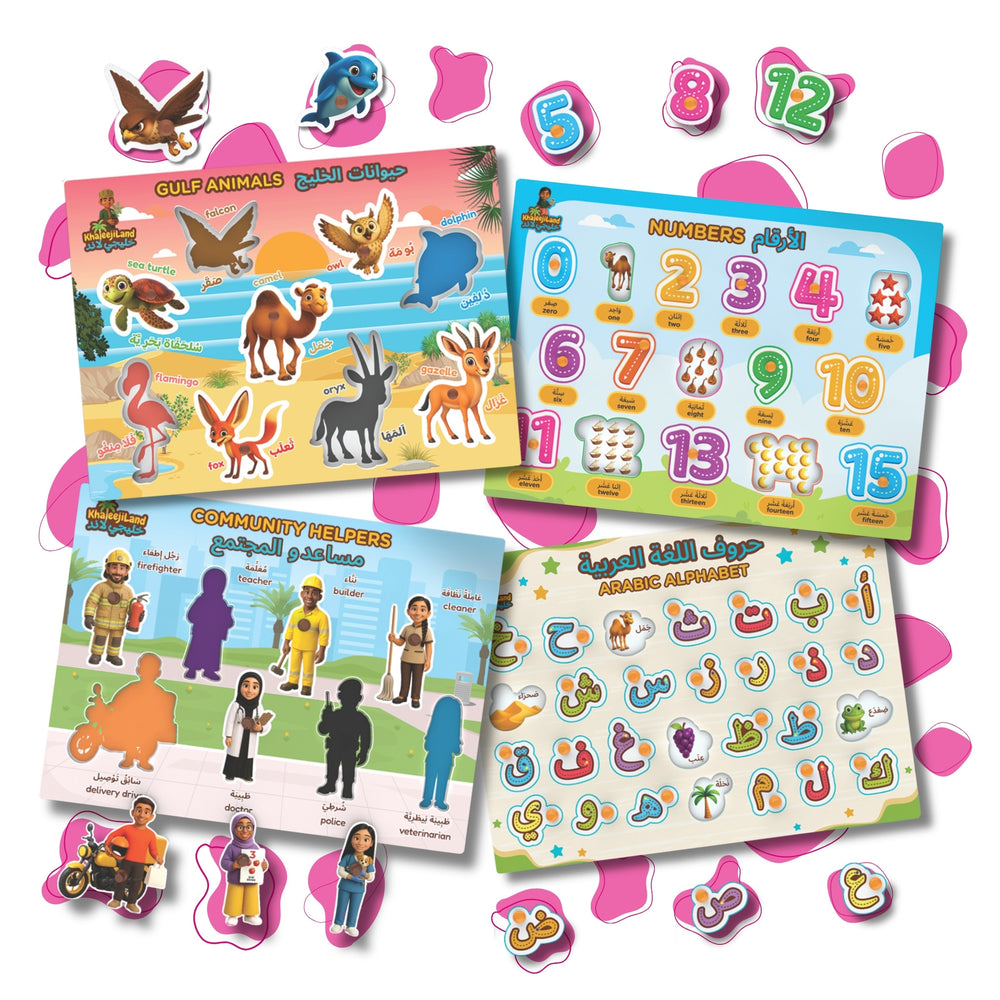
With peg puzzles, the goal is not to make the child finish quickly. Start with a few pieces, watch how the child searches, turns, compares, and tests, then add more pieces as confidence grows. This is the kind of use we encourage with KhaleejiLand wooden peg puzzles: give the child enough support to stay engaged, but not so much that the adult does the thinking. The Numbers 0-15 Wooden Peg Puzzle suits this well, because the problem-solving and early counting give a child plenty to reason through at their own pace.
Why is it so hard for adults to step back?
Because watching a child struggle is uncomfortable, and helping feels like kindness. We are wired to soothe distress, and we are often short on time, so doing it ourselves is faster. There is also a quieter reason: a finished, correct piece of work feels like proof that learning happened, and we like that proof. But the neat result and the real learning are not always the same thing.
Stepping back does not mean abandoning a child to flounder. It means staying close, staying warm, and resisting the specific urge to supply the answer. You can be fully present and still let the work be theirs. Comfort the feeling without solving the problem: “This is tricky, and I can see you are working hard. Have another go, I am right here.” The message a child takes from that is the one we most want them to carry, which is that they are capable, and that hard things are worth staying with.
In many UAE classrooms and homes, children are learning across languages, routines, and expectations. Some children may understand the task but need more processing time. Some may be used to adults stepping in quickly. Productive struggle gives adults a helpful middle ground: stay close, keep the child emotionally safe, but leave space for the child's own thinking.
|
EXTEND THE LEARNING If you would like ready-made activities that give children room to try, test, and self-correct, our free Activity Library has printable puzzles, sorting games, and counting tasks you can use at home or in the classroom. Browse the KhaleejiLand Activity Library and pick something pitched just above where your child is now. |
Frequently asked questions
At what age should I let my child struggle with tasks?
From the toddler years onward, in an age-appropriate way. Even very young children benefit from being allowed to keep trying, as long as the task is pitched to their stage and they are safe. The goal is never to leave a child overwhelmed, but to give them the chance to work through manageable difficulty rather than removing it for them.
How long should I let my child struggle before helping?
There is no fixed number, but most adults step in too soon. A useful habit is to pause and silently count to ten before offering anything, and even then to offer the smallest nudge rather than the answer. If the child is still engaged and trying, stay back. If they have disengaged or become distressed, that is the moment to adjust the task or step in with support.
Isn't letting my child fail bad for their confidence?
It is the opposite, when handled well. Confidence built only on easy success can be fragile. Confidence built on overcoming difficulty is more durable, because the child has evidence that they can handle hard things. The key is keeping the difficulty in the productive range and noticing effort, so a wrong attempt becomes part of figuring something out rather than a verdict on the child.
How can teachers explain this to parents?
A simple way to explain it is: “We are not ignoring your child when we wait. We are giving them time to think. If they become upset or the task is too hard, we step in with support. But if they are still trying, that effort is part of the learning.”
|
Sara is a special educator based in the UAE, with a Master's in Special Education from Simmons University and nearly a decade in Abu Dhabi classrooms, from early years through special needs. She writes about the science of play, bilingual learning, and helping children thrive in UAE classrooms and beyond. |


