

Raising Bilingual Children in the UAE: Strategies for Teaching Arabic and English at Home
Raising a bilingual child is less about formal teaching and more about consistent, meaningful exposure to both languages. Parents get the best results when they pick a clear pattern for when each language is used, build Arabic and English into everyday routines through talk, books, and play, and keep it low-pressure. Children are wired to learn two languages at once, and in the UAE the surrounding culture gives Arabic a head start most families can build on.
|
Key takeaways • Bilingualism does not confuse children or delay speech. This is a long-disproven myth. • Consistency matters more than method: choose a pattern for using each language and stick with it. • Count your child's vocabulary across both languages combined, not one at a time. • In the UAE, Arabic is now part of early years education from age four, and home support reinforces what school begins. • You do not need to be fluent in a language yourself to raise a child who is. |
Will learning two languages confuse my child or slow down their speech?
No. This is the single most common worry I hear from parents, and the research has put it to rest. Children who grow up with two languages reach the major speech milestones (babbling, first words, putting two words together) at broadly the same ages as children learning one language. Young dual-language learners achieve the same milestones as monolingual children for babbling, first words, understanding familiar words, combining words, and reaching a 50-word vocabulary.
The confusion myth usually comes from one observation: bilingual toddlers mix their two languages in the same sentence. A child might say “I want more حليب” (milk) at the table. This is called code-switching, and far from being a problem, it is a sign of competence. An integrative review of the research found no evidence to support the existence of language confusion in bilingual children. Your child is not muddling two systems; they are using everything they have to communicate, exactly as bilingual adults do.
If a child is genuinely struggling, falling behind on milestones in both languages at once, that is worth raising with a professional, because it may point to something separate from bilingualism. But two languages alone are seldom the cause.
What if my child has additional needs?
This is the question I am asked most often by the families I work with, so I want to be clear about it. For years, parents of children with autism, Down syndrome, language disorders, or intellectual disabilities were told by well-meaning professionals to drop one language and raise their child monolingually, to “avoid confusion” or “reduce the load.” The current evidence does not support that as a blanket rule. Studies across autism, Down syndrome, and language impairment consistently find that bilingualism does not harm a child's language development, and current clinical guidance from the Royal College of Speech and Language Therapists treats it as an advantage rather than a risk.
In my years in special education, I met family after family who had been told to give up their home language. Many followed that advice and raised their children in English only, trusting the experts in front of them, and their children lost out on both the language and the connection to family that came with it. That advice was not founded in evidence, and it is one of the things I most want parents to hear corrected.
The practical principle is simple: do not remove a family language just because a child is autistic, delayed, disabled, or has a communication disorder. Use the languages that are real and useful in the child's life, whether that is the language parents speak best, the language of school or therapy, or the language of grandparents, community, and culture. A child may progress more slowly, may be stronger in one language, may mix languages, and may need additional communication supports, but those are support needs, not signs that bilingualism is doing harm.
If you would like a warm, parent-friendly starting point, Colorín Colorado's short bilingual video series Being Bilingual Is a Superpower, available in English and Arabic, is a lovely watch for families at the very beginning of this journey.
What is the most effective method for raising a bilingual child?
The honest answer is that no single method is magic. What the evidence keeps pointing to is consistency (a clear, predictable pattern for when and with whom each language is used) rather than any one named strategy. Children work out the “rules” of their languages when those rules stay stable.
A few common patterns parents use:
• One Parent, One Language (OPOL): each parent speaks their own language to the child. Common in mixed-language families.
• Minority Language at Home (ML@H): the family speaks the language not used at school or in the wider community at home, so the home becomes the stronghold for the weaker language. Which language that is depends on the family. For many UAE households the wider world is dominated by English, so home becomes the place to protect Arabic. For families whose children attend Arabic-medium public schools, or who speak mostly Arabic at home, it is often English that is weaker and needs the dedicated time at home. The principle is the same in both directions: whichever language gets less exposure outside the home should get more inside it.
• Time and place: one language at certain times or in certain activities, such as Arabic at mealtimes and bedtime stories, English during a particular game.
Think of these as starting frameworks, not strict rules. Pick whichever fits your household and (this is the part that matters) keep it reasonably steady. A child who knows that Baba always speaks Arabic, or that Mama's bedtime story is always in English, gets a clear, repeated signal. Switching the system every few weeks is what makes it harder.
One reassurance that frees a lot of parents: you do not have to speak a language perfectly to pass it on, and you do not have to rigidly police which language is used when. What you are aiming for is rich, frequent, affectionate input in both languages. The structure simply helps you make sure both actually get a turn.
How much exposure does each language really need?
More than most parents expect. Because bilingual children are learning two languages within the same waking hours a monolingual child spends on one, each language naturally gets fewer exposures, a pattern researchers call distributed exposure.
This has two practical consequences.
First, the language that gets less time in the wider world needs more deliberate time at home. In the UAE, English is often everywhere (screens, playgrounds, shopping centers, many nurseries), so Arabic is frequently the language that needs protecting and topping up. For a deeper look at this balance, check out when English is everywhere, where does Arabic fit.
Second, it changes how you should judge progress. Do not measure your child's English vocabulary against a monolingual English child's, then panic. When you combine their total vocabulary across both languages, dual-language learners and monolingual toddlers have virtually identical vocabularies. A child might know “camel” in English and حليب in Arabic, which is two concepts and two words, even though neither language alone shows the full picture. Speech and language professionals call this conceptual scoring, and it is the fair way to look at a bilingual child's growth.
Does Arabic education in UAE schools mean I can leave it to them?
Not quite, but the UAE has made the school side of this much stronger, and that is genuinely good news for parents. As of the 2025–26 academic year, Arabic instruction became a required part of early years education across the Emirates. All private schools in the UAE must teach Arabic to kindergarten-age pupils for 40 minutes each day from the start of the 2025–26 academic year, as part of a nationwide push to champion the language early. That requirement is set at 200 minutes per week, rising to 300 minutes (an hour a day) by the 2027–28 academic year, delivered by qualified early childhood educators.
This sits within each emirate's own framework. Dubai's private schools are overseen by KHDA, Abu Dhabi's by ADEK, and Sharjah's by SPEA, with all three now following the UAE's unified inspection framework. In Dubai specifically, KHDA announced on International Mother Language Day that children from birth up to six years in all private schools and early childhood centers or nurseries would learn Arabic as part of their education. If you want the detail on what these policies mean in practice, I have written a fuller breakdown in Dubai and Abu Dhabi's new Arabic language policy and what it means for your child at home.
Our schools do a great job of setting the stage for Arabic. But school exposure alone (even an hour a day) is not the same as a language being woven through a child's whole life. The children who thrive are the ones for whom school and home pull in the same direction. School gives structure and instruction; home gives the warmth, repetition, and emotional connection that make a language stick. You are not replacing the school. You are reinforcing it.
What can I actually do at home? Practical, low-effort strategies
Here is where it gets reassuringly simple. The most effective things are also the least formal.
Talk, narrate, and describe. The richest input is ordinary conversation. Name what you are doing, what your child sees, how they feel, in whichever language you are using. This costs nothing and does more than any app. In teaching and speech-and-language work this is called modeling, and it is the single most important way children build language: without good models, they have nothing to learn from. Resist the urge to turn talk into a quiz, though. Firing off “What's this? What color is that?” feels like practice, but to a child it lands like an interview, and most quietly shut down under it. Narrate and describe instead, and let your child join in when ready. When they make an error, you do not need to correct them outright; just repeat it back correctly in your reply. If your child says “He go-ed to the store,” you might answer, “Oh, he went to the store?” You have acknowledged what they said and modeled the right form, without shaming or ignoring the mistake.
Read together, every day. Shared books are one of the highest-value activities for any language. Children crave routine, so a regular bedtime story does more than build vocabulary; it is good for your bond with your child and their sense of security. If it is not already part of your day, it is one of the easiest habits to start. Read in Arabic and in English. And as hard as it can be to pick up the same book for the fiftieth time, re-reading favorites is not wasted repetition to a young child; it is actually how vocabulary and sentence structure get consolidated, and for early learners it can do as much good as a stack of new titles.
Use play as the vehicle. Children absorb language most readily when they are enjoying themselves and not being “taught.” This is the whole principle behind play-based learning, and you can check out what is play-based learning and what it looks like in the classroom for more on why it works. Pretend play is especially powerful: a pretend shop, a toy kitchen, or sorting and naming objects all generate natural, repeated language. To build this kind of environment without screens, take a look at screen-free Arabic learning at home: simple ideas that actually work.
Make the everyday bilingual. Counting stairs in Arabic, naming animals on a walk, talking about colors while getting dressed. Little, frequent moments beat occasional long “lessons.” As your child starts to read, sticking bilingual labels on everyday objects (for example, “fridge / ثلاجة”) is another simple way to grow both vocabulary and early literacy. It also helps to fill their play with toys that are bilingual by design rather than translated as an afterthought; if you would like a steer on what to look for, how to choose educational toys that actually teach something walks through it.
Bring in the wider family. Grandparents, aunts, and uncles who speak Arabic are an enormous asset. Through them, children listen to family stories, get the jokes, and build real relationships across the generations. This emotional connection is often what motivates a child to want the language, which matters more than any technique.
One of my own students shows how much motivation matters. He was seven, from an Arabic-speaking family, and thoroughly resistant to Arabic; he understood it and had real ability, but would only speak English and turned sour whenever Arabic came up. What he loved was screen time. So rather than fight that, we worked with it: the family set his tablet to Arabic and filled it with shows he genuinely enjoyed. English content stayed available, but on a timer, while the Arabic shows had no limit. Over a few weeks he drifted toward them, grew far more comfortable, and began holding real conversations in Arabic with his mother. Meeting him where his motivation already was changed everything. (We did later help that family rein the screens back in, a story for another day; at KhaleejiLand we are firmly in the screen-free camp, and the lesson here is about motivation, not screens.)
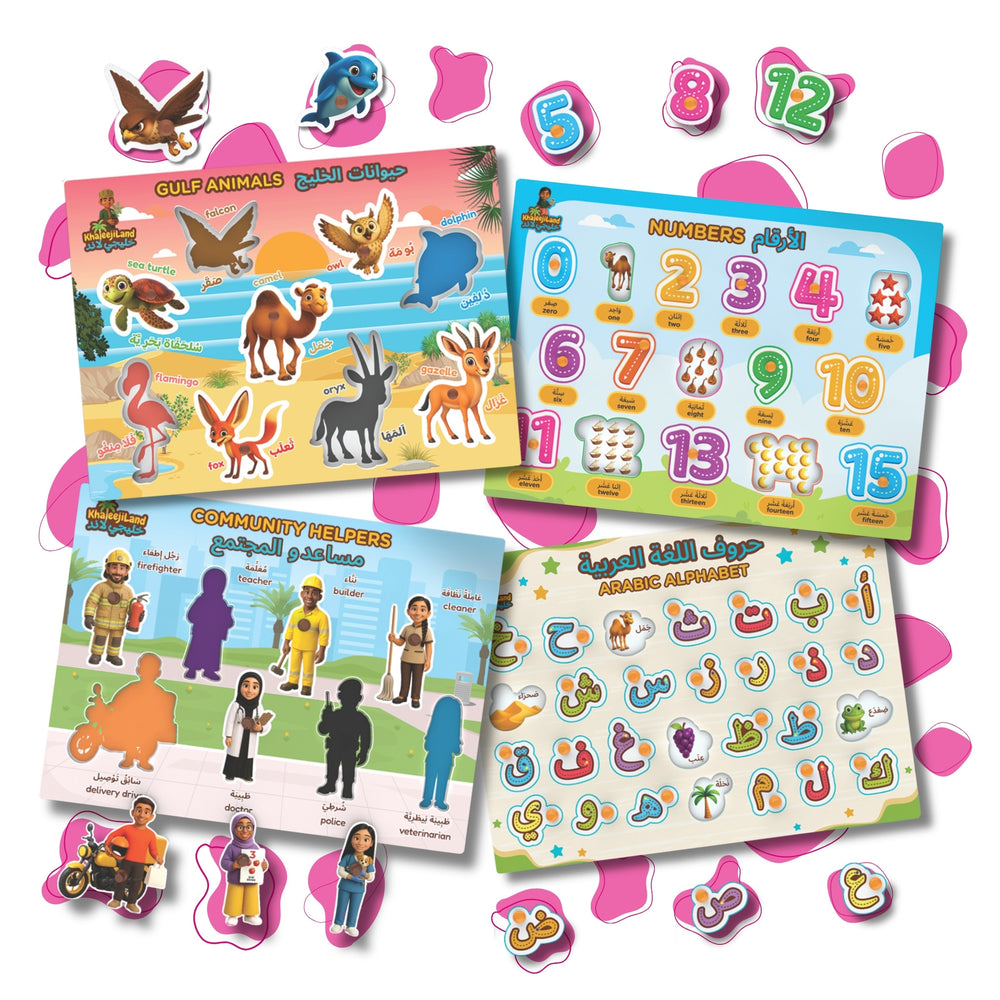
If you want ready-made activities to make some of this easier, our free bilingual activity downloads are built around exactly these everyday moments, and tactile bilingual toys like our Gulf Animals Wooden Peg Puzzle give children Arabic and English labels on objects they can hold, which is how young children learn vocabulary best.
What if I don't speak Arabic myself?
You can still raise a child who does, and a great many UAE families are in exactly this position. Your job is not to be your child's Arabic teacher. It is to value the language, create opportunities for exposure, and learn alongside them. Children take their cues from you: if Arabic is treated as important and enjoyable rather than a chore, they absorb that attitude.
Lean on the sources you do have: your child's school, Arabic-speaking friends and family, audio, books, and shared activities where you are learning the words together. I have written a full guide on this for parents in your situation: how to support your child's Arabic learning at home if you don't speak Arabic yourself. There is no shame in being a step behind your child; some of the most successfully bilingual children I taught had parents who could barely manage a greeting in the second language but who made it clear, every day, that the language mattered.
Many children also love playing teacher. Hand your child a simple worksheet or activity, let them lead the “lesson,” and play the student yourself. The role-reversal is usually a source of great hilarity, but it is also genuinely effective: it gives your child a reason to use the language and turns your own gaps into part of the fun rather than a source of pressure. Our free bilingual activity library is an easy place to start.
The same applies in reverse. If you speak Arabic at home and it is English you are less confident in, the approach does not change: keep speaking rich, natural Arabic with your child rather than switching to broken English, and let English come through books, school, and other English-speaking sources. Your child gains most from hearing each language spoken well by someone who loves them, so the strongest thing you can do is give them confident input in the language you know best.
A realistic word on expectations
Bilingualism is a long game, and it rarely runs in a straight line. Some children go through a “silent period” when they take in a new language before producing much of it, which is normal and temporary, not a stall. It can be prolonged by anxiety, though, which is one more reason to model language rather than quiz it; a child who feels put on the spot is far slower to start speaking. One language will often be stronger than the other at any given moment, and which one is “ahead” can shift with school, holidays, travel, and who the child is spending time with. None of this is cause for alarm. You are raising a whole bilingual person over years, not running a race with a finish line.
What you are giving your child is significant. Some research links bilingualism to stronger executive function, the ability to think flexibly, focus attention, and filter out distractions, though scientists still debate how large that effect is. What is not in doubt is the deepest benefit, and it is not on any test. It is connection: to family, to community, and here in the Gulf, to the culture and identity of the place your child calls home.
Frequently asked questions
At what age should I start raising my child bilingually?
From birth is ideal, because the early years are when children acquire languages most naturally and effortlessly. This matters especially for Arabic and English, since each has sounds the other does not; hearing both early gives children more chance to recognize and produce those sounds naturally. That said, there is no cut-off and it is never too late to start, as children remain highly capable language learners throughout early childhood. Starting later still works well, though new speech sounds may take a little more focused practice.
Is it too late to introduce Arabic if my child already speaks mostly English?
No. Children can successfully add a language at any point in early childhood. The key is to increase meaningful, regular exposure to Arabic through talk, books, play, and the people around them, and to keep it positive rather than pressured. Consistency from this point forward matters more than the age you began.
My child mixes Arabic and English in the same sentence. Should I correct them?
There is no need to correct it. Mixing languages, or code-switching, is a normal and healthy part of bilingual development and a sign your child is using both languages competently. Rather than correcting, simply keep modeling rich language in each language yourself, and the separation develops naturally over time.
How do I know if my bilingual child has a real speech delay or is just developing normally?
The key is to look at both languages together, not one in isolation. A child developing typically will be progressing across their combined languages, even if each one alone looks smaller than a monolingual peer's. If you see difficulties in both languages at once (missed milestones across the board), that is worth discussing with a speech-language professional, as it points to something independent of bilingualism. If your child is in nursery or school, their teacher is also a good first port of call; they will have a sense of what is typical for the age group and whether specialist advice would help.
|
Sara is a special educator based in the UAE, with a Master's in Special Education from Simmons University and nearly a decade in Abu Dhabi classrooms, from early years through special needs. She writes about the science of play, bilingual learning, and helping children thrive in UAE classrooms and beyond. |


